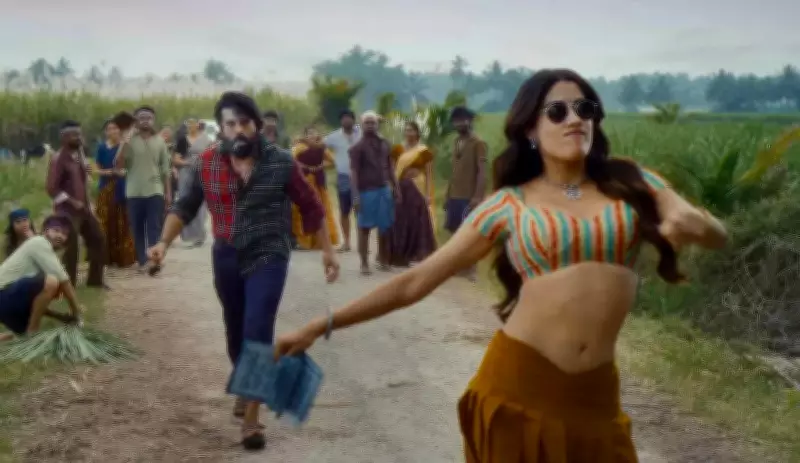
The morning-after post-mortem of a Tollywood blockbuster usually follows a predictable script: box-office percentages, theatre counts, and mass moments. Yet, less than twenty-four hours after the Ram Charan-starrer Peddi hit screens, public conversation has shifted away from collections toward the treatment of its female lead. The focal point is the perceived reduction of Janhvi Kapoor's character, Achiyamma. The debate gained traction after Kapoor reportedly liked and then unliked a post critical of the role, a move widely seen as tacit agreement with the criticism. Whether or not that interpretation is accurate, the episode has forced open a conversation that the Telugu film industry often grapples with but rarely addresses publicly.
Can a film fight marginalisation while marginalising its own heroine?
A glaring contradiction highlighted by viewers is the disconnect between the film's socio-political themes and its character design. There is a distinct irony in a narrative that passionately champions a community's dignity, yet denies its own heroine basic consideration. As singer Sumangali noted when summing up the backlash, it creates a jarring cinematic paradox where structural empathy stops short of the female lead.
Director Buchi Babu Sana responded, saying, It didn't land the way I intended, and I take responsibility for that. I'll correct it in my next film.

Is it cinematography, or is it pure objectification?
Much of the backlash focuses on specific camera choices, with audiences arguing the cinematography frequently objectifies the performer by prioritising anatomy over emotional perspective. Viewers were quick to call out this visual disconnect. Literally there's a scene where the hero describes her face but they show her waist and chest, wrote one viewer. Another questioned a sequence where the camera reportedly focused away from her facial features, asking, To the editor, are you really that clueless that you don't know what eyes and lips are?
Sumangaly Ariyanayagam, re-posting a viral post, stated: A room full of powerful men sat down to write a story about the trauma of being powerless. In the same breath, they turned Janhvi Kapoor's character into a body for the lens, a prop for a forced kiss, and a tool to be thrown away when the songs ended. They knew exactly what human dignity meant. They just decided she didn't deserve it.
Why are toxic harassment and coercion still sold as romance?
Beyond the visual framing, audiences have raised serious concerns about consent. Several viewers argue that behaviour they perceived as harassment is framed as romance, with one user questioning why stalking, misbehaviour, harassment, and no concept of consent continue to be normalised through heroic characters. Commentators are questioning behind-the-scenes power dynamics, asking how much influence female leads truly possess in an ecosystem heavily dominated by directors and male superstars. Many argue that actresses are routinely reduced to desirable objects with little narrative significance, while questioning why overtly objectifying content escapes the strict censorship faced by political themes.
Sunitha Krishnan, social activist and filmmaker, remarked: When women are treated primarily as visual attractions, concepts such as consent, agency and dignified representation rarely enter the writing process. The focus becomes what will sell rather than whether something is right or wrong.
Instead of constantly objectifying her, maybe give her a role that lets her act
Social media users turned to memes to voice their criticism of Janhvi's portrayal in Devara and Peddi. Actress, film producer, and politician Ramya noted: Even if there's an agreement in place for prior consent, the industry just doesn't take heroines seriously no matter how big a star you are.

Telugu cinema has repeatedly faced criticism for songs and scenes that sexualise female characters. While the stars and films have changed over the years, debates around the male gaze, objectification and the limited agency afforded to heroines continue to resurface. Examples include Peelings (Pushpa 2, 2024), Dabidi Dibidi (Daaku Maharaaj, 2025), Saana Kastam (Acharya, 2022), Ragada Ragada (Ragada, 2010), Tauba Tauba (Sardaar Gabbar Singh, 2016), Chuttamalle (Devara: Part 1, 2024), and the waterfall sequence in Baahubali: The Beginning (2015) featuring Prabhas and Tamannaah Bhatia.
Enough is enough: Viewers call out objectification
User @recommendationcommunity wrote: Peddi frames the denial of human identity as the ultimate systemic evil, yet the camera turns around and denies Janhvi Kapoor's Achiyamma that exact same humanity. Ram Charan's character gets a socio-political crusade for his soul, while she gets a regressive 1980s midriff close up.
@ramya.tallavajhula stated: It is 2026 and we are still doing this... Here we are, still struggling to get the bare minimum dignity for a female lead.
@rmaganti15 commented: Buchi Babu completely sexualised Janhvi Kapoor in the first half. Not leaving any part of her body untouched... Absolutely disgusting work.
@preetiphalke noted: Its not Peddi alone. Pushpa and so many other movies have done this in the past in their own way.
@your.safe.space2025 added: Radhika Apte was absolutely right when she said that Telugu industry is filled with patriarchy and misogyny.
@Capable_List_6290 concluded: Actresses don't deserve to get reduced to mere objects in the year 2026, and Telugu cinema is notorious for romanticizing rape, stalking, sexual assault against women.
About the Author: Divya Shree, full-time Tollywood observer and lifelong movie buff, wanders through city stories, mental health conversations, women-in-cinema narratives, and weekend trends.