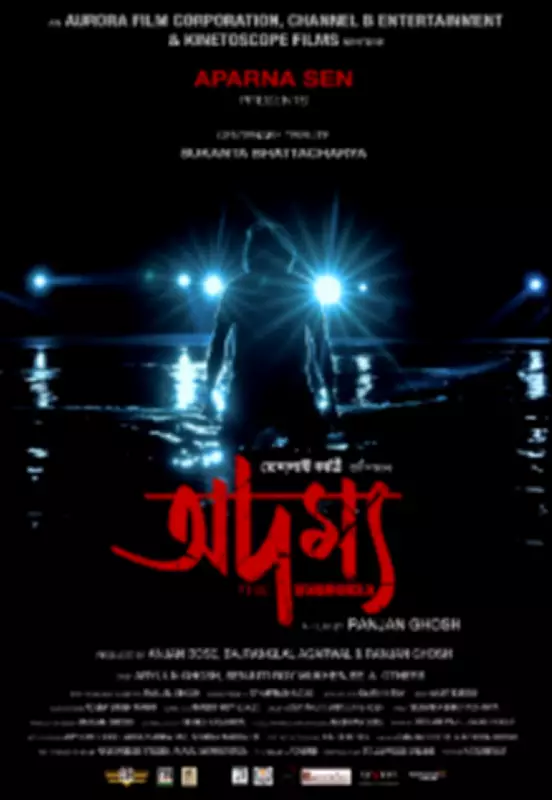
Adamya Movie Review: A Bold Political Thriller That Breaks Conventions
Release Details: The Bengali drama-thriller 'Adamya' premiered on February 13, 2026, with a runtime of 1 hour 50 minutes. Directed by Ranjan Ghosh, the film has garnered impressive ratings from both critics and audiences, earning a solid 4.0 out of 5 stars across the board.
Plot Synopsis: A Fugitive's Journey Through Ideological Turmoil
The narrative centers on Palash, portrayed by Aryuun Ghosh, who becomes a fugitive after a failed political assassination attempt. Seeking refuge in the conflict-ridden Sundarbans, Palash undergoes a profound transformation as his understanding of ideology, resistance, and personal identity begins to shift dramatically. The film's premise sets the stage for an exploration of moral complexity rather than simple political commentary.
Critical Acclaim: Freshness in Political Cinema
Critic Raima Ganguly's review, published on February 16, 2026, highlights the film's unexpected freshness within contemporary Bengali cinema. Despite its deep political currents, 'Adamya' manages to avoid becoming heavy or didactic, instead unfolding with remarkable restraint and narrative tension that keeps viewers thoroughly engaged.

The review breaks down the film's technical achievements:
- Direction (4.0/5): Ranjan Ghosh maintains a measured, unsentimental tone that resists melodrama while allowing ideological and emotional layers to emerge organically.
- Story (4.0/5): While pivoting around a botched assassination, the true intrigue lies in the protagonist's internal conflict, inspired by ideals of Sukanta Bhattacharya and Bhagat Singh.
- Music (3.5/5): A thoughtfully designed soundtrack that experiments without intrusion, complementing the film's organic rhythm.
- Visual Appeal (4.0/5): Cinematographer Arkaprabha Das creates frames that carry emotional and thematic weight, functioning as genuine storytelling devices.
Performance Analysis: Aryuun Ghosh's Commanding Presence
Aryuun Ghosh delivers an assured performance as protagonist Palash, anchoring the film with growing intensity as the story progresses. His portrayal begins with subtle tentativeness that gradually sharpens into a commanding presence, particularly during the latter half when emotional stakes deepen significantly. Ghosh successfully balances vulnerability with ideological firmness, lending credibility to a complex role that demands both qualities.
Technical Excellence: Visual Storytelling at Its Finest
The cinematography by Arkaprabha Das represents one of the film's strongest elements. Rather than merely serving aesthetic purposes, the visual composition carries substantial emotional and thematic weight. Moments of striking visual clarity demonstrate how rarely cinematography functions as a primary storytelling device in mainstream Bengali cinema.
Shot across authentic locations in West Bengal with a remarkably lean crew, 'Adamya' quietly dismantles the notion that cinematic impact depends on scale or polish. The film's world feels textured, lived-in, and authentic, creating an immersive experience that enhances the narrative's political and emotional dimensions.
Supporting Cast and Creative Team
The ensemble cast includes Subham Dutta and Senjuti Mukhopadhyay in significant roles, though the film primarily focuses on Aryuun Ghosh's transformative journey. Director Ranjan Ghosh demonstrates exceptional control over the material, ensuring that political themes remain deeply human rather than abstract or academic.
Cultural Significance and Impact
'Adamya' arrives as a rare surprise in Bengali cinema—a film that feels refreshingly alive while exploring complex political themes. What could have easily turned into heavy-handed commentary instead unfolds with narrative confidence and cinematic sophistication. The film treats its protagonist's internal conflict with nuance rather than spectacle, allowing exploration of conviction, doubt, and ethical ambiguity without simplification.

Bold yet controlled, political yet deeply human, 'Adamya' stands as a powerful reminder that vision and craft can still cut through cinematic convention. It represents a significant achievement in balancing ideological depth with engaging storytelling, setting a new standard for political thrillers in regional Indian cinema.
The film currently holds a 4.0 average user rating, matching its critical acclaim, and has generated significant discussion about the intersection of politics, identity, and cinematic expression in contemporary Bengali filmmaking.