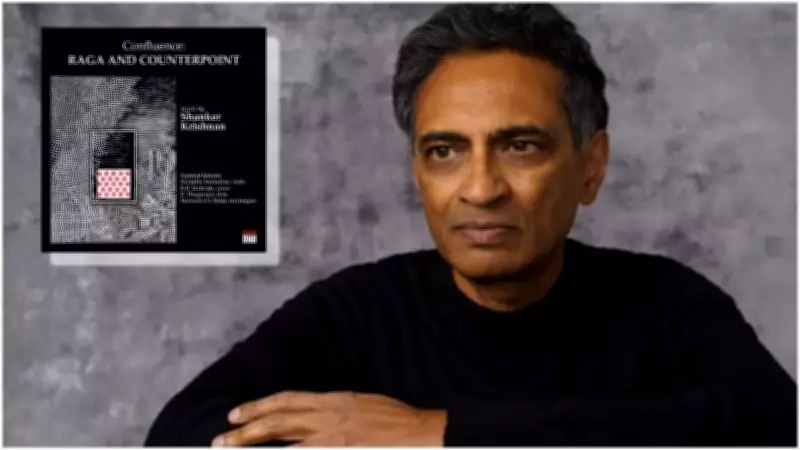
Shanker Krishnan's 'Confluence' Album Merges Carnatic and Western Classical Music
Music transcends all boundaries, serving as a universal language of expression that defines and refines human emotions. In a groundbreaking artistic endeavor, musician and composer Shanker Krishnan has released his latest album, 'Confluence: Raga and Counterpoint,' which presents a harmonious fusion of Carnatic music and Western classical elements. This album is a profound reflection of Krishnan's personal musical journey, encapsulating decades of learning and exploration across diverse traditions.
How Music Shaped Shanker Krishnan as an Artist and Individual
In an exclusive conversation, Shanker Krishnan shared insights into how his life experiences have influenced his music. "Moving between India and the West has fundamentally shaped both my identity and my musical style," he explained. "With over a decade of intensive training in each classical tradition, I've come to see music as a means to access a larger, ineffable whole that goes beyond mere words." This cross-cultural upbringing has allowed him to bridge two distinct worlds through his compositions.
Bringing Carnatic Music and Western Counterpoint Together
The album 'Confluence: Raga and Counterpoint' showcases the exceptional talents of Shraddha Ravindran on violin, R. Thiagarajan on flute, K.R. Shrievats on veena, and Mannarkoil Dr. J. Balaji on mridangam. Krishnan elaborated on the album's concept, stating, "In this work, I integrate the two musical worlds I feel closest to: Carnatic music and Western counterpoint, which involves combining multiple independent melodic lines." He highlighted that while harmony has often been paired with Carnatic ragas, counterpoint remains an underexplored area in such fusions.

"If I did not compose this music, something essential in my life would feel unfinished," Krishnan added, emphasizing the personal significance of this project. He described the emotional resonance he finds in both traditions, noting, "Carnatic music and Western counterpoint, though very different, evoke similar powerful responses in me. The connection lies in a shared appreciation for intricacy, where meaning emerges gradually from finely layered details."
The Creative Tension and Integration in Musical Fusion
Krishnan delved into the challenges and rewards of blending these styles. "There is creative tension in bringing them together," he observed. "Carnatic music relies on gamakas, where notes oscillate and glide, while Western counterpoint demands clarity when multiple melodies sound simultaneously." As a composer, he constantly evaluates whether simultaneous gamakas enrich or obscure the musical texture, turning this tension into a point of integration where both systems meet at a fundamental level.
Shanker Krishnan on the Future of Cross-Cultural Collaborations
Discussing the broader implications for the music industry, Krishnan offered a historical perspective. "Taking the long view, all music could be considered cross-cultural, as societies continually respond to external influences," he remarked. He cited examples like Carnatic music adopting the Western violin and Hindustani music incorporating Persian elements, noting that what we now view as traditional is merely a snapshot in an ongoing evolution.
"In the modern world, the pace of cross-cultural collaboration has accelerated," Krishnan continued. "Yet, there is also growing interest in the roots of these great traditions." He pointed to movements in Western classical music, such as historically informed performances using instruments like the harpsichord, and the renewed appreciation for subtle artists in Carnatic music. "There is ample room for both tradition and innovation, but lasting cross-cultural work must stem from depth, not just novelty," he concluded, advocating for meaningful artistic integration over superficial trends.