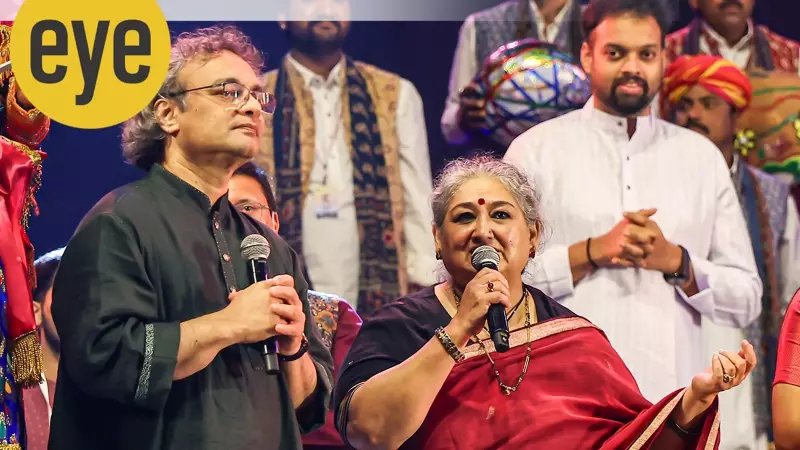
In a unique musical journey back in time, renowned Hindustani classical vocalist Shubha Mudgal and celebrated tabla maestro Aneesh Pradhan recently resurrected the sounds of 19th-century Bombay. Their presentation, titled '1871 in 2025', recreated the inaugural concert of the Parsi Gayan Uttejak Mandali, one of the city's first formal music clubs, at the Serendipity Festival in Goa. This performance wasn't just a concert; it was a historical re-enactment highlighting a pivotal moment when classical music stepped out of royal courts and into the public sphere of a bustling metropolis.
The Birth of a Musical Democracy in Bombay
The second half of the 1800s marked a transformative era for Hindustani classical music in India. With the decline of traditional royal patronage, musicians began migrating to the emerging hub of Bombay. The city, a dynamic melting pot fueled by its strategic port and Western education, had cultivated a new, culturally hungry audience comprising the mercantile class and educated elite. It was within this context that the Parsi Gayan Uttejak Mandali was founded in 1871 by writer and journalist Kaikhushro Navrojee Kabrajee.
"The mandali was a monumental step in the history of Hindustani music, not just in Bombay but across India," explains Aneesh Pradhan in a conversation from Goa. "A formal club with printed programme notes, dedicated to teaching amateur vocalists in a classroom setting was almost unheard of before. We wanted to revive this significant story." The idea for the project stemmed from Pradhan's 2015 book, Hindustani Music in Colonial Bombay, though his research into the club's archives at the University of Mumbai library dates back to his doctoral studies.

Recreating the Lost Jalsa: A Labour of Love
The recreation at Serendipity was a meticulous endeavour. Pradhan had discovered a compendium of roughly 1,100 compositions performed by the mandali between 1871 and 1886, all documented in Gujarati. To access this treasure trove, he taught himself to read the language. The archival material contained only text, no musical notations. While some compositions from the diverse list—featuring dhrupad, dhamar, thumri, tappa, bhajan, and garbi—are still sung today, others had been lost to time.
For these lost pieces, Mudgal and Pradhan composed new music based solely on the raag mentioned next to the title in the archives, striving to stay true to the original spirit. To complete the immersive experience, designer Ashdeen Lilaowala was brought on board to recreate the sartorial elegance of the Parsi community of that era, including the iconic Parsi Gara embroidery.
Beyond Community: A Legacy of Inclusivity and National Pride
Initially established to encourage music learning within Parsi families, including women and children, the mandali's vision had a complex layer. "Kabrajee wrote that if Parsi women learned music, their husbands would stop visiting prostitutes. This patriarchal tendency was present," Pradhan notes. However, the club's impact soon transcended its community origins. It opened its doors to other communities, fostering an inclusive environment for artistic exchange.
Its legacy is profound. One of its students and later a teacher was the legendary Vishnu Narayan Bhatkhande, who authored the first modern treatise on Hindustani classical music, with his initial works published by the mandali itself. Notably, scholar and political leader Dadabhai Naoroji served as its president for five years. "There was a strong desire to project a pan-Indian culture, to preserve and prove that Indian music was as good as, if not superior to, Western culture," Pradhan emphasises.
This duality was captured in the club's very performances. The original 1871 jalsa concluded with the British anthem, 'God Save the Queen', a nod to the ruling empire. In stark contrast, the 2025 recreation at Serendipity ended with a bhajan by Surdas. Between these two endings lies the powerful narrative of an institution that cherished India's classical heritage and a city that learned to listen collectively, paving the way for the democratisation of an ancient art form.