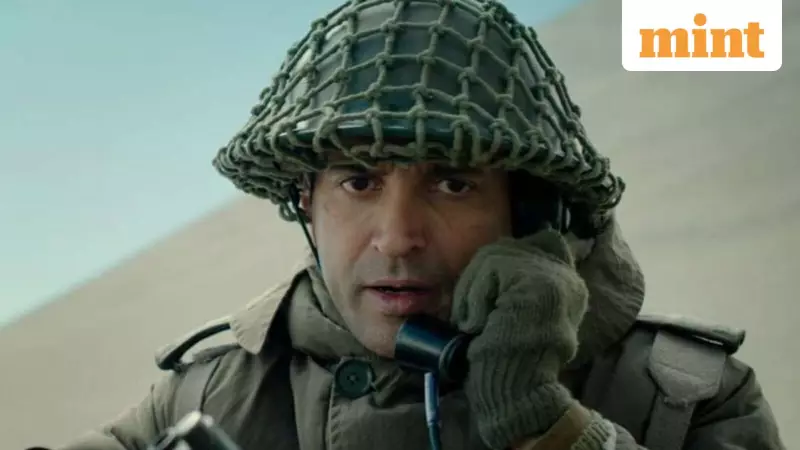
In a cinematic landscape dominated by hard-edged military dramas, Razneesh Ghai's 120 Bahadur arrives as a surprisingly tender portrayal of wartime heroism. Starring Farhan Akhtar as Major Shaitan Singh, the film revisits the Battle of Rezang La from the 1962 Sino-Indian War with an emotional depth that sets it apart from contemporary war films.
A Square Film in Cynical Times
120 Bahadur feels distinctly out of step with current Hindi war film trends. Where recent successes like Uri, Shershaah, and Fighter embrace triumph and cynicism, Ghai's creation chooses to be stirring and wholesome. The tone may remind viewers of Farhan Akhtar's own Lakshya, made 21 years ago but feeling even more distant in today's cinematic climate.
The film's timing presents an interesting paradox. Announced in September 2024, the project seemed perfectly positioned to address ongoing tensions with China, including the 2020 Galwan clashes. However, diplomatic developments quickly changed the context. Just a month after the film's announcement, India and China reached an agreement to de-escalate and create a buffer zone. Subsequent thawing of relations, including Prime Minister Modi's August visit to China after seven years, has shifted the political landscape significantly.

The Battle of Rezang La Revisited
The film centers on the November 1962 defense of Rezang La pass in Ladakh. Chinese forces under Lt. Col. Gao launch an offensive aimed at capturing Chushul and its vital airstrip. The defense falls to Charlie Company, a 120-strong battalion led by Major Shaitan Singh, portrayed by Farhan Akhtar.
Akhtar's Shaitan Singh emerges as a calm, calculated leader who leads by example. In an early scene that showcases clever writing by Rajiv G. Menon and Sumit Arora, Shaitan walks alone into open ground, seemingly inviting enemy fire. The maneuver reveals itself as a tactical ploy to locate an enemy sniper, demonstrating the character's strategic mind and bravery.
The film shines brightest in its buildup to the main battle, drawing inspiration from Haqeeqat (1964), considered the grandfather of Indian war films. The soldiers, all Ahirs by tradition, speak with authentic Haryanvi accents and engage in roughhousing and trash-talking that establishes their camaraderie.
Memorable Details and Emotional Payoffs
Ghai fills the narrative with simple but effective details that later resurface with emotional impact. Two friends stage a wrestling match for a bar of chocolate, while another soldier writes a letter to Madhubala. A curtailed singing career receives brief attention, and even light punishment involving a night among livestock yields unexpected tactical benefits.
The combat sequences, choreographed by Marek Svitek of All Quiet on the Western Front fame, feel more realistic than typical Hindi film action. One particularly effective sequence shows Shaitan Singh moving through narrow village lanes under attack, switching to a pistol while retaining his rifle—a nice touch of authenticity.
However, the film stumbles during its climactic battle sequence. What should be the emotional and narrative peak descends into incoherence, with chaotic mini-battles that fail to convey the larger strategic picture. Akhtar's performance, appealingly low-key for most of the film, becomes overstrained in these moments, with bulging eyes and off-putting line readings.
A Soft-Edged Vision of Patriotism
120 Bahadur ultimately presents a gentle vision of patriotic duty that feels like a broadcast from a gentler era. The violence of war is frequently interrupted by promises and tearful goodbyes, and even the Chinese commander—largely a caricature—receives a moment of grace at the end.
This emotional approach echoes Akhtar's Lakshya, which presented the armed forces as a finishing school for young men learning camaraderie and patriotism. The sentiment finds perfect expression when one soldier declares he doesn't feel separation from family because he has uncles and brothers in the unit and lies in his mother's lap—referring to Mother India.

120 Bahadur may not align with current cinematic or geopolitical trends, but its square, emotional approach offers a distinctive perspective on military heroism. The film is now playing in theaters nationwide.