Not enough has been said about artist Rao Bahadur MV Dhurandhar. This belief led researcher and art historian Sandeep Dahisarkar to author a comprehensive book on the painter. Seeking to correct a historical oversight, Dahisarkar wrote a 370-page volume titled Rao Bahadur MV Dhurandhar: A Painter from the Bombay School of Art, which was recently launched at the Indira Gandhi National Centre for the Arts (IGNCA).
Documenting a Legacy
Documenting Dhurandhar's vast body of work, spanning five decades, the book situates him within early 20th-century Indian art. It chronicles how the academic-realist contributed to the nationalist movement while navigating his relationship with colonial rulers, and explores how he illustrated the city and women.
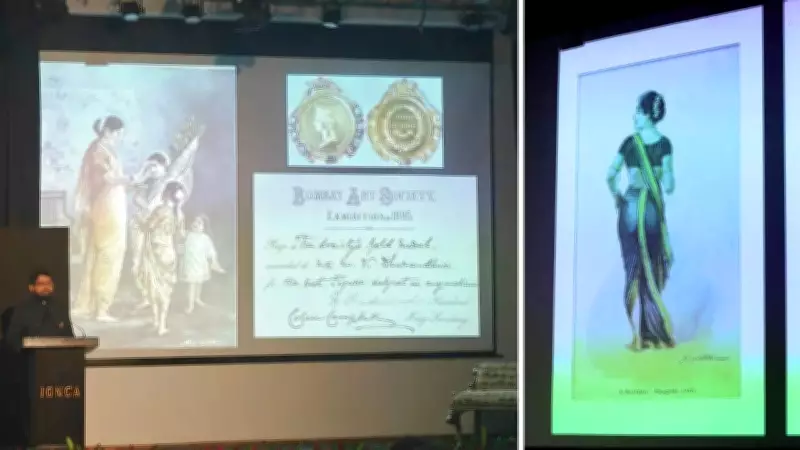
Mahadev Vishwanath Dhurandhar’s watercolour painting, capturing a Pathare Prabhu wedding, titled Scene of Hindu Marriage Ceremony (also known as Brides’ Maids), exemplifies his focus on cultural traditions. According to Dahisarkar, "Dhurandhar appreciated beauty in every person. This book is full of observations, which will make every art lover appreciate his art again."

Celebrating Indian Traditions
Sandeep Dahisarkar noted, "Dhurandhar, a swadesi artist from the pre-independence era, constantly reminded people who we are and why our traditions, festivals, and clothing are valuable. The book is an attempt to showcase almost all of his work. The way he treats every figure is what interests me most. The success of an artist is to draw viewers in directly, and I think Dhurandhar was able to do this in his lifetime."
Architect and curator of the evening Seetu Kohli added, "Dhurandhar did not illustrate India, he celebrated it. In his paintings – of women, of festivals, of streetscapes – you don’t see documentation, you see devotion." She further remarked, "Dilli ka mausam, Trump ka mood, aashiq ka mizaaj... Iss rang badalti duniya mein, art ka rang toh chahiye hi. Human life has always been unpredictable, even unkind. So, where have we always turned? To art, creativity, beauty."
Questioning Erasure
Art historian Alka Pande shared her thoughts, asking, "Have we forgotten Dhurandhar?" Through her presentation, she placed some of his artworks in direct comparison with his contemporaries Abanindranath Tagore, Amrita Sher-Gil, and his teacher Ralph Peacock. Highlighting his artistic significance, she added that Dhurandhar’s works, such as Chhatrapati Shivaji Maharaj’s coronation, Shivaji in Aurangzeb’s court, and scenes like a Pathare Prabhu wedding, demonstrate how he localized academic realism while capturing historical and cultural identity, aligning indirectly with broader currents of emerging nationalistic consciousness. "Influence can be seen in the continued presence of realistic traditions in Indian art, education, and practice," she said.
The event also featured dignitaries including Vivek Aggarwal, Secretary, Ministry of Culture; Sri Lankan High Commissioner Mahishini Colonne; Sapna Aggarwal; Sandhya Purecha; Manuel Rabaté; Kiran Nadar; Shibani Sethi; Samar Jodha; and Devyani Jaipuria.