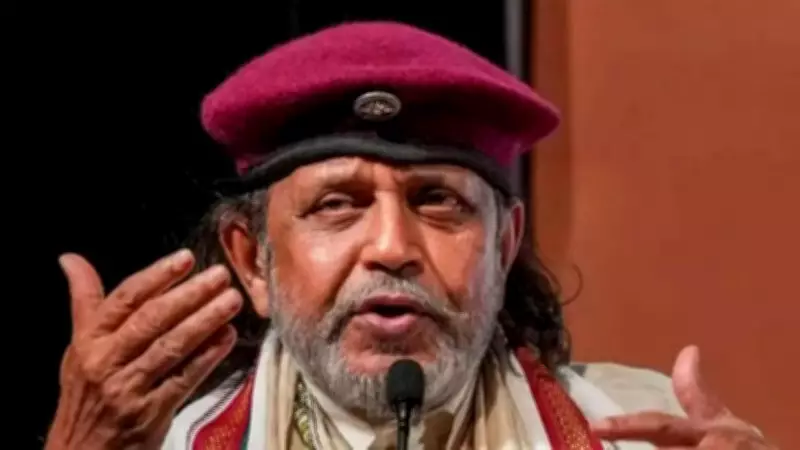
Mithun Chakraborty turns 76 today, born in 1950, the year India became a Republic. Over seven decades, he has seen and survived it all, much like the country itself, thanks to his ability to reinvent himself. He made a stunning debut in the 1970s with Mrinal Sen's arthouse film Mrigayaa, earning his first National Award. After minor supporting roles, he monopolized the 1980s with the barefoot disco dancer rhythm, establishing himself as a non-Hindi speaking, dark-skinned outsider who had all the right moves. Through the 1990s and beyond, he inspired many with his acting, action, signature hairstyle, and skinny pants.
The Disco Dancer Phenomenon
Mithun Chakraborty and Bappi Lahiri had a successful partnership in the 1982 film Disco Dancer. As Bollywood turned glossy with designer weddings and NRI romances, Gouranga (his real name) saw the writing on the wall. He transitioned to supporting roles with finesse: the mentor to Abhishek Bachchan in Mani Ratnam's Guru, the nuanced hero battling mid-life crisis in Rituparno Ghosh's acclaimed Titli, among others. He became a TV fixture as a judge on dance reality shows, his affable mannerisms winning over young and old.
The Art of Staying Relevant
Reinvention equals relevance in Mithun's book. His political choices reflect his transformation. Influenced by Naxal figure Ravi Ranjan, he dropped out of Kolkata's Scottish Church College to join the Naxalite movement in the early 1970s. After Prime Minister Indira Gandhi clamped down on the movement, he enrolled at the Film and Television Institute of India in Pune. From Naxal rebel to BJP mascot, Mithun has mastered reinvention. His dream opening in 1976 with Mrigayaa led to the stupendously successful Disco Dancer six years later. The Babbar Subhash directorial made him a household name as his character Jimmy set a new tempo to Bappi Lahiri's beats. The tall, dark, lanky Mithun became a symbol of middle-class hope and aspiration, soon a force at the box office and one of India's highest income tax payers.

Left is Right. Right is Right, Too.
As Mithun's success soared, his Left-leaning ideology remained intact, validated by his close association with then West Bengal Chief Minister Jyoti Basu. He famously performed gratis at the 1986 "Hope '86" cultural event at the request of "Jyoti Uncle." In Bombay, he found a guardian in Balasaheb Thackeray, who helped him navigate Bollywood's preferential treatment for North Indian actors. Mithun called the Shiv Sena supremo "Daddy" until his death. In Mithun Chakraborty: The Dada of Bollywood, author Ram Kamal Mukherjee writes that Mithun's proximity to Thackeray was a shield against critics. Mithun has said, "Apart from Netaji, two people I really respect and admire are Jyoti Basu and Balasaheb Thackeray."
Dilli Chalo!
After two decades in Bollywood, Mithun looked at homecoming in Bengal in the late 1990s, resuscitating filmdom with home productions. In his second innings, he played fiery, middle-aged saviors taking on mafia and corruption in films like Fatakeshto. In Bengal, it struck a chord. After 34 years of Left rule, anti-incumbency sentiment was powerful, and Mithun's anti-establishment movies sparked the Trinamool Congress (TMC) campaign in 2011. He campaigned for TMC in the 2014 Lok Sabha polls, three years after Mamata Banerjee became chief minister. In return, he received a Rajya Sabha berth from TMC, but things soured, and he made an early exit in 2016 citing health reasons, months after the Saradha chit scam blew up.
The 5-Year-Itch
After quitting the Rajya Sabha in December 2016, Mithun took a political sabbatical for five years. In March 2021, as the BJP stepped up its campaign to oust Mamata Banerjee, Mithun was roped in to revive the anti-establishment narrative. Often seen with senior BJP leader Kailash Vijayvargiya campaigning in rural Bengal, he regaled audiences with filmy one-liners. The defeat did not discourage him. Despite health issues, he threw his weight behind the saffron party, mobilizing booth-level workers and calling for Hindu unification, campaigning aggressively for a historic win on May 4, 2026.

Right at Home
On May 9, 2026, at Kolkata's Brigade Parade Ground, Mithun Chakraborty, wearing a black cape and cap, was among key figures on stage as Suvendu Adhikari took oath as West Bengal's first BJP chief minister. His ease with senior BJP and NDA leaders suggested he had found another political home, completing a journey from Left to Right. Much like his character in MLA Fatakeshto, remembered for the line "Marbo ekhane, lash porbe soshane" (If I thrash you here, your lifeless body will land in the crematorium), Mithun has built a career on taking on the establishment, on screen and off.
For more than five decades, Mithun Chakraborty has reinvented himself—driven by ideology and instinct, often challenging the status quo. The rebel, outsider, actor, and political campaigner all make up the enduring phenomenon that is Mithun Chakraborty. For many Bengalis of a certain generation, he represents the change that has swept the state: once flirting with revolutionary Left politics, then TMC, now speaking the language of Hindu consolidation.