Indian American Physicist Bulbul Chakraborty Achieves Unlikely Milestone with Obie Award
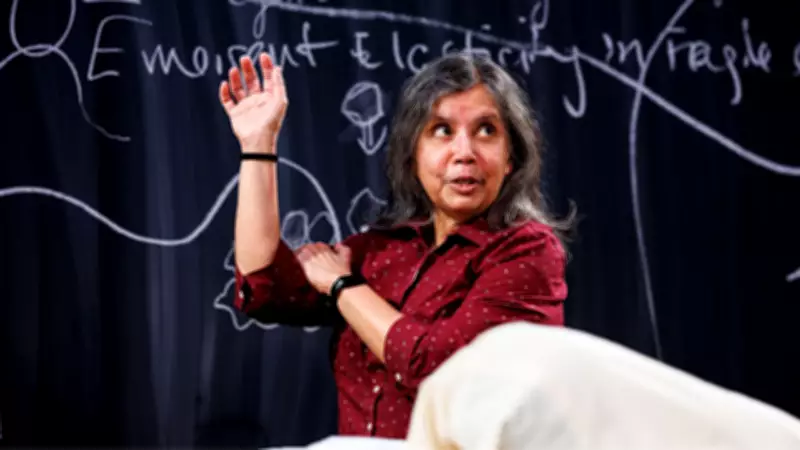
In a remarkable career shift, Indian American physicist Bulbul Chakraborty has achieved an extraordinary milestone by winning a top New York theatre honour for her very first acting performance. The prestigious Obie Award recognized her powerful role in the off-Broadway play Rheology, marking a rare transition from theoretical physics to the theatrical stage.
From Physics Laboratory to Theatre Stage
At 71 years old, Chakraborty appeared on stage with absolutely no formal acting training, playing herself in a deeply personal work that required her to speak openly about life, death, and loss before complete strangers. The citation specifically praised the profound honesty of her performance and its remarkable emotional force, highlighting how her scientific background informed her theatrical presence.
Rheology is a one-act play that masterfully blends scientific concepts with personal memory and theatrical performance. Written and directed by Chakraborty's son, Shayok Misha Chowdhury, the production explores mortality through the complex relationship between a mother and her adult son. On stage, Chowdhury imagines a future where his mother has passed away, expressing his fear that he might not survive her absence, while Chakraborty challenges this belief with quiet insistence that he will continue.

The Unique Nature of Chakraborty's Performance
Bulbul Chakraborty does not portray a fictional character in Rheology. Instead, she appears on stage as herself, but as a performer within a carefully scripted theatrical work. Her role transcends mere lecture or talk, representing a deliberate acting presence shaped entirely by the play's structure.
The performance begins with a brief, self-contained physics lecture, but what follows is not teaching. Chakraborty steps fully into the dramatic space of the play, where she speaks, sings, listens, and responds with authentic emotion. She shares memories and reflections written into the script, utilizing silence and stillness as integral components of her performance. Her lack of conventional acting technique becomes a surprising strength, allowing audiences to witness not a scientist explaining ideas, but a person enacting vulnerability and confronting mortality within a theatrical framework.
Physics as Emotional Language
The title Rheology refers specifically to the scientific study of how materials flow and deform. Granular materials like sand become central metaphors throughout the play, with sand's ability to behave as both solid and suddenly collapsing substance mirroring human relationships and grief.
Chakraborty spent decades studying such systems as a condensed matter physicist, and on stage, this scientific knowledge transforms into a powerful language for discussing fragility and endurance. The metaphors remain beautifully simple and accessible to audiences without any scientific background, demonstrating how scientific concepts can illuminate human emotional experience.
Performing Grief in Public Space
The creative process behind the play proved emotionally demanding for both mother and son. Chakraborty has revealed that the project began as a way to help her son confront his deepest fears, but over time evolved into something she needed to face herself. Each performance required her to contemplate her own mortality with remarkable courage.
Audience reactions were consistently intense and deeply personal. Many people approached Chakraborty after shows to share stories about their own parents, while younger viewers frequently expressed an immediate urge to call their mothers. The play created genuine human connection without offering simplistic comfort or easy resolutions.
New York Response and Critical Acclaim
Rheology ran at The Bushwick Starr in Brooklyn through May 2025, attracting significant attention from New York's theatre community. Reviews in The New York Times and The New Yorker highlighted the production's emotional clarity and unusual structural approach to blending science with personal narrative.

The Obie Award, announced in early 2026, confirmed this positive critical response by specifically praising Chakraborty's courage and openness on stage. This honour placed her among New York's most compelling new performers of the entire theatre season, an extraordinary achievement for someone without traditional acting credentials.
A Distinguished Scientific Career
Beyond the stage, Bulbul Chakraborty maintains an impressive scientific legacy as professor emerita of physics at Brandeis University. She earned her doctorate from State University of New York at Stony Brook in 1979 and joined the Brandeis faculty in 1989, where her research focused on granular matter, jamming phenomena, and systems far from equilibrium.
Her scientific achievements include becoming a fellow of the American Physical Society in 2008 and receiving a prestigious Simons Fellowship in 2018. Chakraborty never intended to become an actor, agreeing initially to step on stage solely for a family project. That single decision ultimately led to both a powerful theatrical work and a major New York honour.
Her remarkable journey demonstrates how scientific thinking and human emotion can occupy the same creative space. On a small Brooklyn stage, a distinguished physicist discovered an entirely new language for speaking about life, loss, and the enduring connections that define our human experience.