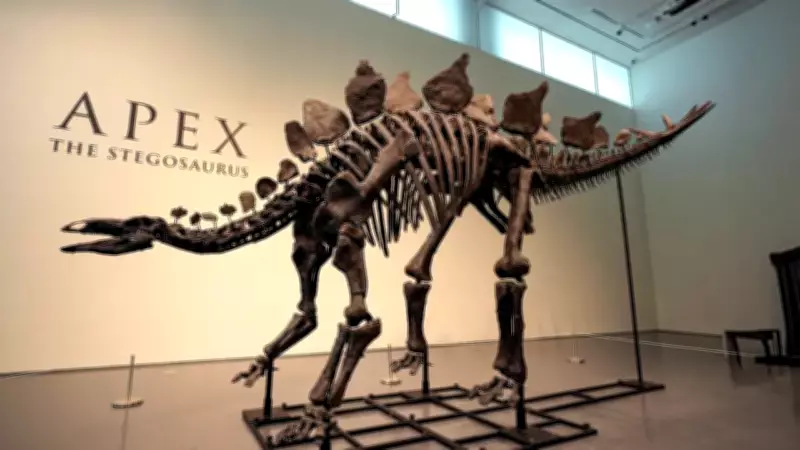
The $44.6 Million Stegosaurus That Shook the Scientific World
For millions of years, colossal dinosaurs reigned supreme across the Earth's terrestrial, marine, and aerial domains. Their monumental size and formidable power enabled them to traverse continents, transform entire ecosystems, and maintain an unchallenged position at the apex of the prehistoric food chain. Ultimately, a cataclysmic mass extinction event erased them from existence, leaving behind only fossilized remains entombed within the planet's geological layers.
Today, those ancient bones have re-emerged into an entirely different spotlight. Once the quiet domain of museum curators and academic researchers, dinosaur fossils are now commanding global headlines and astronomical prices at auction. They are increasingly treated as luxury assets, displayed in private galleries as potent symbols of wealth, power, and exclusivity.
A Record-Breaking Auction That Redefined the Market
The catalyst for this renewed and contentious fascination occurred in 2024, when a remarkably complete Stegosaurus skeleton, nicknamed "Apex," was sold at a Sotheby's auction for a staggering $44.6 million. This unprecedented sum, paid by billionaire hedge fund CEO Ken Griffin, shattered all previous records for a fossil sale and sent shockwaves through the scientific community.

This landmark transaction has unequivocally signaled a market transformation. Dinosaur skeletons are no longer niche collectibles for enthusiasts; they have entered the rarefied arena of high-end investment assets, competing directly with masterpieces of fine art, vintage automobiles, and rare timepieces. While Griffin has stated his intention to loan the specimen to a public institution, the sale has ignited a profound and heated debate concerning money, science, and the rightful stewardship of Earth's deep history.
Why the United States Fuels a Thriving Commercial Trade
A primary driver of this booming commercial fossil market is a unique combination of geography and legal framework, particularly within the United States. Under U.S. law, fossils discovered on privately owned land are considered the legal property of the landowner, who retains the right to sell them. This establishes the nation as one of the few global jurisdictions permitting a large-scale, legal commercial trade in paleontological specimens.
This stands in stark contrast to nations like Mongolia and China, which classify significant dinosaur fossils as protected national heritage. In these countries, private sales and international exports are strictly prohibited, with all major discoveries mandated for preservation and study within public institutions.
"This fundamental legal disparity is precisely why so many scientifically important specimens originate from the United States," explains Dr. Thomas Carr, a noted paleontologist. "Once these fossils enter the private auction market, the scientific community often loses all control and guaranteed access."
Billionaires, Status, and the 'Dinosaur Effect'
For ultra-wealthy collectors, dinosaur fossils represent a uniquely compelling acquisition. They are visually spectacular, inherently rare, and utterly irreplaceable. A fully mounted skeleton commands any space, serving as an instant centerpiece of awe and conversation.
Collectors frequently frame their purchases as acts of preservation and patronage for education. However, researchers also identify a powerful status-driven motivation. "Owning a dinosaur is the ultimate symbol of exclusivity," observes fossil trade researcher Dr. Ashley Hall. "There is a finite supply; there will never be another identical specimen." This demand has been further amplified by popular culture, with blockbuster films and documentaries reinvigorating global fascination, particularly among affluent buyers in Asia, the Middle East, and North America.
The Growing Scientific Research Crisis
While the market celebrates record prices, paleontologists are sounding alarms about a concurrent research crisis. Their paramount concern is the irreversible loss of scientific access. Rigorous research depends on the ability to repeatedly study, compare, and analyze specimens. When fossils vanish into private collections, that critical access is often permanently severed.

The scale of the problem is significant. Studies indicate that more than half of all known Tyrannosaurus rex specimens are now in private hands. "This creates massive, irreparable gaps in our scientific data," warns Dr. Jingmai O'Connor of the Field Museum. "We cannot accurately study dinosaur growth patterns, anatomical variation, or behavior if a majority of the evidence is locked away in private vaults."
Furthermore, public museums and research institutions are increasingly priced out of the market. With budgets incapable of matching multimillion-dollar auction bids, scientists fear a future where the most significant fossil discoveries will never become part of the public scientific record.
A Market Without Signs of Slowing Down
The defence from auction houses and some collectors centers on preservation and access. They argue that private investment often rescues specimens from natural erosion or destruction and that loans to public museums remain a common practice. Sotheby's has emphasized that many buyers are motivated by educational and public-interest goals.
However, critics counter that voluntary loans are no substitute for enforceable public policy, as they can be revoked at any time. The core ethical question remains unresolved: should dinosaur fossils be treated as tradable private property akin to art, or should they be protected as non-commodifiable scientific and cultural heritage?
Industry analysts estimate the global commercial fossil trade is now worth tens of millions of dollars annually, a figure that continues to climb. As financial incentives grow, the risk increases that landowners and commercial excavators will prioritize lucrative private sales over collaborative work with researchers.
The $44.6 million sale of the Stegosaurus "Apex" has transformed an academic debate into a urgent public dilemma. As billionaires vie to own singular pieces of prehistory, the scientific community warns that humanity risks losing a vital connection to its own planetary origins. The age of the dinosaurs ended eons ago, but the fierce battle over the legacy of their bones is unfolding in the present day, with profound implications for both science and society.