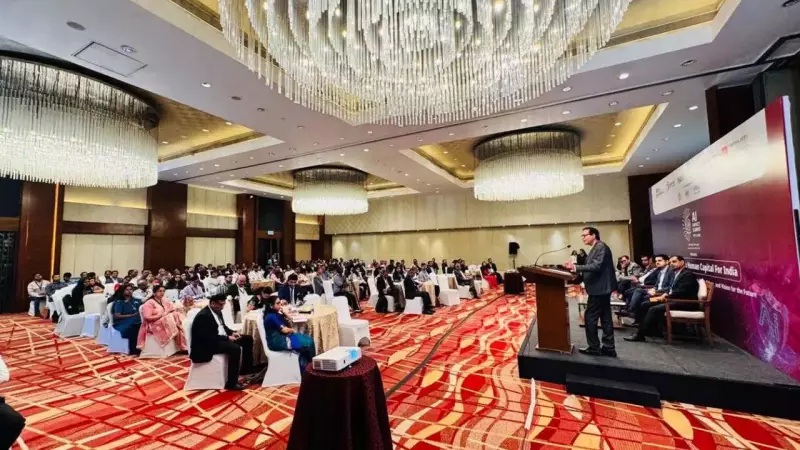
As Artificial Intelligence reshapes global economies and workplaces, a crucial dialogue on preparing India's workforce for this transformation took center stage in Pune. Vishwakarma University (VU) orchestrated a significant AI Pre-Summit on Human Capital in the AI Era on Monday, forging a collaborative effort with the All India Council for Technical Education (AICTE), alongside major academic and industry partners.
Convening Minds for a National Agenda
The day-long summit, held at Hotel Hyatt Ista in Pune, served as a strategic platform. It assembled a diverse group of policymakers, corporate leaders, academic experts, tech professionals, and students. Their collective mission was to deliberate on actionable strategies for India to fortify its human capital, ensuring inclusive and responsible adoption of AI technologies.
Beyond AICTE, the university partnered with the Ministry of Electronics and Information Technology and IndiaAI. Key industry support came from the Confederation of Indian Industry (CII) and technology leader Infosys.

Industry and Academia Call for Human-Centric AI
In his inaugural address, Bharat Agarwal, President of Vishwakarma University, placed human talent at the core of progress. He observed that human capital attracts investment and drives urban development, even amidst infrastructural constraints. Agarwal highlighted the unique learning dynamic of the AI era, where professionals, teachers, and students are learning concurrently, sometimes with students leading the way. He stressed that AI's impact spans all professions, not just engineering, and urged a collective effort to rapidly adapt, citing Pune's growth as a testament to its talent development.
Dr. Sunil Luthra, Bureau Head and Director of AICTE's Training and Learning Bureau, delivered the keynote, framing the discussion within a global context. He announced a landmark event: India will host the AI Impact Summit in February 2026. This global forum aims to establish a future-focused agenda where AI acts as a catalyst for inclusive human development, social empowerment, and sustainable progress.
Redesigning Work, Skills, and Leadership for the Future
Industry voices provided critical perspectives on the ground-level changes required. Pravin Kulkarni, Vice President and Delivery Head at Infosys, Pune, argued that embracing AI transcends technology. "It is about redesigning work, the workforce and the workplace to combine human judgement with intelligent workflows," he said, emphasizing that technology should amplify human potential through trust and collaboration, not replace people.
Rohit Ramanand, Senior Vice President of Engineering at FIS, drew a historical parallel to the Industrial Revolution. He predicted inevitable job displacement and creation, noting that new roles will demand different skills. "The companies that will win will be the ones that invest in human capital, redesign skills and focus on higher-value work," Ramanand stated.
Echoing the theme of augmentation, Manish Tambe, CEO of Dassault Systèmes Global Services, spoke on the future of learning. He said working with AI involves mastering interaction with intelligent systems while bolstering inherently human skills like creativity, critical thinking, and leadership. "AI is not here to take jobs, but to make jobs better," Tambe affirmed.
Rajnikant Behara, Executive Director of RSB Transmissions, underscored the necessity of collaboration for national goals. He asserted that Viksit Bharat (Developed India) is unattainable without close industry-academia collaboration in curriculum and solution design. Behara pointed out that AI implementation hinges on the right human capital, and its true value lies in solving pressing national challenges in healthcare, sustainability, and logistics.
Forging a Path Forward for India's Talent Ecosystem
The summit's deliberations zeroed in on critical areas: emerging skill demands, transforming educational curricula, building faculty capacity, and creating frameworks for lifelong learning. Through expert discussions, a consensus emerged on the indispensable role of human intelligence, ethical judgment, and social responsibility in complementing machine intelligence.

Organized with AICTE, MeitY, IndiaAI, CII, and Infosys, the event aimed to generate policy insights and practical strategies to strengthen India's human capital pipeline. The summit reinforced Pune's position as a leading hub for education, innovation, and thought leadership, directly contributing to the national vision of Viksit Bharat 2047.