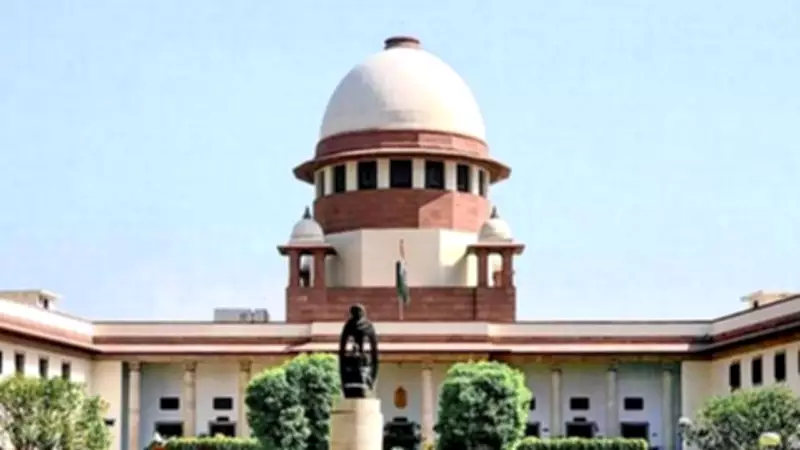
Supreme Court Intervenes in UGC Equity Regulations, Raises Constitutional Questions
The Supreme Court of India has issued a significant interim order that places the UGC (Promotion of Equity in Higher Education Institutions) Regulations, 2026 in abeyance. This decision, while not a final verdict on equity itself, represents a profound judicial examination of regulatory design and constitutional boundaries in addressing caste discrimination within academic institutions.
Court's Interim Order and Constitutional Concerns
Invoking Article 142 of the Constitution, a Bench led by Chief Justice of India Surya Kant has temporarily halted the implementation of the 2026 framework while reviving the 2012 anti-discrimination regulations until further hearings. The Court framed its intervention in remarkably direct language, expressing apprehension that unchecked implementation could potentially "divide society" and lead to "grave repercussions."
The judicial concern did not question the existence of caste discrimination in Indian universities—a reality the Court acknowledged without equivocation. Rather, the focus centered on whether the chosen regulatory architecture might cross constitutional boundaries, particularly through its definitional framework.

The 2026 Regulations: From Advisory to Enforceable Governance
The UGC's 2026 regulations marked a substantial transformation from advisory language to enforceable governance mechanisms. These regulations mandated several institutional structures:
- Establishment of Equal Opportunity Centres across campuses
- Formation of dedicated Equity Committees
- 24-hour Equity Helplines for immediate grievance reporting
- Defined timelines for conducting inquiries
- Ombudsperson appeals processes
- Regulatory consequences for institutional non-compliance, including potential loss of program permissions and UGC recognition
This framework represented operational law rather than symbolic policy, explicitly aiming to convert caste discrimination from a moral concern into a compliance obligation within higher education institutions.
The Critical Definition: Regulation 3(1)(c)
At the heart of the constitutional debate lies Regulation 3(1)(c), which defines "caste-based discrimination" exclusively as discrimination against members of Scheduled Castes, Scheduled Tribes, and Other Backward Classes. In regulatory law, definitions function as gatekeepers, determining which complaints activate institutional machinery and which claimants gain access to accelerated grievance mechanisms.
Petitioners argued before the Court that this definition effectively categorizes victimhood, providing structured remedies to specific caste identities while excluding others from the same procedural channels, regardless of the context or severity of alleged discrimination. The Court's interim response suggests it found this argument legally significant and worthy of deeper examination.
Equity Versus Equality: Constitutional Tensions
The 2026 framework operates on an equity-first philosophy, recognizing caste as a historically specific axis of exclusion requiring targeted institutional protection. This approach mirrors decades of constitutional reasoning on reservations and affirmative action. However, the difficulty emerges when procedural access to grievance redressal—rather than benefit allocation—becomes filtered through identity categories.
Unlike reservation systems that distribute opportunities, grievance mechanisms distribute institutional attention and remedies. Courts have traditionally treated denial of remedies with heightened constitutional sensitivity under Articles 14 and 21, which protect equal protection and access to justice. The Court expressed concern that university grievance systems cannot function as gated structures without triggering constitutional scrutiny.

Data Landscape and Reporting Realities
Official data on caste discrimination within higher education remains limited and often contested, yet not entirely absent. According to UGC-linked disclosures, over 1,100 complaints related to caste discrimination were recorded across campuses in the past five years, with a noticeable increase post-2020. Approximately 90% were marked as resolved, though this figure reveals little about the quality of resolution while indicating growing formal reporting.
When contextualized against the scale of Indian higher education—encompassing over 1,100 universities and more than 45,000 colleges—these numbers appear modest. However, complaint data reflects not only incidence but also trust in reporting systems, fear of retaliation, and confidence in institutional responsiveness.
Why the Court Revived the 2012 Framework
The Supreme Court's decision to revert to the 2012 regulations reveals important judicial preferences. The Court did not dismantle the equity project but instead chose a framework that addresses discrimination without formally embedding grievance eligibility in caste categories. This suggests the judiciary values:
- Anti-discrimination mechanisms with open-ended access
- Substantive adjudication that remains sensitive to caste realities
Essentially, the Court appears to favor universal entry with differentiated evaluation over differentiated entry itself—a familiar constitutional preference in Indian jurisprudence.
Institutional Risks and Governance Legitimacy
The stakes extend beyond legal correctness to encompass governance legitimacy. Universities function as densely plural spaces where grievance mechanisms perceived as structurally inaccessible to some groups risk becoming sites of secondary conflict rather than resolution. The Court's warning about "division" reflects anxiety over procedural alienation, not denial of caste injustice—a distinction often collapsed in public discourse.
Potential Future Scenarios
When the matter returns to the Supreme Court, several outcomes appear plausible:
- Reading down Regulation 3(1)(c) to allow universal access while retaining caste-sensitive assessment
- Mandating parallel grievance tracks ensuring equivalent procedural safeguards for non-caste complaints
- UGC-led redrafting clarifying that equity machinery supplements rather than supplants general grievance redressal
A wholesale rejection of institutional equity structures seems unlikely, as the regulatory moment has progressed beyond that point.
The Philosophical Question for Higher Education
The deeper issue raised by this judicial pause transcends legal technicalities to address philosophical concerns: Can a system designed to correct historical exclusion afford to reproduce procedural exclusion—however well-intentioned—in the present? The Supreme Court's stay does not provide definitive answers but insists that any resolution must remain constitutionally legible. Ultimately, equity involves not only whom institutions protect but also how institutions listen and respond to diverse grievances within India's complex social fabric.