In the heart of Bihar, the ancient whispers of the world's oldest residential university are finding a powerful, modern voice. The ruins of Nalanda, a Unesco World Heritage site, stand as a poignant testament to a premier centre of Buddhist learning that flourished from the 5th century CE, over 600 years before Europe's oldest university. Though ravaged by Turkish invaders in the 12th century CE, its 'magic bricks' still tell a story of grandeur. Today, about 15km away, that story is being reborn in a stunning new avatar.
An Architectural Homage and an Ecological Marvel
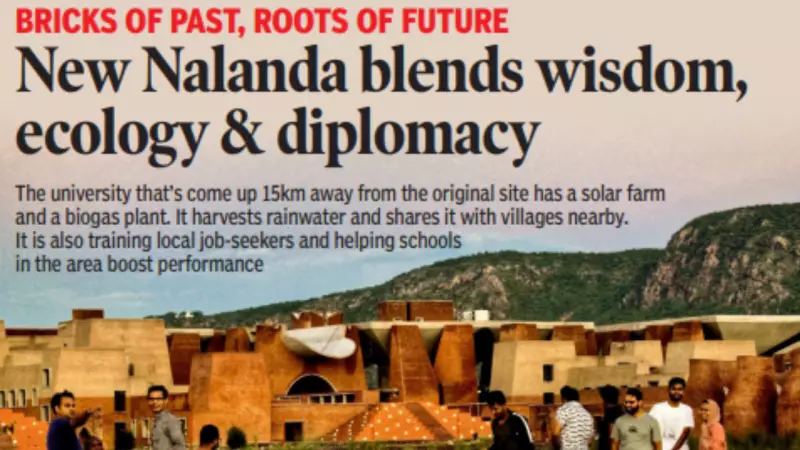
The new Nalanda University campus, spread over 455 acres near the Rajgriha hills, is a conscious tribute to its ancient predecessor. While its imposing gates might suggest high security, the design philosophy is one of serene, monastic inspiration. The buildings are overwhelmingly red, angular, and bathed in natural light, with the library shaped like a stupa—a nod the Chinese pilgrim Hiuen Tsang would likely approve.
More than just aesthetics, this is India's first 'net zero' university. The campus is a model of ecological sustainability, being carbon-neutral and self-sufficient. Only 12% (55 acres) of the land is used for construction, with the rest dedicated to greenery and water bodies. Fossil fuel vehicles are banned beyond visitor parking, replaced by battery carts and bicycles—even the vice-chancellor cycles. The university runs on its own solar farm and biogas plant, uses only surface water, and is completely polythene-free.

A Global Classroom Rooted in Interdisciplinary Wisdom
The academic vision mirrors the ancient Nalanda's spirit of international scholarship and broad inquiry. Born from a 2006 idea by former President APJ Abdul Kalam and championed by Chief Minister Nitish Kumar, the university was established by a special act of Parliament in 2010. It gained momentum as an international project, supported by 17 East Asia Summit countries. Nobel laureate Amartya Sen served as its first chancellor from 2010 to 2016.
Unlike conventional universities, it does not offer engineering or standard business courses. Instead, it focuses on interdisciplinary programmes in Buddhist Studies, Philosophy, Ecology, History, and Literature, including a unique MBA in Sustainable Development. The School of Buddhist Studies, Philosophy and Comparative Religions is a global hub, with about 90% of its students coming from abroad, from Laos to the UK. Teaching emphasises primary sources in Sanskrit, Pali, and Tibetan, fostering rigorous debate or vaad-samvaad, a cherished Nalanda tradition.
Beyond Walls: The University as a Community Catalyst
Perhaps the most transformative aspect is the university's 'sahbhagita' (partnership) initiative with neighbouring villages. Under Vice-Chancellor Sachin Chaturvedi, the university actively engages with local communities. It shares water and electricity, provides compressed bricks for school walls, and distributes compost and seeds for green farming to marginal farmers like Tanoj Kumar.
Students and faculty survey nearby villages like Pilki and Mahadeva to identify skills and heritage for community upliftment, especially for women. Workshops in sculpture, Madhubani painting, and embroidery are organised, with the university committing to procure the crafted items. Additionally, foreign language classes like Japanese are offered to locals to boost employment.
The engagement extends to 14 government schools, where faculty help address issues like student dropouts and promote organic farming. This symbiotic relationship enriches both parties. As student Devyansh Pandey notes, it provides invaluable insights into local farming histories and climate adaptation.

The new Nalanda University, officially inaugurated by Prime Minister Narendra Modi in August 2023, is more than an educational institution. It is a living bridge between a glorious past and a sustainable future, proving that elite universities can be powerful drivers of ground-level change, intellectual exchange, and ecological stewardship.