English Education Divide in Telangana: Caste Disparities Exposed in New Report
In Telangana's rapidly evolving education landscape, language has quietly emerged as one of the most significant lines of inequality. The SEEEPC Survey-2024 and Independent Experts Working Group report reveals that access to English medium education—now closely tied to employment opportunities and upward mobility—increases with caste advantage and drops dramatically among the most marginalized communities.
State-Level Disparities in English Medium Education
At the state level, 47% of individuals below 30 years old have studied in English medium institutions. However, this distribution reveals deeply uneven patterns across caste groups. Among general castes, the figure stands at 56.6%, followed by 48.1% among Backward Classes (BCs), 40.7% among Scheduled Castes (SCs), and just 36.6% among Scheduled Tribes (STs). The report characterizes this as a "significant language-based educational divide", directly linking English medium education to competitive learning environments, higher education access, employment prospects, and digital participation.
Caste-Specific Variations in Access
The disparity becomes even more pronounced when examining individual caste groups. While the state average remains at 47%, access reaches as high as 72.4% among OC Brahmins and similar levels among OC Komatis, but plummets to approximately 11% among ST Kolams. The upper tier of English medium access is dominated by forward castes including Brahmins, Komatis, Kammas, Velamas, Rajus, and Reddys, along with a few upwardly mobile BC groups such as BC-B goldsmiths and Padmasalis.

At the opposite end of the spectrum are communities like ST Kolam, ST Gond, ST Koya, SC Beda, and BC-A groups including Valmiki and Odde. Most SC and ST castes fall below the state average, with SC Malas representing a rare exception to this pattern.
The 'Birth Lottery' and Socio-Economic Mobility
The report emphasizes that English medium education has become a crucial pathway to socio-economic mobility in contemporary Telangana. It directly connects language skills to access to the global knowledge economy, describing English proficiency as a new gatekeeper in what it terms the 'birth lottery'. Communities that have successfully transitioned toward English medium schooling are better positioned to enter skilled professions and secure economic advantages.
Goldsmiths and Padmasalis, for instance, demonstrate approximately 75% access among youth, reflecting concerted efforts to overcome historical economic disadvantages through educational advancement. Conversely, communities with limited access to English medium education remain concentrated in traditional and insecure occupations. The report notes that Kolams, with minimal English education access, also show high dependence on agricultural labor, with 50.4% engaged in such work. Similar patterns emerge among groups like Mudiraj, Valmiki, and Pitchiguntla, where English medium access remains below 30%.
Schooling Access and Private Institution Concentration
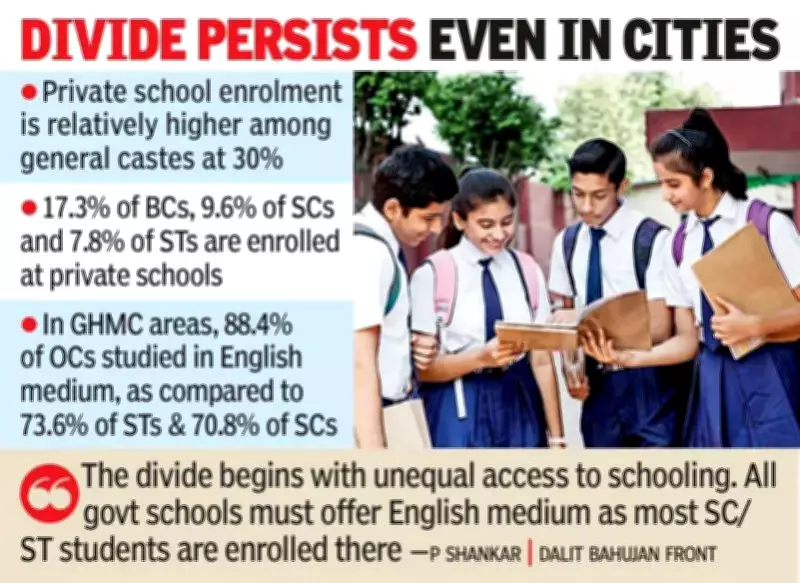
This educational divide is intimately connected to broader schooling access disparities. Private school enrollment rates reveal significant inequalities: 30% among general castes compared to 17.3% among BCs, 9.6% among SCs, and just 7.8% among STs. Since English medium education is predominantly concentrated in private institutions, this gap reflects intersecting caste and class inequalities that reinforce existing social hierarchies.
Importantly, urban data demonstrates that this divide persists even in metropolitan environments. In Greater Hyderabad Municipal Corporation (GHMC) areas, 88.4% of Other Castes (OCs) studied in English medium compared to 73.6% of STs and 70.8% of SCs. Similar gaps are visible across other urban districts, indicating that urbanization alone has failed to bridge the language-based educational divide.

Expert Perspectives and Policy Implications
P Shankar, national secretary of Dalit Bahujan Front, observes that the divide begins with unequal access to schooling itself. Most SC and ST children attend government schools where English medium education is either absent or inadequately implemented, while children from other castes are more likely to enroll in private institutions. He notes that the contemporary job market is increasingly linked to English proficiency and argues that all government schools should offer comprehensive English medium education alongside nursery classes to level the playing field.
The report's findings highlight how educational inequalities in Telangana are being reproduced through language access, with English medium education serving as both a marker of privilege and a mechanism for socio-economic advancement. As the state continues to develop, addressing these disparities will require targeted interventions in both educational infrastructure and language policy to ensure equitable opportunities for all communities.