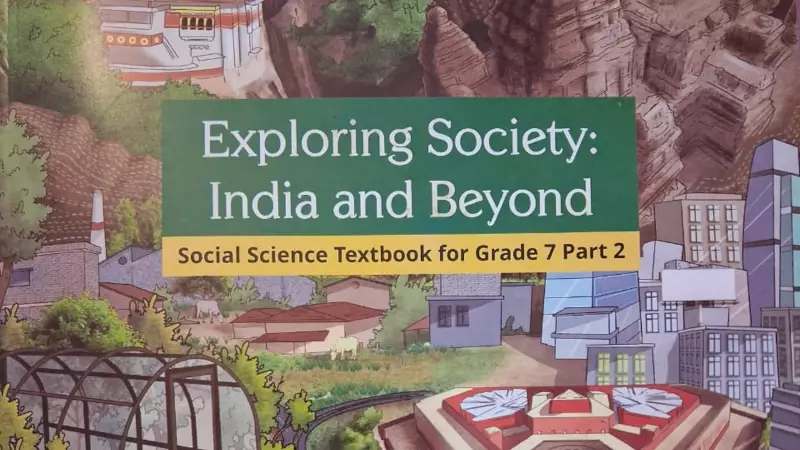
The National Council of Educational Research and Training (NCERT) has introduced a significantly expanded section on the Ghaznavid invasions in its newly released Class 7 social science textbook. The updated content, spanning about six pages, offers a detailed account of Mahmud of Ghazni's campaigns in India, marking a substantial increase from the brief paragraph in the previous edition.
A 'Word of Caution' Prefaces the Chapter
The section begins with a distinctive box containing "a word of caution". This note mirrors a similar advisory placed before the Delhi Sultanate chapter in the Class 8 textbook. It explains that historical records often emphasize war and conquest over peace and creativity. The textbook advocates for confronting these darker periods to understand their causes and prevent recurrence, while clearly stating that "it would be wrong to hold anyone responsible for them today." The new book is intended for the ongoing academic session.
Detailed Account of Destruction and Plunder
The chapter, titled "Turning Tides: 11th and 12th centuries", meticulously documents Mahmud of Ghazni's 17 raids into the Indian subcontinent. It describes his targeting of wealthy temples, including those in Mathura and Kannauj, and the infamous destruction of the Somanatha Shiva temple in Gujarat. The text notes that the present-day Somnath temple was rebuilt in 1950 and inaugurated by then President Dr. Rajendra Prasad.

The narrative goes beyond temple plunder, stating that Mahmud's campaigns involved the "slaughter of tens of thousands of Indian civilians" and the enslavement of children. It quotes his court historian, Al-Utbi, who wrote about killing infidels, destroying temples, and building mosques to make "the light of Islam visible." Scholar Al-Biruni's account of the Somnath lingam's fate is also included, noting a part was used as a step at a Ghazni mosque.
The textbook explicitly links Mahmud's actions to a religious motive, stating he was "keen to spread his version of Islam to non-Muslim parts of the world." None of these specific details were present in the old Class 7 history book.
Broader Context of Invasions and New Additions
The chapter also covers Muhammad Ghuri's territorial conquests and his generals, Qutb-ud-din Aibak and Bakhtiyar Khilji. A significant new addition is the detailed account of Bakhtiyar Khilji's destruction of the Buddhist universities at Nalanda and Vikramashila in eastern India. The text states the library at Nalanda burned for months and cites a historical consensus that this destruction accelerated Buddhism's decline in India.
Furthermore, the preceding chapter now includes the Arab invasion of Sindh led by Muhammad bin Qasim, another topic absent from the old textbook. It quotes a 13th-century source on waging war against infidels and explains the medieval Islamic context of the term. However, it concludes that the Arab conquest's impact in Sindh was limited compared to other regions.
The chapter concludes by noting that large parts of north and all of south India remained outside Turkic control and that native rulers sometimes united against them.
Curriculum Shift Under NEP 2020
This revision is part of NCERT's ongoing effort to align textbooks with the National Education Policy (NEP) 2020 and the National Curriculum Framework for School Education 2023. The new social science curriculum for Class 7 has been condensed from three separate books (History, Social & Political Life, Geography) into two integrated textbooks. The old books were based on the 2005 framework and underwent rationalization in 2022-23. When asked for comment, NCERT Director Dinesh Saklani stated that the content is self-explanatory.