Maharashtra Primary Teachers Voice Alarm Over State Scholarship Exam Difficulty
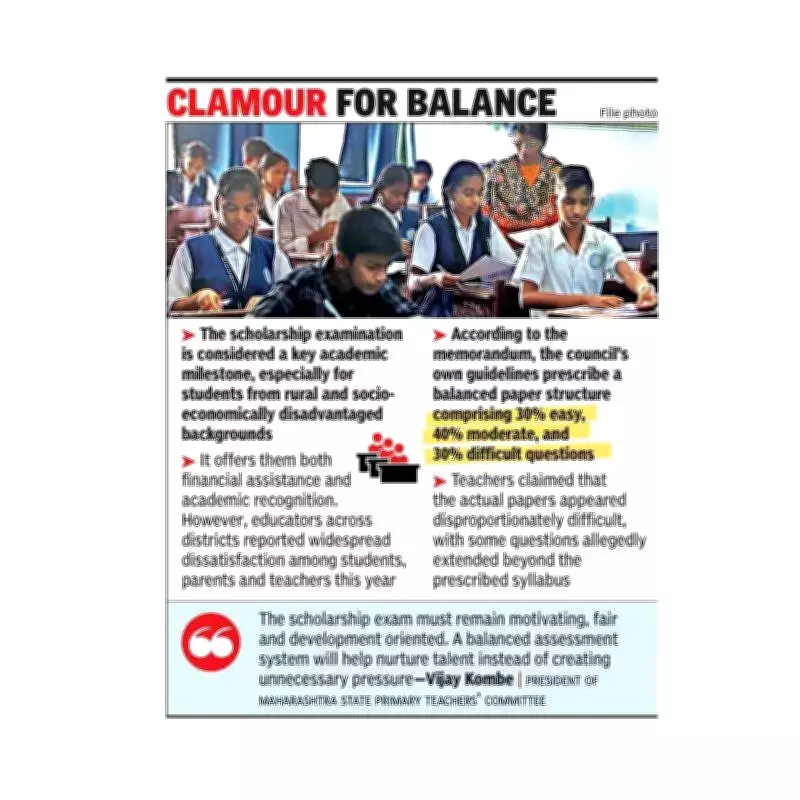
The Maharashtra State Primary Teachers' Committee has issued a formal complaint regarding the state scholarship examination conducted on Sunday, expressing grave concerns about its excessive difficulty level and inappropriate structure for Class 5 students.
Exam Questions Beyond Cognitive Level and Syllabus
Committee members have highlighted that numerous questions in both the language and mathematics papers far exceeded the prescribed syllabus and cognitive capabilities expected of primary school children. This has reportedly led to significant stress and a loss of confidence among the young examinees.
In a detailed representation submitted to Maharashtra State Examination Council chairman Nandakumar Bedse and commissioner Mahesh Chothe, the teachers' body provided specific examples. They noted that students were required to process lengthy passages containing multiple complex clauses and solve multi-step mathematical problems that demanded advanced reasoning skills not typically associated with primary education.

Teachers observed that many students struggled to interpret the questions within the allotted time, indicating a clear mismatch between the exam's design and age-appropriate learning outcomes. This has raised serious questions about the assessment's effectiveness and fairness.
Official Response and Committee's Stance
In response to the concerns, Examination Council chairman Nandakumar Bedse stated, "We will take cognisance of the letter and understand what can be done. But, it is not possible to make changes in the exam that has been conducted. The difficulty level was uniform across papers. If any student has scored less, it will be the case for all who took the exam."
However, Vijay Kombe, the state president of the committee, countered this view, emphasizing, "The purpose of a scholarship examination is to identify talent, not to discourage children at an early age. When questions become excessively complex for their developmental stage, the exam stops measuring ability and begins testing endurance."
Negative Impact on Young Learners and Teachers
The organisation has warned that such challenging exam experiences could have detrimental effects on young learners. Educational psychology underscores that assessments at an early age should aim to build confidence, strengthen conceptual understanding, and encourage curiosity.
Instead, teachers reported observing heightened anxiety, confusion, and a growing fear of exams among several students following the test. This emotional toll is particularly concerning as it may hinder long-term academic motivation and performance.
Kombe further explained that the issue extends to teachers working in zilla parishad schools, where many institutions ensure full student participation in scholarship exams. "If the difficulty level is not carefully calibrated, it undermines students' morale and the efforts of teachers who prepare them," he added, highlighting the broader implications for educational stakeholders.
Call for Reform in Exam Design
In light of these issues, the committee has urgently appealed to the examination council to adopt a more scientific and inclusive approach to paper setting. They recommend involving experienced primary teachers, education experts, and educational psychologists in the process to ensure that future exams are appropriately tailored to the developmental stages of young students.
This move aims to align assessments with educational goals, fostering a positive learning environment rather than one that induces stress and discouragement among India's future generations.