In a significant move to promote science education, the Karnataka government has announced plans to broaden the reach of its ambitious Telescope Distribution Scheme. Science and Technology Minister NS Boseraju revealed on Thursday that the initiative, currently serving residential schools, will be expanded to encompass a wider network of government institutions across the state.
Statewide Expansion for Astronomy Education
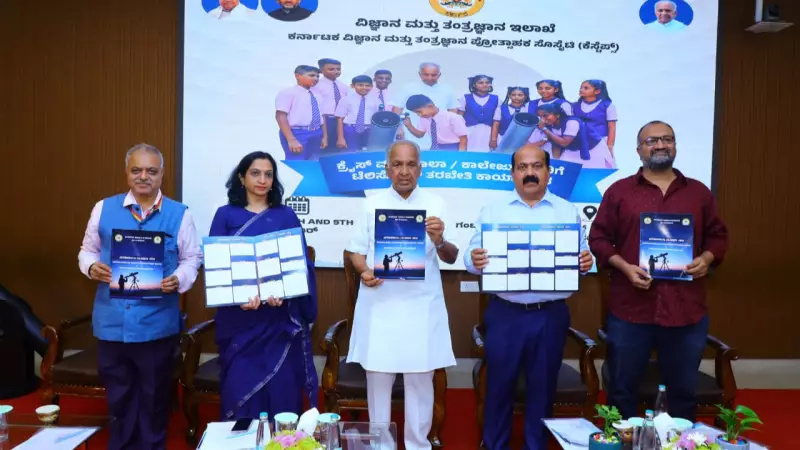
The minister made the announcement at the Jawaharlal Nehru Planetarium in Bengaluru, during the inauguration of a special training program for teachers. He confirmed that a formal proposal seeking additional funds for this expansion will be presented to the Chief Minister during the upcoming budget discussions. This step marks a pivotal phase in the state's mission to embed astronomy-based learning deeply into its educational framework.
Under the existing scheme, a total of 833 residential schools and Pre-University colleges under the Karnataka Residential Educational Institutions Society (KRIES) have already been equipped with telescopes. The project, executed at a cost of Rs 3 crore, has been hailed as unique in its scale, with Boseraju stating that no other government department in India has undertaken a project of such magnitude for educational institutions.

Training Teachers for Hands-On Learning
A core component of the scheme is ensuring its effective implementation. The government emphasized that its goal is not merely to distribute scientific instruments but to build lasting capacity. The training workshop for KRIES teachers focuses on the operation and maintenance of the telescopes, empowering them to integrate regular sky observation sessions into regular school activities.
Minister Boseraju stressed the critical need to nurture a scientific temper and rational thinking among the student community. He highlighted that strengthening science education is non-negotiable in today's era, which is fundamentally driven by knowledge and technological innovation. The hands-on approach aims to move beyond textbook learning, encouraging students to explore the wonders of the universe directly.
Supporting the Initiative with an Astronomical Calendar
To further aid educators in this endeavor, the Department of Science and Technology released its 2026 astronomical calendar at the same event. This specially curated calendar lists important monthly celestial events, providing teachers with a ready reference to plan their observational sessions and use the telescopes more effectively and engagingly.
The event saw the participation of around 90 teachers from KRIES institutions, along with senior officials from the department and the planetarium. With the proposed expansion and continued focus on teacher training, Karnataka is positioning itself as a leader in making practical astronomy education accessible to students in government schools, aiming to inspire the next generation of scientists and rational thinkers.