At first look, India's school education system seems robust and dominant. Fresh government data for the 2024-25 academic year reveals that public schools enrolled a staggering 121.6 million students, decisively ahead of the 95.9 million enrolled in private unaided institutions. This means government education anchors the system, teaching around 25.7 million more children than the private sector.
The Stark Contradiction: Full Payrolls for Empty Classrooms
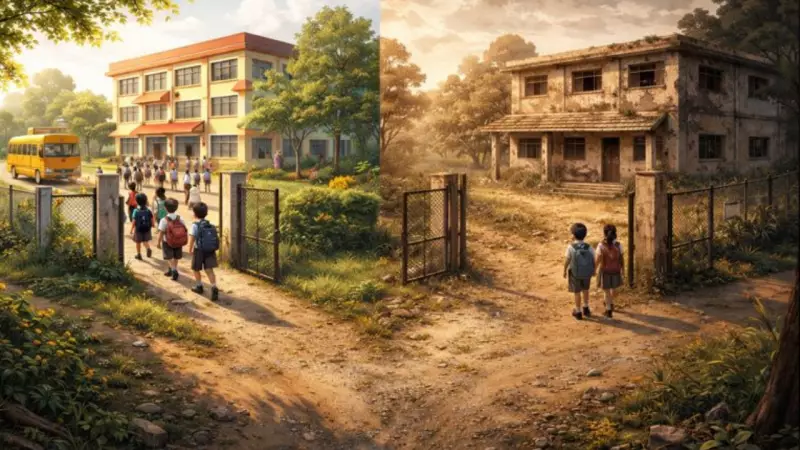
However, embedded within this vast scale is a troubling contradiction. In the same year, 65,054 government schools across India reported having zero students or fewer than ten students. This figure represents a sharp 24 per cent increase in just two years. This is not a picture of wholesale abandonment but of a system thinning unevenly.
The paradox deepens when examining staffing. These near-empty institutions together had 144,238 teachers posted to them. On average, that's more than two teachers per school where there are barely any children to teach. This is a structural mismatch between where India's students are and where its education workforce remains anchored.

A State-by-State Breakdown of the Imbalance
The national imbalance becomes even sharper when examined state by state.
West Bengal sits at the top, with 6,703 low-enrolment schools employing 27,348 teachers. This is striking as the state remains overwhelmingly dependent on government schools for enrolment. The data suggests a deep internal skew where students cluster into fewer institutions while staffing remains spread out.
In Uttar Pradesh, the number of near-empty schools jumped from 4,556 in 2022-23 to 6,561 in 2024-25. Teachers in such schools surged from around 17,000 to over 22,000. Here, the rise coincides with rapid private school expansion, indicating families are moving faster than the system can adjust.
Other states show varied patterns:
- Maharashtra shows steady increases in low-enrolment schools with fluctuating teacher numbers, suggesting piecemeal redeployment.
- Rajasthan displays volatile year-to-year swings, pointing to unstable restructuring attempts.
- Karnataka appears in a holding pattern, with low-enrolment schools plateauing at over 5,300 and teacher numbers static, normalizing inefficiency.
- Telangana shows rising empty schools but teacher postings not keeping pace, indicating a more responsive redeployment approach.
States like Madhya Pradesh and Uttarakhand highlight the access dilemma, where high teacher numbers in shrinking schools raise questions about preserving access in remote areas versus political difficulty of closures.
Why Staffing Lags Behind Demographic Reality
The core of the problem lies in institutional inertia. School closures and mergers are politically sensitive and administratively slow. Teacher transfers are governed by rigid rules, union negotiations, and service protections that prioritize job stability over system responsiveness. This institutional delay is compounded by migration, falling fertility, urban concentration, and parental choice.
The result is an undeniable paradox: India's government school system still educates the majority of the nation's children, but it is increasingly staffed for classrooms that, in thousands of locations, no longer exist in practice. This is a costly misalignment—fiscally, administratively, and pedagogically.
Clustering Within and Exit to Private Schools
The enrolment map explains why this isn't a side-story. Government schools hold a clear majority nationally, especially in an eastern axis including West Bengal, Bihar, Jharkhand, and Odisha. Here, public schooling is "the main tent," not just a safety net.
Children have not exited government schooling en masse. Instead, they have clustered into fewer, preferred institutions—often larger or better-functioning schools—leaving a long tail of smaller schools quietly bypassed. West Bengal epitomizes this: it relies heavily on government schools yet has the country's highest number of near-empty ones.

Meanwhile, in a growing set of states, private schools now lead enrolment. Manipur, Nagaland, and Puducherry show private provision as the default. More consequentially, large states like Telangana, Haryana, and Uttar Pradesh (where private schools enrol over 22 million students) have crossed a threshold where families are bypassing the government system itself.
A System at a Crossroads
The data presents an awkward truth. Government schools are still the national mainstay, yet thousands stand nearly empty. The rise of near-empty schools alongside stable or rising teacher postings signals a dangerous misalignment where enrolment is reorganizing faster than administration can follow.
The lag is now measurable and expensive, risking the normalization of inefficiency and dissolved accountability. The policy choice is now unavoidable. Governments must either redraw the school map carefully and transparently, with access safeguards, or continue funding a system that looks comprehensive on paper but functions unevenly on the ground.