Gujarat Launches Comprehensive Education Overhaul Following PARAKH Assessment Findings
Ahmedabad: The Gujarat government is embarking on a transformative journey to revamp its entire education system after the recently released Performance Assessment, Review, and Analysis of Knowledge for Holistic Development (PARAKH) Rashtriya Sarvekshan 2024 exposed substantial learning deficiencies across primary and secondary classes in government schools throughout the state.
Assessment Triggers Systemic Transformation
State officials have confirmed that the PARAKH assessment results will serve as the catalyst for a complete overhaul of teaching methodologies, evaluation systems, and student management practices across all government educational institutions. The government has explicitly stated its intention to use these findings to fundamentally transform how education is delivered and monitored at every level.
Weekly Cabinet Reviews and Priority Shifts
As part of this renewed commitment to educational excellence, sources reveal that Gujarat's top administrative officials have instituted a new protocol where every Wednesday, the state cabinet will select one social or health indicator for detailed examination and analysis. This initiative will commence with an intensive review of learning outcomes in government schools, signaling the administration's heightened focus on educational quality.

School-level reforms and the comprehensive restructuring of secondary education have now been elevated to the highest priority on the government's agenda, reflecting a strategic shift toward addressing foundational educational challenges.
Access Versus Achievement: The PARAKH Revelation
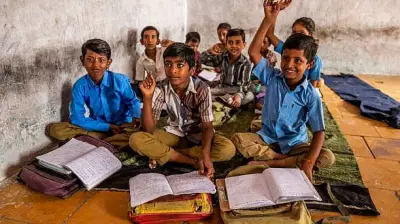
Over several decades, Gujarat has dramatically expanded its educational infrastructure, establishing 53,604 institutions across 34 districts, staffed by 3.98 lakh teachers serving approximately 1.16 crore students. While access to primary education has become nearly universal throughout the state, the PARAKH assessment uncovered a troubling disconnect between enrollment and actual learning.
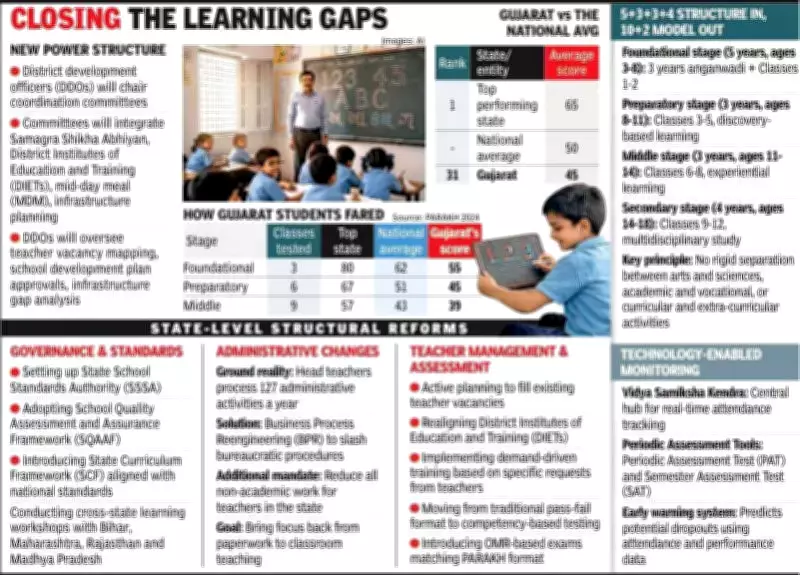
The survey found Gujarat's overall "learning among children" average at 45, significantly below the national average of 50, highlighting that mere access to schools has not translated into meaningful educational achievement for students.
Decentralization and Structural Reforms
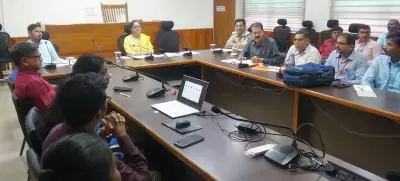
As part of its comprehensive course correction strategy, the Gujarat government is implementing substantial decentralization measures. District Development Officers (DDOs) will now chair coordination committees that unify previously separate functions including primary and secondary education wings, District Institutes of Education and Training (DIETs), the mid-day meal scheme, and infrastructure planning—all previously centralized at the state level.
Addressing the Secondary School Shortage
A critical imbalance the government aims to rectify is the substantial supply gap between primary and secondary educational institutions. Gujarat currently operates 40,203 government elementary schools but only 13,401 secondary schools, creating a severe bottleneck in educational progression.
Officials acknowledge that this structural mismatch accelerates the dramatic decline in government school enrollment at secondary levels. Senior administrators confirm the state is actively considering expanding secondary school infrastructure to prevent students from migrating to private institutions during these crucial educational transitions.
The Public-Private Enrollment Shift
The PARAKH assessment data reveals a striking pattern in school enrollment dynamics. Government schools dominate the elementary education stage, operating approximately 80% of institutions and enrolling over 70% of students. However, this landscape undergoes a complete reversal at secondary and higher secondary levels, where only 17% of schools are government-run, enrolling barely 8% of students, while private and aided institutions account for the overwhelming majority.

Concerning Learning Trajectory
Internal audits combined with PARAKH learning scores have intensified the urgency for reform. Among 1.04 lakh students tested across 3,899 schools in Classes 3, 6, and 9, Gujarat demonstrates a continuous academic decline—recording average scores of 55 in Class 3, 45 in Class 6, and 39 in Class 9, indicating a progressive deterioration in learning outcomes as students advance through the system.
Enhanced Monitoring and Early Intervention
District Development Officers will assume expanded responsibilities including monitoring teacher vacancies, approving comprehensive school development plans, tracking infrastructure deficiencies, and utilizing the district Vidya Samiksha Kendra's early warning system. This innovative mechanism, based on detailed attendance pattern analysis, will help identify and support potential dropouts before they leave the education system entirely.
Learning from Other States
To avoid reinventing established solutions, Gujarat is systematically studying educational reforms implemented in Bihar, Maharashtra, Rajasthan, and Madhya Pradesh. One particularly promising initiative adopted from Maharashtra is the "Mothers' Group" model—a community-driven mechanism where mothers actively monitor children's transition from anganwadis and track their foundational literacy progress, creating valuable home-school connections.
Alignment with National Education Policy
Gujarat has already aligned its educational framework with the National Education Policy 2020's innovative 5+3+3+4 structure, moving away from the traditional 10+2 model toward competency-based, experiential, and multidisciplinary learning approaches. This shift eliminates rigid separations between arts and sciences, fostering more holistic educational development for all students.