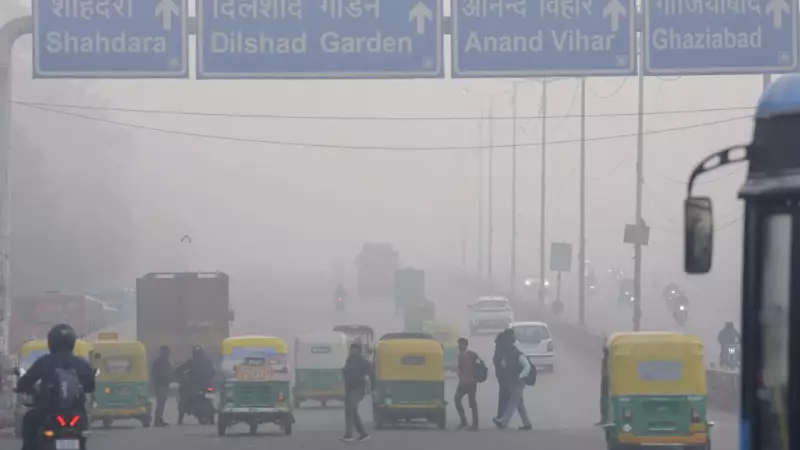
In a decisive move to protect young children from toxic air, the Delhi government on Monday mandated a shift to complete online education for all students up to Class V. The order comes as the national capital grapples with a dense blanket of smog, with air quality indices touching alarming levels.
Government Directive for Schools
The Directorate of Education (DoE) issued a circular, discontinuing physical classes for nursery to Class V students with immediate effect. This directive applies uniformly to all government, government-aided, and private recognised schools across Delhi. The order will remain in force until further notice.
School authorities have been instructed to ensure the seamless availability of online teaching for these younger students and to communicate the change promptly to parents and guardians. However, classes for students of Class VI and above will continue in their current hybrid or physical mode as per guidelines issued on December 13. District and zonal education officers are tasked with overseeing the smooth execution of these new directions.

Severe Air Quality Crisis Grips Capital
The decision was triggered by a severe and persistent deterioration in Delhi's air quality. On Monday, the city's average Air Quality Index (AQI) soared to 498, perilously close to the maximum possible reading of 500. Monitoring data painted a grim picture, with 38 stations recording 'severe' air quality and two reporting 'very poor' levels.
The Jahangirpuri area recorded the worst AQI at 498. This follows Sunday's AQI of 461, which was recorded as the most polluted day this winter and the second-worst December day in the city's history. Residents reported widespread issues including breathlessness and significantly reduced visibility.
Understanding the AQI Scale and Health Risks
As per the Central Pollution Control Board, an AQI from 401 to 500 is classified as 'severe', posing serious health risks to the entire population. The scale categorises 0-50 as 'good', 51-100 as 'satisfactory', 101-200 as 'moderate', 201-300 as 'poor', and 301-400 as 'very poor'. The current 'severe' level is particularly dangerous for children, the elderly, and those with pre-existing health conditions.
The Air Quality Early Warning System's forecast offers little respite, predicting that Delhi's air is likely to remain in the 'severe' category, with 'very poor' conditions expected over the next six days. This pattern is typical for the capital during winter, when meteorological conditions trap pollutants.
Precautions and Broader Implications
Authorities have advised all citizens to take necessary health precautions. The shift to online schooling for the youngest learners is a key preventive measure aimed at reducing their exposure to the hazardous outdoor environment. The situation underscores the ongoing public health challenge posed by annual pollution peaks in the Delhi-NCR region and highlights the need for sustained, long-term solutions to the air quality crisis.