CBSE Class 10 Mathematics Paper Triggers Widespread Second Exam Applications
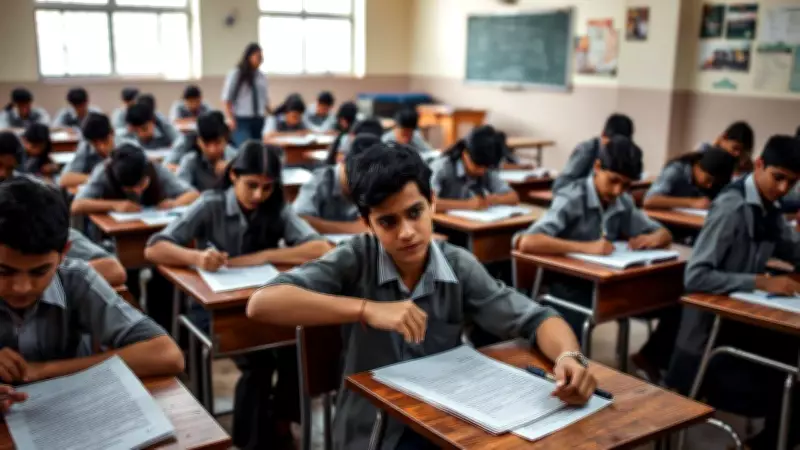
This year's Central Board of Secondary Education (CBSE) Class 10 results have left a substantial number of students and parents dissatisfied, primarily due to an unexpectedly difficult mathematics examination. The challenging paper has catalyzed an unprecedented surge in applications for the board's newly introduced second exam opportunity, scheduled for May.
Significant Portion of Students Opt for Betterment Round
Across numerous schools in Mumbai and the broader Pune region, principals report that between 20% and 35% of their Class 10 students are choosing to participate in the betterment round. This decision is largely motivated by the desire to recover marks lost in mathematics and science, subjects that adversely affected otherwise strong academic performances.
Hari Vashishtha, principal of DPS Navi Mumbai, highlighted the regional impact. "The mathematics and science papers were comparatively quite difficult this year. The Pune region, which encompasses all of Maharashtra and traditionally ranks among the top five, has been pulled down to the seventh position this time," he explained. "Approximately 20% of students in my school will undertake betterment in these subjects, while in other institutions, the figure is closer to 30-35%."

Student Experiences Reflect Broader Trends
The case of Vivaan Awasthi, a Class 10 student from DPS Nerul, exemplifies the widespread issue. Anticipating a top score in mathematics, Vivaan fell short due to the paper's complexity. His father noted, "A five-mark question was extremely difficult, and no one was able to solve it effectively. We have decided to pursue revaluation and also sit for the second round of exams for mathematics and science."
Such scenarios are far from isolated. Avnita Bir, director-principal of R N Podar School, observed that the scale of uptake has exceeded expectations. "More students are opting for betterment than we initially anticipated. Many bright and performing students saw their averages brought down by mathematics, prompting them to take the second round," she stated.
Pre-Result Applications and Teacher Insights
Kalpana Dwivedi, principal of Bal Bharati Public School in Kharghar, revealed that nearly a quarter of students had already applied for the second exam before the results were officially declared. She expects the final numbers to settle between 25% and 30%.
Mathematics teacher Naresh Singh from a city school provided further context, noting that many students in his class struggled to score well. "Some questions were completely out of the syllabus, and a few others were presented in a twisted manner that many students found difficult to comprehend," he explained.
Flexibility and New Exam System Provisions
The CBSE has introduced notable flexibility for the second exam. A notification issued on Wednesday clarified that students who initially appeared for the 'Standard' level mathematics paper may opt for the 'Basic' level in May, and vice versa.
This new dual-exam system permits students to reattempt up to three subjects, with the higher score being retained. This effectively softens the traditionally 'one-shot' nature of board examinations, offering a safety net for those underperforming.
Subject-Specific Trends and Common Choices
Despite the broader options available, subject trends remain telling. Rashmi Panagriha, principal of Skyline School, confirmed, "Mathematics and science are the most common choices for the second round." Students can seek improvement in up to three subjects, specifically science, mathematics, social science, and languages.
The introduction of the second exam represents a significant shift in the CBSE's examination approach, providing students with an opportunity to enhance their scores and mitigate the impact of a single challenging paper. However, the high uptake rates this year underscore the profound effect the difficult mathematics examination has had on student outcomes and confidence.