Statewide Demonstrations Against UGC Equity Committee Mandate Intensify
For the second consecutive day on Wednesday, protests demanding the immediate withdrawal of new University Grants Commission (UGC) regulations swept across Uttar Pradesh, with significant demonstrations reported in multiple cities including Lucknow, Prayagraj, Varanasi, Kanpur, Deoria, Rae Bareli, and Kaushambi. The contentious regulations make it compulsory for all higher education institutions to establish equity committees comprising members from OBC, SC, and ST communities to address discrimination complaints and foster inclusion.
Student Outcry in Lucknow and Beyond
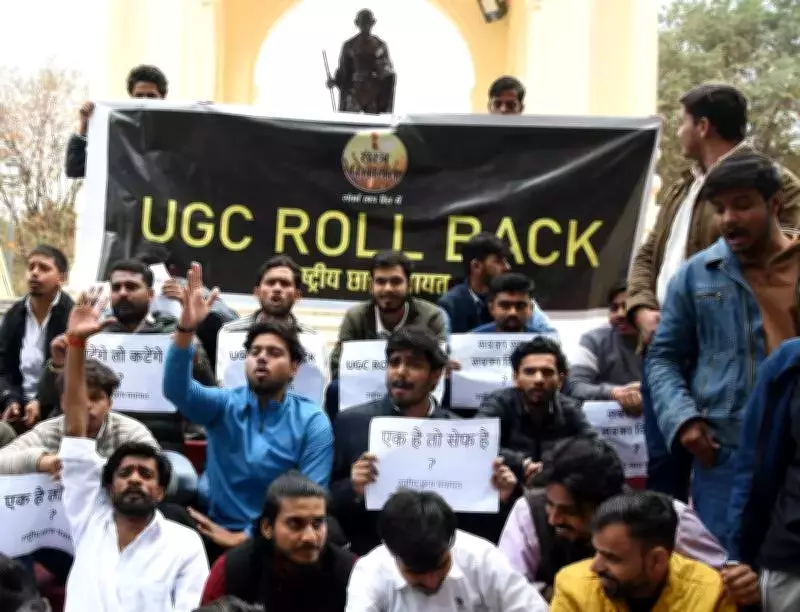
In the state capital Lucknow, students affiliated with the Chhatra Panchayat gathered at the Gandhi statue in Hazratganj, voicing strong opposition to what they termed as divisive policies. The protesters argued that the new rules are detrimental to student interests and would artificially create divisions within university campuses that currently function harmoniously.
Chanting slogans such as "UGC Roll Back," "Bantenge Toh Katenge," and "Ek Hain Toh Safe Hain," the demonstrators accused the UGC of promoting discriminatory measures under the guise of equality. They contended that the regulations unfairly target students from the general category while overlooking the economic challenges many within this group face.

Chhatra Panchayat president Shivam Pandey expressed his concerns, stating, "This black law is unacceptable. While the Prime Minister emphasizes unity, these regulations threaten to poison the atmosphere on university campuses. Students currently interact without awareness of each other's surnames, studying and dining together in harmony. This politically motivated legislation appears designed to sow division among students."
Protesters also highlighted the absence of provisions to penalize false complaints, warning that this omission could lead to potential misuse of the grievance mechanisms.
Multi-City Student Mobilization
In Prayagraj, numerous students representing various student organizations assembled at the Chhatra Sangh Bhawan on the Allahabad University campus, echoing similar concerns. They asserted that the new UGC regulations would negatively impact the rights of general category students and lacked adequate safeguards against potential abuse through fabricated complaints.
Varanasi witnessed protests from students of Banaras Hindu University and Mahatma Gandhi Kashi Vidyapeeth, who threatened to escalate their movement if the regulations are not revoked. When agitated students attempted to enter the district headquarters, police intervention at the main gate prompted them to stage a sit-in demonstration, raising slogans against the government.
Students questioned the composition of the proposed grievance redressal committees, noting that while OBC, SC-ST, and disabled members were made mandatory, no provision existed for representation from upper caste communities. "If the bill genuinely aims for equality, representation from the upper caste community should also be mandatory to prevent future allegations of discrimination," remarked one student protester.
Kanpur saw students from Chandra Shekhar Azad University of Agriculture and Technology protesting with black bands on their hands and black flags, followed by a foot march from Karpuri hostel to Company Bagh intersection. In a separate symbolic protest, some individuals from upper caste backgrounds shaved their heads in opposition to the UGC regulations.
Legal Community Joins the Fray
The legal community in Prayagraj significantly amplified the protest movement, with a section of Allahabad High Court lawyers issuing a 48-hour ultimatum to the government for withdrawing the recently introduced UGC equity regulations. Threatening to launch a broader public movement, the lawyers staged a protest at Ambedkar crossing near the high court, where they raised slogans, burned copies of the UGC regulation, and demanded the withdrawal of what they described as divisive measures.
The protest was led by former joint secretary of the High Court Bar Association, Ashutosh Tiwari, with active participation from prominent lawyers including Shashi Dwivedi, Brijesh Singh Senger, Ashutosh Shukla, and Krishna Mohan Pandey.

Widespread Discontent Across Districts
In Deoria, scores of people led by Pritam Mishra, president of the Deoria Collectorate Bar Association, staged a sit-in protest on the district court premises, adding legal weight to the growing opposition.
Rae Bareli witnessed political ramifications as Shyam Sundar Tripathi, president of the BJP Kisan Morcha's Salon mandal, resigned from his position in protest against the new UGC regulations. In his resignation letter dated January 25 addressed to the prime minister and party leaders, Tripathi expressed dissatisfaction with what he termed "harmful" and "divisive" rules.
Kaushambi gained attention through a viral social media video showing a protest by a local office-bearer of the 'Savarna Army.' Abhishek Pandey, the district head of the organization, wrote a letter to Prime Minister Narendra Modi using his own blood, describing the new regulations as a "black law."
The coordinated protests across educational, legal, and political spheres indicate deepening resistance to the UGC's equity committee mandate, with participants demanding comprehensive reconsideration of regulations they believe could fundamentally alter campus social dynamics and institutional fairness mechanisms.