Supreme Court Halts Implementation of UGC's 2026 Equity Regulations
The Supreme Court of India, in a significant ruling on Thursday, has stayed the implementation of the University Grants Commission's (UGC) 2026 equity regulations. The bench, comprising Chief Justice of India Surya Kant and Justice Joymalya Bagchi, directed that the 2012 equity regulations shall remain in force until further orders. This decision comes amidst widespread protests and concerns regarding the new rules, which were notified earlier this month to address discrimination, including caste-based discrimination, in higher education institutions across the country.
Background and Immediate Impact
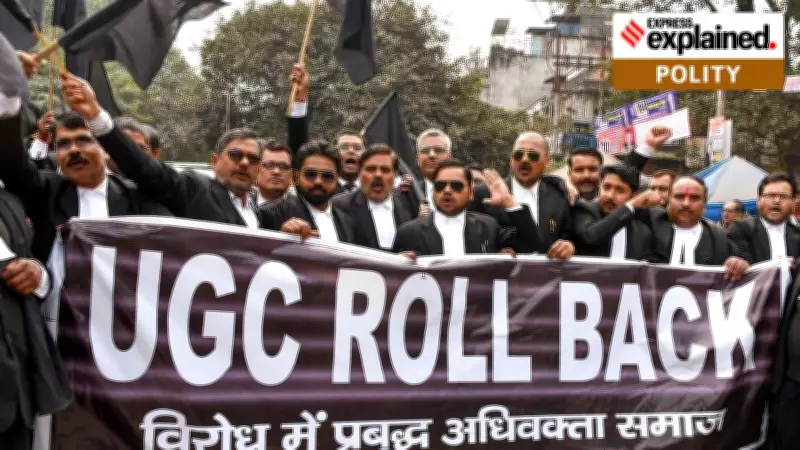
The 2026 regulations were designed to replace the commission's 2012 equity guidelines. However, they sparked immediate backlash from various student groups who argued that the new rules could potentially create divisions based on caste and lead to what they termed as "harassment" against students from the general category. Advocates from the Allahabad High Court were among those who held protests against the UGC Bill 2026, highlighting the contentious nature of these regulations.
The Supreme Court's intervention has put a temporary halt to these regulations, ensuring that the older, more established 2012 guidelines continue to govern anti-discrimination measures in universities and colleges. This stay order provides a breathing space for stakeholders to reassess the implications of the new rules.

Key Differences Between 2012 and 2026 Regulations
The core of the debate revolves around how the two sets of regulations define and address discrimination. Here are the primary areas where they diverge:
Definitions of Discrimination
2012 Regulations: The older guidelines define "discrimination" in a broad manner, encompassing unfair treatment based on religion, race, caste, gender, place of birth, disability, language, and ethnicity. Additionally, they separately define terms like "harassment", "victimisation", and "ragging", providing a comprehensive framework to address various forms of misconduct.
2026 Regulations: In contrast, the new rules introduce a separate definition for "caste-based discrimination" under section 3(1)(c), specifying it as discrimination only on the basis of caste or tribe against members of the Scheduled Castes, Scheduled Tribes, and Other Backward Classes. Discrimination in general is defined under section 3(1)(e) as any unfair treatment on grounds of religion, race, caste, gender, place of birth, or disability, but it omits language and ethnicity.
Justice Bagchi raised critical questions about this separation, noting, "We fail to understand when 3(1)(c) is already ingrained in 3(1)(e), why it was culled out as a separate definition clause?" This redundancy has been a point of contention, with the bench questioning whether it aligns with the constitutional mandate under Article 15(4), which empowers the state to make special laws for SCs and STs.
Specific Forms of Discrimination
2012 Regulations: These guidelines provide a detailed list of specific acts that constitute discrimination, harassment, or victimisation. This includes:
- Breaching reservation policies in admissions.
- Discrimination in processing applications.
- Limiting access to benefits for students.
- Announcing students' caste, tribe, religion, or region.
- Labeling students as "reserved category".
- Passing derogatory remarks based on caste or background.
- Earmarking separate seats or facilities.
- Discrimination in evaluating exam papers.
- Segregating students in hostels, mess, or common rooms.
- Ragging targeted at specific sections of students.
2026 Regulations: The new rules omit this exhaustive list. Instead, they task the "equal opportunity centre" within each institution to prepare and disseminate an illustrative list of acts that shall be construed as discrimination. This shift has raised concerns about consistency and clarity in identifying discriminatory practices.

Chief Justice Surya Kant expressed apprehension about provisions related to hostels, stating, "Another provision which I am finding is an indication among the measures you are taking, you are speaking of separate hostels. For God's sake, don't do that. We have lived in hostels. Every community has students living together. We have developed inter-caste marriages also. We should move forward to develop a casteless society."
Punitive Actions and Monitoring Mechanisms
2012 Regulations: The older guidelines did not specify punitive actions for non-compliant institutions, relying more on preventive and corrective measures.
2026 Regulations: The new rules introduce stricter consequences. Institutions that fail to comply can be debarred from participating in UGC schemes, offering degree and online programmes, or receiving central grants. Additionally, the UGC is required to establish a monitoring mechanism and a national-level committee to oversee implementation, ensuring greater accountability.
Equal Opportunity Centres and Procedures
2012 Regulations: These guidelines provided for the establishment of "Equal Opportunity Cells" but did not detail their composition, functions, or procedures for handling discrimination cases. They applied broadly to "students belonging to marginalised sections, including SC/ST students" without specifically mentioning OBCs.
2026 Regulations: The new version mandates "Equal Opportunity Centres" with "equity committees" that must include representation from OBCs, Persons with Disabilities, SCs, STs, and women. It also outlines specific procedures and timeframes for reporting and addressing incidents of discrimination, along with requirements for equity helplines and "equity squads".
Origins of the New Regulations
The 2026 regulations were formulated following a plea in the Supreme Court filed by Radhika Vemula and Abeda Salim Tadvi, the mothers of Rohit Vemula and Payal Tadvi. The petitioners advocated for regulations that focus on discrimination against SC, ST, and OBC individuals, suggesting that specific aspects from the 2012 guidelines be incorporated. In an April 2025 order, the court expressed confidence that the UGC would notify the regulations after considering stakeholder suggestions, but the current stay indicates unresolved issues.
Conclusion
The Supreme Court's decision to stay the 2026 UGC equity regulations underscores the complexities involved in framing anti-discrimination policies in India's higher education sector. While the new rules aimed to address specific concerns, their departure from the 2012 guidelines in terms of definitions, specificity, and punitive measures has led to legal and social challenges. As the 2012 regulations continue to apply, stakeholders await further judicial clarity on how to balance equity, inclusion, and constitutional principles in creating a discrimination-free academic environment.