NITK Surathkal Hosts Dynamic National Science Day Celebrations
Mangaluru witnessed a significant celebration of scientific inquiry as the National Institute of Technology Karnataka (NITK) in Surathkal observed National Science Day on Friday. The event featured a comprehensive program of lectures, exhibitions, and interactive sessions that engaged students from schools across Dakshina Kannada and Udupi districts.
Keynote Address on Animal Navigation and Climate Impact
Professor Maria Thaker from the Centre for Ecological Sciences at the Indian Institute of Science (IISc), Bengaluru, delivered the keynote address. She presented fascinating insights into how animals navigate complex landscapes, exploring whether they rely on mental maps to traverse forests and savannas.
Drawing from extensive fieldwork conducted in both South Africa and India, Professor Thaker detailed the sophisticated technologies used in modern ecological research. GPS collars, radio tracking systems, satellite data analysis, and temperature sensors have revolutionized the study of large mammals, particularly elephants.

She highlighted a crucial climate connection: rising temperatures are altering animal movement patterns, with elephants demonstrating accelerated movement to reach essential water sources during heat stress.
Professor Thaker also outlined her team's ambitious seven-year research project mapping mesocarnivores in the Deccan Plateau savanna. This comprehensive study aims to understand predator movement dynamics and broader ecosystem interactions in this unique habitat.
Interactive Student Engagement and Leadership Perspectives
Students from 21 participating schools actively engaged in an extended interactive session with Professor Thaker. They posed thoughtful questions about animal empathy and the practical challenges of field research, which she addressed in detail, fostering meaningful scientific dialogue.
In his inaugural address, NITK Director B. Ravi emphasized that curiosity and creativity remain fundamental drivers of scientific progress. He articulated the vital connection between scientific advancement, engineering innovation, and national development objectives, specifically referencing the Viksit Bharat vision for a developed India.
Director Ravi also discussed the expanding role of artificial intelligence in educational contexts and highlighted NITK's significant contribution to the Virtual Labs initiative. This innovative program enables remote access to laboratory experiments, democratizing scientific education across geographical barriers.
Vibrant Science Exhibition and Competitive Elements
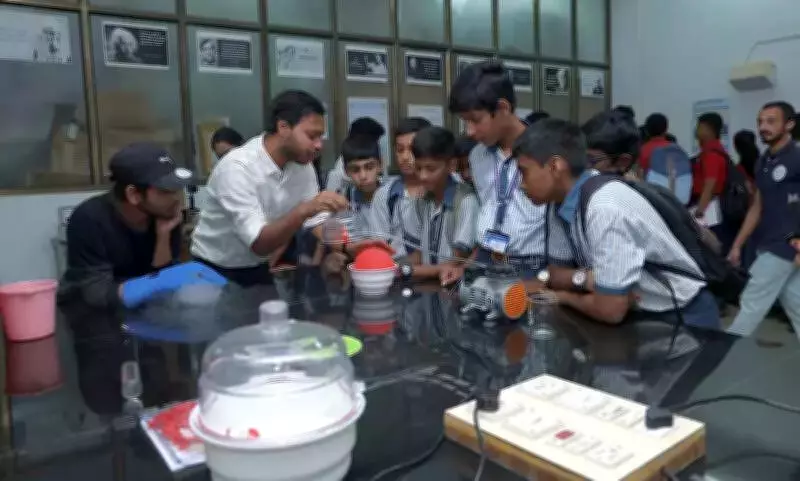
The celebration featured a comprehensive science exhibition showcasing over 30 live demonstrations presented by research scholars and Master's students from multiple departments. The Physics, Chemistry, and Mathematical & Computational Sciences departments contributed diverse exhibits that captivated attendees.
Notable demonstrations included holography displays, operational Tesla coils, line-following robots, chemical clock reactions, fluorescence experiments, communication systems, mathematical puzzles, and cryptography applications. Each exhibit provided hands-on learning opportunities about fundamental scientific principles.
The event concluded with an inter-school science quiz competition that tested participants' knowledge across scientific disciplines, followed by a certificate distribution ceremony recognizing student participation and achievement.
National Science Day is observed annually on February 28th to commemorate the groundbreaking discovery of the Raman Effect by Nobel laureate Sir C.V. Raman, celebrating India's rich legacy of scientific achievement and inspiring future generations of researchers.