ICAR-NDRI Holds 22nd Convocation, Honors 253 Students with Degrees
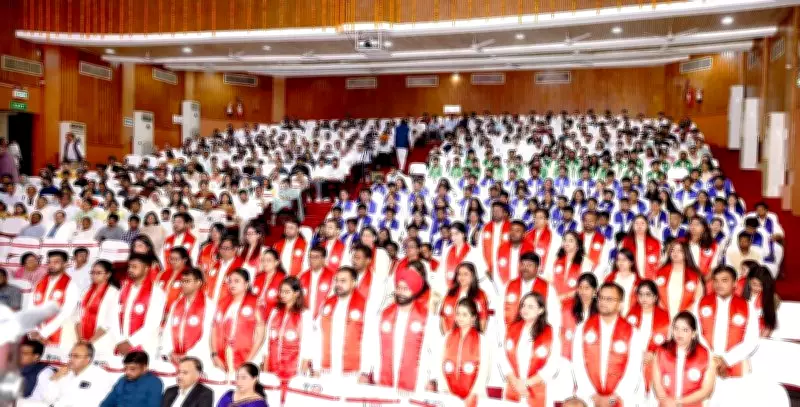
The 22nd Convocation of the ICAR-National Dairy Research Institute (ICAR-NDRI) was a momentous occasion held on Friday at the Dr D Sundaresan auditorium in Karnal. The event marked a significant milestone for 253 students who received their degrees, celebrating their academic achievements and stepping into new professional beginnings.
Chief Guest Highlights Dairy Sector's Economic Impact
Dr ML Jat, Secretary (DARE) and Director General of ICAR, served as the chief guest and delivered a keynote address that underscored the critical role of the dairy industry in India's economy. He revealed that dairy dominates the livestock sector, which is valued at Rs 17.25 lakh crore, contributing 65% of its output and driving 16% of India's Gross Value Added (GVA). This sector supports 46.1% of the population, highlighting its widespread socio-economic importance.
Dr Jat emphasized the government's commitment to bolstering this vital industry, noting that the Union Budget has allocated Rs 6,153 crore for animal husbandry, a 16% increase from previous allocations. This funding aims to recruit 20,000 veterinarians, subsidize colleges and laboratories, and provide cooperative tax relief, all part of the broader vision to power Viksit Bharat by 2047.

Milk Production Trends and Future Projections
In his speech, Dr Jat provided insights into India's remarkable growth in milk production, which has surged from 17 million tonnes in 1950 to 247 million tonnes in 2025. Uttar Pradesh leads in production, while Punjab and Haryana top the charts in yields. Looking ahead, NITI Aayog projects that demand for milk will reach 480 to 606 million tonnes by 2047, indicating substantial growth opportunities for the sector.
He detailed the contributions of various livestock to total milk production, with indigenous buffaloes leading at 31.18%, followed by crossbred cattle at 30.80%, indigenous cattle at 11.20%, non-descript cattle at 9.64%, non-descript buffaloes at 11.97%, goats at 3.32%, and exotic cattle at 1.89%. Dr Jat also praised circular crop-livestock models for advancing sustainable development goals, promoting economical, ecological, and societal growth.
NDRI's Legacy and Achievements Recognized
Dr Jat commended NDRI for its century-old legacy across campuses in Karnal, Bengaluru, and Kalyani, highlighting the institute's 100% placement rate and its innovative "Degree to Company" incubator, which commercialized 10 technologies last year. This recognition underscores NDRI's role as a premier institution in dairy research and education.
Degree Distribution and Special Honors
Dr Dheer Singh, Director of ICAR-NDRI, announced the awarding of degrees to the 253 students. This included 41 students in BTech Dairy Technology, 130 Master's students (79 boys and 51 girls), and 82 PhD scholars (48 boys and 34 girls). Additionally, the prestigious Doctorate of Science Degree was presented to Dr RS Paroda, former Secretary (DARE) and DG of ICAR, and Dr Harsh Kumar Bhanwala, former chairman of NABARD.
Special guests of honour at the convocation included Dr Raghavendra Bhatta, DDG (Animal Science), along with Dr RS Paroda and Dr Harsh Kumar Bhanwala, who added to the ceremony's significance.
Medal Awards for Academic Excellence
The convocation also recognized outstanding academic achievements through medal awards. Under the doctoral programme for 2024-25, Dr Abhijeet Fernandes from Animal Reproduction Gynaecology and Obstetrics received the gold medal, Dr Amit Thakur from Agricultural Economics was awarded the silver medal, and Dr Pasagadi Adiytasukumar from Dairy Engineering earned the bronze medal.
In the BTech Dairy Technology category for 2024-25, Kirti was honored with the gold medal, Harshvi received the silver medal, and Sree Hari S was awarded the bronze medal, celebrating their dedication and excellence in their studies.
This convocation not only celebrated the accomplishments of the graduates but also reinforced NDRI's commitment to advancing dairy science and contributing to India's agricultural and economic development.