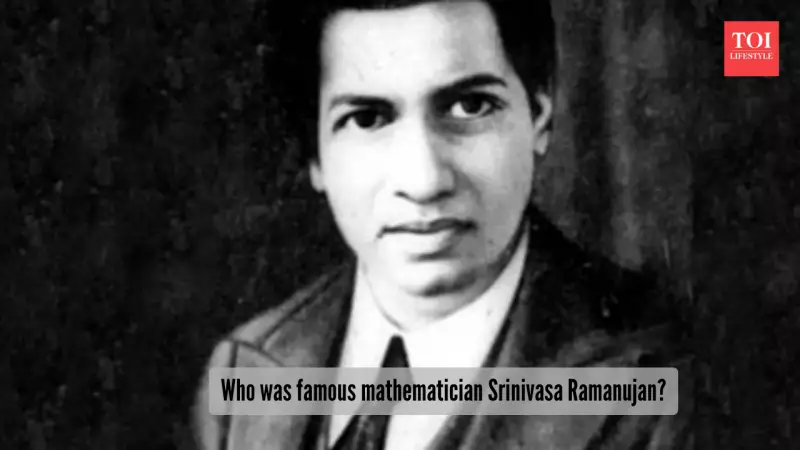
Every year on December 22, India turns its focus to the world of numbers, celebrating National Mathematics Day. This day is dedicated to honouring the life and monumental contributions of one of history's greatest mathematical minds, Srinivasa Ramanujan. His journey from a humble town in Tamil Nadu to the halls of Cambridge University remains a powerful testament to sheer brilliance and intuitive genius.
From Erode to Eternity: The Self-Taught Prodigy
Srinivasa Ramanujan was born on December 22, 1887, in Erode, Tamil Nadu, into a poor Brahmin family. From the age of ten, his fascination with mathematics became all-consuming, often leading him to neglect other subjects. His life changed at 16 when he encountered George Shoobridge Carr's book, 'A Synopsis of Elementary Results in Pure Mathematics'. This outdated book, filled with thousands of theorems, became his bible. Ramanujan didn't just read it; he verified every result and began creating his own original theorems.
Despite winning a scholarship to the University of Madras in 1903, his singular obsession with math caused him to lose it. Living in poverty in Kumbakonam, he continued his work, scribbling complex formulas on slate boards. This period of isolation was where his unique genius truly began to flourish, laying the groundwork for discoveries that would later stun the world.

Breakthroughs and the Historic Partnership with G.H. Hardy
In his twenties, Ramanujan began publishing papers that revealed his extraordinary command over areas like infinite series, continued fractions, and number partitions. His 1911 paper in the Journal of the Indian Mathematical Society sent shockwaves through the academic community. He had independently mastered complex concepts like the Riemann series and zeta functions, and even invented his own method for summing divergent series, now famously known as Ramanujan summation.
The turning point came in 1913 when he wrote to the renowned British mathematician G.H. Hardy. Initially skeptical of the unschooled Indian clerk's letters filled with unproven theorems, Hardy soon recognized the work of a pure genius. He arranged for Ramanujan to travel to Cambridge University in 1914. Despite struggling with the cold climate and poor health, their legendary partnership produced groundbreaking work in modular forms, analytic number theory, and the distribution of prime numbers.
A Divine Language: The Philosophy Behind the Numbers
For Ramanujan, mathematics was not merely a subject; it was a spiritual pursuit. He famously believed that "An equation has no meaning for me unless it expresses a thought of God." He saw zero as absolute reality and infinity as its myriad manifestations. His theorems, he claimed, were divine revelations, visions granted to him by the goddess Namagiri. This deep philosophical connection fueled his work, with his notebooks seamlessly blending complex mathematics with spiritual insight, even during his time in England.
A Legacy That Endures
Tragically, Srinivasa Ramanujan died of tuberculosis in 1920 at the young age of 32. However, his legacy was far from over. His personal notebooks, filled with thousands of unpublished results, continued to baffle and inspire mathematicians for decades. Concepts from his final letter to Hardy, known as the "mock theta functions," found unexpected applications in 21st-century physics, including the study of black holes.
In 2012, marking his 125th birth anniversary, the Government of India declared his birthday, December 22, as National Mathematics Day. This day is more than a tribute; it is a nationwide recognition of how one man's spark can ignite a global intellectual revolution. His life continues to inspire through books and films like 'The Man Who Knew Infinity', ensuring that the spirit of this unparalleled genius continues to ignite young minds across India and the world.