In a Kerala Village, Children Discover Learning Through Senses
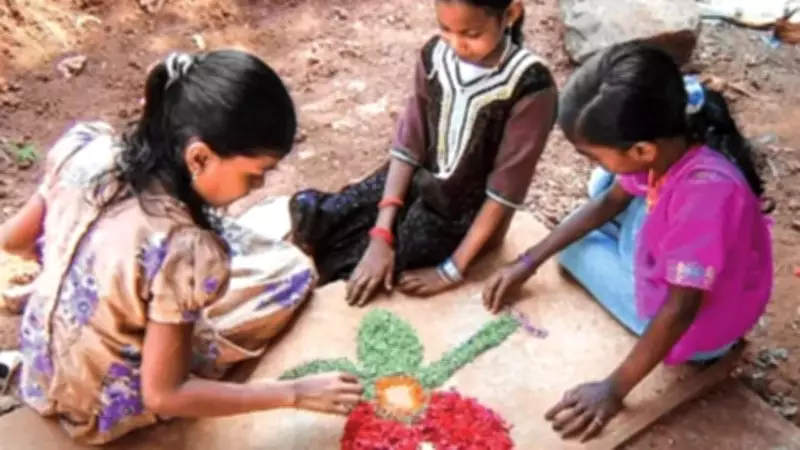
In the tranquil courtyard of Aruvacode village in Nilambur, filtered sunlight illuminates a remarkable scene. A group of children sits on the ground, surrounded by natural and simple materials: dry leaves, old magazine scraps, and six small cups of poster color. There is no blackboard, no teacher giving instructions, and no prescribed curriculum. Yet, within minutes, these young minds begin creating patterns, mixing colors intuitively to match the shades of fallen leaves around them.
The Philosophy of KB Jinan: Learning Without Teaching
This is not a conventional art workshop but part of a decades-long inquiry led by KB Jinan, a designer-turned-researcher who has spent more than thirty years questioning fundamental assumptions about how children truly learn. An alumnus of the prestigious National Institute of Design (NID) in Ahmedabad, Jinan was recently honored with the Pride of NID Ahmedabad Award 2025–26 for his groundbreaking work.
"Don't teach," Jinan advises adults observing from a distance. "Just respect their cognitive ability." For him, these village workshops capture the essence of what he has been articulating since the 1980s: genuine learning begins not with instruction but with sensory engagement with the world.

From Engineering Student to Educational Revolutionary
Jinan's journey began in Thrissur, where he grew up immersed in the rigid structures of formal education. Even as a student, he sensed something profoundly wrong with the system. While pursuing engineering, he began asking uncomfortable questions that would shape his life's work: Why does scientific knowledge predominantly carry Western names? Why do students chase marks rather than understanding? Why does learning seem to evaporate after examinations?
By his fourth year of college, he made a life-altering decision: he would never engage in work he did not genuinely love. This resolve led him to NID Ahmedabad, where he encountered something rare—a learning environment that felt truly alive. "NID taught me the difference between teaching and learning," Jinan reflects. "Elsewhere you find teaching environments. At NID, you find learning environments."
Discovering Indigenous Intelligence
Despite NID's freedom, Jinan felt it remained framed within Western paradigms of aesthetics and design. A decisive transformation occurred when he began working closely with rural artisans and indigenous communities in Odisha and other regions. Living among these communities, he encountered forms of intelligence largely absent from modern classrooms.
"The literate learn the word," he observes. "The illiterate learn the world." He witnessed how children in these communities moved freely, learning through observation, touch, and participation. Despite having fewer material possessions, they exhibited a psychological richness and contentment often missing in urban life.
The Critique of Modern Education
These experiences reshaped Jinan's thinking dramatically. He arrived at a stark conclusion: modern education does not cultivate complete human beings but produces what he terms "cognitive labor." Formal schooling, he argues, was never designed to nurture human potential but to manufacture workers for an expanding global marketplace.
"Education created cognitive workers—people trained to analyze information, not to understand life," Jinan states. He notes that for decades, this system supplied industries with disciplined minds, but artificial intelligence has now disrupted even that arrangement. "The market no longer needs this kind of labor. Machines can do it faster."
Documenting Natural Learning Patterns
Since the early 1990s, Jinan has meticulously documented children's natural interactions with spaces, objects, and materials through photography and film. Clear patterns emerged: children bounce on sofas because their bodies seek rhythm; they slide on smooth floors because the environment invites motion.

"The world tells the child what to do with it," he explains. "But adults interrupt this intelligence." In villages across Kerala and other parts of India, he began organizing annual workshops where children received simple materials and complete freedom. Without guidance, they often produced compositions of remarkable sophistication.
The Power of Intuition Over Instruction
When Jinan conducted the same color-mixing exercises with urban schoolchildren and even trained teachers, many struggled to match the intuitive abilities displayed by village children. This contrast convinced him that intuition, not instruction, lies at the heart of genuine learning.
He also noticed that children who had not experienced rigid schooling systems often lacked even a word for 'mistake.' They experimented freely, without fear of being wrong. "In life, there is no mistake," Jinan asserts. "There is only exploration."
Experimental Education and Parenting
Jinan later ran an experimental school in Pune for three years, centered on what he calls "cognitive autonomy." There were no toys, no rigid lessons, and no forced activities. Teachers transformed into learners, documenting what children naturally did.
Today, he conducts 'Do Nothing Parenting' sessions and immersive retreats where families live together without screens, toys, or instructions. Parents learn to observe instead of directing; children rediscover their innate capacity for play and inquiry.
"My workshops are not for children," Jinan clarifies. "They are for adults. Parents are the problem, not children." His approach reverses conventional parenting logic. Instead of trying to fix children, he asks adults to examine their own conditioning—their need to control, instruct, and optimize.
A Larger Question About Human Potential
In an educational system driven by speed, measurable outcomes, and market demands, Jinan's approach may appear marginal. Yet, by returning learning to the body, the senses, and everyday life, he poses a profound question: not about how children should be educated, but about what kind of humans society still allows them to become.
Every child, Jinan believes, arrives with inherent freedom, trust, and abundance—qualities that societal systems gradually dismantle. His work serves as a powerful reminder that true education might be less about filling minds with information and more about creating environments where natural intelligence can flourish.