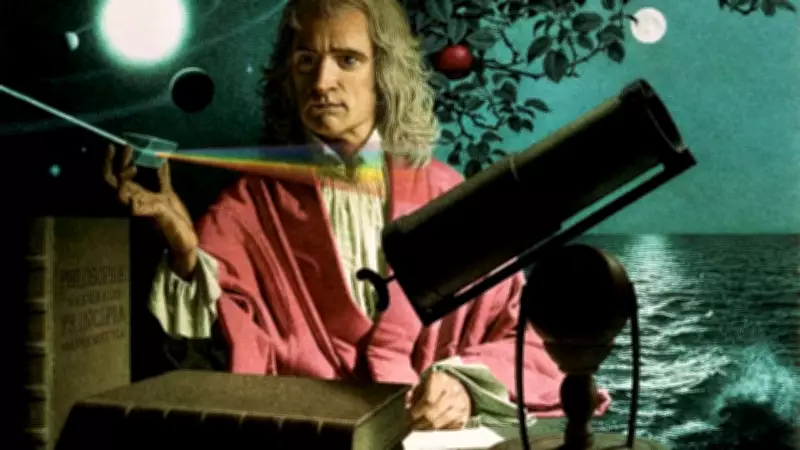
Beyond Gravity: The Hidden Life of Isaac Newton
Isaac Newton is universally celebrated as one of history's most pivotal scientists, yet the intricate details of his personal existence remain remarkably obscure to the general public. While he is immortalized for formulating the laws of motion, discovering gravity, and co-inventing calculus, the man behind these monumental contributions was far more complex than standard textbooks reveal.
The Man Behind the Science: A Troubled Beginning
Newton entered the world on Christmas Day in 1642, a frail and undersized infant whose father had already passed away. His mother's subsequent remarriage led to his abandonment with grandparents, a childhood separation that profoundly impacted his psychological development. This early trauma cultivated a shy, solitary disposition that persisted throughout his life. As a teenager, he documented furious sentiments toward his stepfather, revealing the intense and private nature that would characterize his adult years. Newton never married, largely eschewed social interactions, and dedicated the majority of his time to solitary scholarly pursuits.
From Farm to Fame: An Unlikely Path
At approximately fifteen years old, Newton's mother compelled him to abandon formal education and labor on the family farm. He found the agricultural work deeply unappealing and struggled with its demands. Fortunately, a former headmaster intervened, persuading his mother to permit his return to school. This pivotal decision paved the way for his enrollment at Trinity College, Cambridge, definitively leaving rural life behind and initiating a journey toward earth-shattering scientific revelations.

The Iconic Apple and Empty Lectures
In 1665, Cambridge University shuttered temporarily due to a plague outbreak, forcing Newton to retreat to his familial home, Woolsthorpe Manor. It was here, while observing an apple descend from a tree in the garden, that he conceived his foundational ideas about gravitational force. He later recounted this anecdote to William Stukeley, who published it in his 1752 memoir. Remarkably, the original apple tree still thrives at Woolsthorpe, and a segment of it was transported to the International Space Station in 2010 for the Royal Society's 350th anniversary.
Despite attaining the prestigious Lucasian Professor of Mathematics position at Cambridge in 1669, Newton's lectures were notoriously poorly attended. Students frequently absented themselves, and on occasion, no audience appeared whatsoever. Unperturbed, Newton prioritized his research, writing, and experimental endeavors over pedagogical duties, demonstrating a clear preference for intellectual exploration over instructional engagement.
Counterfeiting, Alchemy, and Secret Codes
In 1696, Newton assumed the role of Warden of the Royal Mint, later ascending to Master, tasked with safeguarding England's currency and apprehending counterfeiters. He conducted personal investigations, occasionally venturing into London's streets to pursue suspects. Several individuals he captured faced execution, and Newton himself received life-threatening intimidations. This governmental responsibility, starkly different from his scientific work, was executed with the same meticulous precision he applied to physics and mathematics.
Concurrently, Newton devoted extensive periods to alchemical studies, seeking the mythical philosopher's stone capable of transmuting base metals into gold. He maintained secrecy around these inquiries, encoding his notes. Furthermore, he meticulously analyzed biblical scriptures, probing for concealed cosmic messages. These clandestine pursuits illuminate a dimension of Newton fascinated by mysticism alongside empirical science.
Political Silence and Bitter Rivalries
Newton served as a Member of Parliament for Cambridge University during two separate terms: 1689–1690 and 1701–1702. Historical records indicate his parliamentary contributions were minimal; legend holds his sole spoken request was for a window to be shut due to cold draughts. Nonetheless, his tenure in London facilitated connections with influential figures like King William III and philosopher John Locke.

He engaged in a protracted and acrimonious dispute with German mathematician Gottfried Leibniz regarding the invention of calculus. Newton developed his version in the 1660s but delayed publication, whereas Leibniz published in the 1670s. Newton alleged plagiarism and, as President of the Royal Society, influenced a committee to affirm his precedence. Ironically, Leibniz's mathematical notation prevails in contemporary usage.
Knighthood, Extreme Habits, and Psychological Struggles
Queen Anne knighted Newton in 1705, following his inheritance of maternal property and publication of seminal works like Principia and Opticks. Upon his death in 1727, he was interred in Westminster Abbey alongside luminaries such as Charles Darwin and Charles Dickens, his knighthood symbolizing broad societal contributions beyond pure science.
Newton's work ethic was notoriously rigorous, often involving 18 to 20-hour daily stretches where he neglected sustenance and sleep. His detailed experimental notebooks reflect an obsessive, meticulous methodology that fueled revolutionary discoveries but also reinforced his reclusive reputation.
In 1693, he endured a severe psychological episode, frequently described as a nervous breakdown. After five consecutive sleepless nights, he temporarily lost grip on reality, suspecting friends like John Locke and Samuel Pepys of conspiring against him, underscoring profound mental and emotional vulnerabilities.
Prophecies and the Apocalypse
Newton invested considerable effort deciphering biblical prophecies, endeavoring to unravel hidden historical truths. He even attempted to calculate the world's potential demise, concluding the apocalypse would not occur before 2060 at the earliest. This esoteric interest confirms that Newton's intellectual curiosity extended far beyond conventional mathematics and physics into theological and prophetic domains.
These twelve facets collectively reveal Isaac Newton not merely as a scientific titan but as a multifaceted individual whose secret studies, extreme routines, and personal tribulations shaped his legendary legacy.