BHU Students Stage Massive Protest Demanding Implementation of UGC Equity Regulations
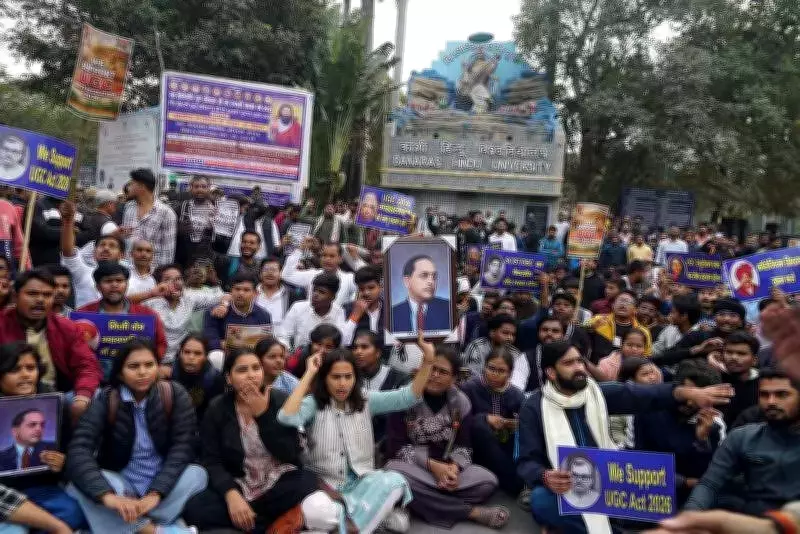
In a significant display of collective strength, hundreds of students from marginalized communities organized a powerful march at Banaras Hindu University in Varanasi on Tuesday afternoon. The demonstration, orchestrated under the banner of the SC/ST/OBC Ekta Manch, centered on the urgent demand for immediate implementation of the UGC (Promotion of Equity in Higher Education Institutions) Regulations, 2026.
Protest Escalates with Sit-In and Tense Campus Atmosphere
The protest escalated as participants staged a determined sit-in at the Mahila Mahavidyalaya gate, where their leader Shivam Sonkar declared that their agitation would persist until their demands were met. The campus atmosphere grew notably tense when a substantial gathering of students assembled near the historic Vishwanath Temple, prompting immediate response from university authorities and law enforcement.
University proctorial board officials were placed on high alert, with substantial police forces and Provincial Armed Constabulary (PAC) units deployed across the campus to maintain order. The protesting students, representing Scheduled Castes, Scheduled Tribes, and Other Backward Classes, marched energetically toward BHU's Lanka gate, their route passing significant landmarks including the Vice-Chancellor's lodge and Bharat Kala Bhawan.

Charter of Demands Submitted to University Administration
Upon reaching the Mahila Mahavidyalaya crossing, the demonstrators established their protest site near the Saraswati statue and formally presented their comprehensive charter of demands to university administrators. This detailed document outlined several critical requirements for institutional reform:
- Immediate establishment and official notification of an Equal Opportunity Centre (EOC) within the university, fully compliant with the UGC (Promotion of Equity in Higher Education Institutions) Regulations, 2026.
- Formation of an equity committee with proper representation as mandated by regulations, ensuring inclusion of SC, ST, OBC, women, and disabled representatives.
- Public disclosure of EOC details, equity committee information, complaint procedures, implementation timelines, and contact information on the university's official website.
- Mandatory orientation and sensitization programs addressing caste discrimination, micro-aggressions, and constitutional values for all faculty members, administrative officers, and university staff.
- Transparent preparation and timely submission of university-level reports to the University Grants Commission regarding equity implementation progress.
Highlighting Systemic Discrimination in Higher Education
Protest speakers powerfully articulated the persistent structural caste discrimination prevalent within higher education institutions across India. They detailed how, for multiple decades, students, researchers, teaching faculty, and administrative staff from SC, ST, and OBC backgrounds have endured systematic humiliation, social exclusion, subtle micro-aggressions, and psychological harassment throughout various institutional processes.
These discriminatory practices reportedly manifest across critical areas including:
- Admission procedures and academic evaluations
- Research opportunities and fellowship allocations
- Hostel accommodations and residential facilities
- Faculty appointments and professional promotions
The student leaders substantiated their claims by referencing authoritative studies, including the influential Thorat Committee Report from 2007 and comprehensive research conducted by IIT-Delhi in 2019. They argued that subtle discrimination often masquerades under the guise of so-called merit and reserved category classifications, creating environments that negatively impact students' mental health and contribute to concerning dropout rates and tragic suicide incidents among marginalized student populations.

The protest at Banaras Hindu University represents a growing movement within Indian higher education institutions, where students from historically disadvantaged communities are increasingly demanding institutional accountability, equitable treatment, and the full implementation of regulatory frameworks designed to promote genuine inclusion and social justice in academic environments.