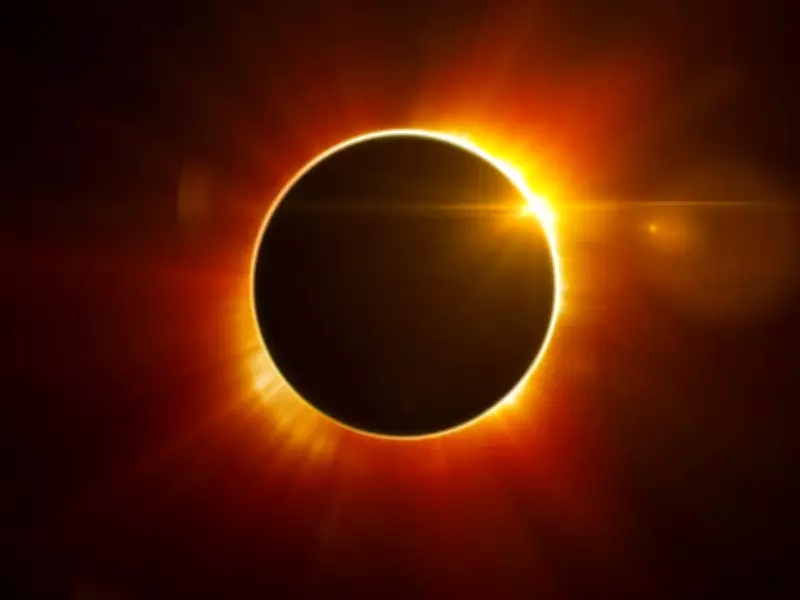
Solar Eclipse 2026: Annular 'Ring of Fire' Event Not Visible from India
When news of an approaching solar eclipse spreads, students across India naturally ask: Will it be visible from our country? Today, on February 17, 2026, the first solar eclipse of the year will occur—an annular solar eclipse that, unfortunately, will not be visible from Indian skies.
Understanding the Solar Eclipse Phenomenon
A solar eclipse, known traditionally as Surya Grahan, occurs when the Moon positions itself between the Earth and the Sun during the New Moon phase. This precise alignment causes the Moon to block some or all of the Sun's light from reaching specific regions of Earth.
Why doesn't this happen every month? The Moon's orbit is slightly tilted relative to Earth's orbit around the Sun. Only when all three celestial bodies align closely enough does an eclipse occur. In astronomical terms, this is purely a geometric shadow event—not a change in the Sun itself.

While cultural traditions and astrology often associate eclipses with transitions or new beginnings, astronomy views them as predictable outcomes of orbital motion, governed by physical laws rather than mystical forces.
The Annular 'Ring of Fire' Eclipse Explained
The February 17, 2026 event will be an annular solar eclipse, distinct from total or partial eclipses. This occurs when the Moon is at a farther point in its elliptical orbit from Earth, making it appear slightly smaller in the sky.
When this smaller-appearing Moon moves in front of the Sun, it cannot completely cover the solar disk. Instead, the center becomes blocked while the outer edges remain visible, creating the spectacular 'Ring of Fire' effect—a bright circle of sunlight surrounding the dark lunar silhouette.
This phenomenon isn't dramatic but mathematical: the apparent sizes of the Sun and Moon change slightly with distance. When the Moon appears smaller than the Sun, the result is annular rather than total.
Visibility Path and Geographic Limitations
The 2026 annular eclipse will be visible across specific regions, while India remains outside the viewing path:
- Southern Africa: South Africa, Namibia, Botswana, Zimbabwe, Tanzania
- Indian Ocean: Mauritius
- South America: Parts of Argentina and southern regions
- Antarctica
Solar eclipses are only visible from limited areas because the Moon's shadow falls on a narrow portion of Earth's surface. As our planet rotates and the Moon continues its motion, this shadow traces a specific path across certain countries and oceans.
This explains why one region might witness the 'Ring of Fire' while another, like India, experiences an ordinary daytime sky. Indian students and astronomy enthusiasts can follow the event through live updates and scientific coverage from space agencies like NASA.
Educational Opportunities Beyond Visibility
The February 2026 eclipse serves as a powerful reminder that astronomy is governed by motion, distance, and alignment. Even without direct visibility from India, this celestial event offers valuable learning opportunities:
- Understanding the New Moon phase and its role in eclipses
- Exploring orbital mechanics and why alignments aren't monthly occurrences
- Learning why the Moon appears different sizes at various orbital points
- Studying how shadows operate in space and on planetary scales
Celestial events occur according to physical laws, independent of our geographic vantage point. While the 'Ring of Fire' will pass over Africa and South America, leaving Indian skies unchanged, the knowledge and educational value remain accessible to students everywhere.
This eclipse underscores that astronomical phenomena don't require local visibility to serve as effective teaching tools about our solar system's mechanics and the predictable nature of celestial movements.