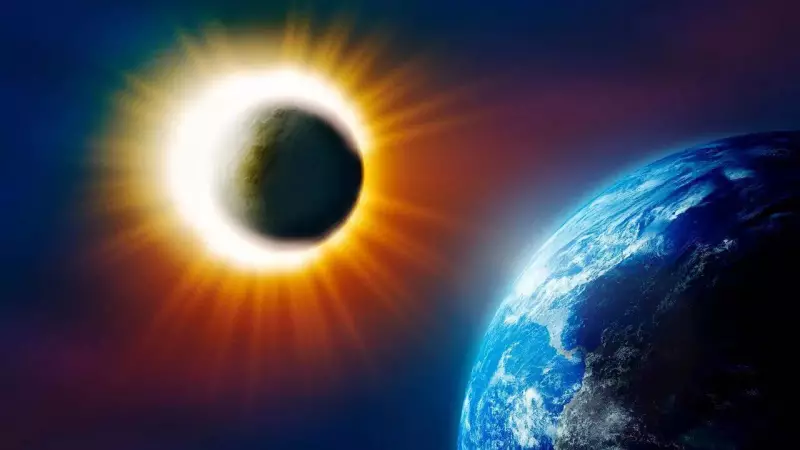
In 2026, skywatchers across the globe will witness a remarkable celestial event where the Sun will seemingly transform into a brilliant, thin circle of light. This phenomenon, often described as the Sun 'disappearing' or being outlined by fire, is not a cause for alarm but a predictable and fascinating alignment of cosmic bodies.
What is the 2026 Ring of Fire Eclipse?
The event, popularly known as a 'Ring of Fire' eclipse, is scientifically termed an annular solar eclipse. It occurs when the Moon passes directly in front of the Sun. However, because this event will happen when the Moon is near its farthest point from Earth in its orbit, it appears slightly smaller in the sky. As a result, it cannot completely cover the Sun's disc. Instead, it blocks the Sun's central, brightest part, leaving a stunning, thin ring—or annulus—of sunlight visible around the Moon's dark silhouette.
This creates the dramatic visual effect of a fiery ring hanging in the sky. The eclipse is the result of a precise alignment of the Earth, Moon, and Sun, a dance governed by orbital mechanics that astronomers can predict with great accuracy years in advance. NASA's official eclipse calculations have already mapped the timing and trajectory of this event.

When and Where to See the 2026 Eclipse
The annular solar eclipse of 2026 is set for February 17. The path of the full 'Ring of Fire' effect will be narrow, traversing primarily over remote southern regions, with the greatest visibility over Antarctica. For observers in India and most other parts of the world, a partial solar eclipse will be visible.
During a partial eclipse, the Moon covers only a portion of the Sun. The extent of coverage, or magnitude, will vary depending on your specific location. Even a partial eclipse presents a unique opportunity to observe our solar system in motion, though the complete ring shape will not be seen from Indian latitudes.
Ring of Fire vs. Total Solar Eclipse: Key Differences
It is crucial to understand that an annular eclipse is distinct from a total solar eclipse, which creates brief totality where the Sun is completely obscured.
- Total Solar Eclipse: The Moon completely blocks the Sun, turning day into an eerie twilight for a few minutes. The Sun's outer atmosphere, the corona, becomes visible.
- Annular (Ring of Fire) Eclipse: The Moon does not fully cover the Sun. A bright ring of sunlight remains visible throughout the entire event. The sky will dim noticeably but will not become dark as night.
This key difference has a major implication for safety: during an annular eclipse, it is never safe to look directly at the Sun without proper protection, as a significant portion of its blinding surface remains exposed.
How to Safely Watch the Eclipse
Viewing any solar eclipse requires strict safety measures to prevent permanent eye damage. Since the 'Ring of Fire' eclipse does not result in total coverage, safe viewing practices are non-negotiable.
- Use Certified Solar Viewing Glasses: Only use eclipse glasses that meet the ISO 12312-2 international safety standard. Ordinary sunglasses, even very dark ones, are completely inadequate and dangerous.
- Solar Filters for Optics: If using binoculars, telescopes, or cameras, they must be fitted with professionally designed solar filters over the front lenses. Never look at the Sun through an optical device without a proper filter.
- Indirect Viewing Methods: Project the Sun's image through a pinhole projector onto a white surface. This is a safe and simple way to observe the eclipse's progress without looking directly at the Sun.
While solar eclipses are not rare on a global scale, they are infrequent for any single location, making each occurrence a special event. Beyond the public spectacle, eclipses provide valuable opportunities for scientists to study the Sun's corona and its effects on Earth's atmosphere.

The 2026 Ring of Fire eclipse will be a brief, meticulously timed natural phenomenon. The Sun itself is not vanishing; it is merely being momentarily masked in a spectacular display of orbital geometry. For millions around the world, this fleeting change in the daytime sky will be a powerful reminder of the dynamic and ever-moving universe we inhabit, offering a compelling reason to pause and look upward.