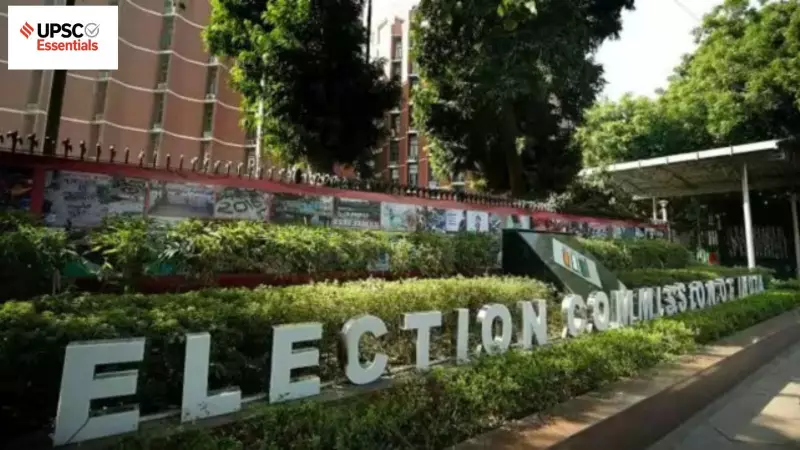
Are you gearing up for the UPSC Civil Services Examination (CSE) Prelims 2026? Consistent revision of static syllabus topics is crucial for success. Our daily subject-wise quiz initiative is designed to help aspirants assess their preparation and reinforce key concepts. Today's edition focuses on the vital area of Polity and Governance, featuring questions on the National Legal Services Authority, the Election Commission's mapping exercise, and fundamental constitutional principles.
Question 1: Understanding the Role of NALSA
The first question tests your knowledge of the National Legal Services Authority (NALSA). Consider the following statements:
- It was established under the Legal Services Authorities Act of 1987.
- Its objectives include providing free legal aid to weaker sections and organizing Lok Adalats.
- The Chief Justice of India acts as its Executive Chairman.
How many of these are correct? The answer is only two. Statements 1 and 2 are accurate. NALSA was indeed constituted under the 1987 Act to offer free legal services and promote dispute settlement through Lok Adalats. However, statement 3 is incorrect. While the Chief Justice of India is the Patron-in-Chief of NALSA, the Executive Chairman is a sitting or retired Supreme Court judge appointed by the CJI. Currently, this position is held by Justice Vikram Nath.

Question 2: Decoding the Election Commission's Mapping Process
This question delves into the technical process of electoral roll mapping used by the Election Commission of India (ECI). The mapping links voters in the current 2025 roll to the 2002 roll prepared after the last Summary Revision. You are asked to evaluate two pairs:
- Self mapping: Voters present in both the 2025 and 2002 rolls.
- Un-mapped: Voters not in the 2002 roll but with blood relatives (parents, grandparents) in that list.
The correct evaluation is that only pair 1 is correctly marked. Self mapping correctly identifies electors found in both rolls. However, the description for 'Un-mapped' is inaccurate. Un-mapped or 'No mapping' refers to voters who are neither in the 2002 roll nor have any relatives listed in it. Voters with blood relations in the old roll fall under a different category called 'Progeny mapping'.
Question 3: The Quasi-Federal Nature of the Indian Constitution
This segment examines foundational features of the Indian Constitution. Four statements are presented:
- The Constitution explicitly calls itself a federation.
- It follows a quasi-federal design.
- India has an unwritten and flexible constitution.
- Power is divided between the Union and States via Union, State, and Concurrent Lists.
Only two statements are correct here. Statement 2 is true; India's governance structure is quasi-federal, blending federal and unitary features. Statement 4 is also correct regarding the division of powers through the three lists. Statement 1 is false because Article 1 describes India as a 'Union of States', not explicitly a federation. Statement 3 is incorrect as the Indian Constitution is written and relatively rigid, requiring a special procedure for amendments.
Question 4 & 5: Key Judicial and Constitutional Provisions
The final questions cover recent judicial interpretations and constitutional mandates. Question 4 concerns caste certification and constitutional provisions. It asks if Articles 15 and 16 empower the state to create special measures for SC/ST communities (true), and if the Supreme Court recently allowed a minor girl to obtain an SC certificate based on her mother's identity despite her father not being from the community (also true). The answer is both statements are correct.
Question 5 addresses the Right to Food. It queries whether the Constitution does not recognise this right (false), and if Article 47 places a duty on the state to raise nutrition and public health levels (true). The correct answer is only statement 2. The Right to Food is implicitly recognised under Article 21 (Right to Life), and Article 47 of the Directive Principles explicitly mandates state action on nutrition.

Why This Quiz Matters for UPSC Aspirants
Regular practice with such MCQs is indispensable for UPSC Prelims preparation. It helps in retaining factual information, understanding nuanced concepts like federalism and legal authorities, and staying updated with recent judicial pronouncements. Polity and Governance form a significant portion of the General Studies Paper-I, and a clear grasp of these topics can greatly enhance an aspirant's score. Revising through quizzes also aids in identifying weak areas that need more focused study.