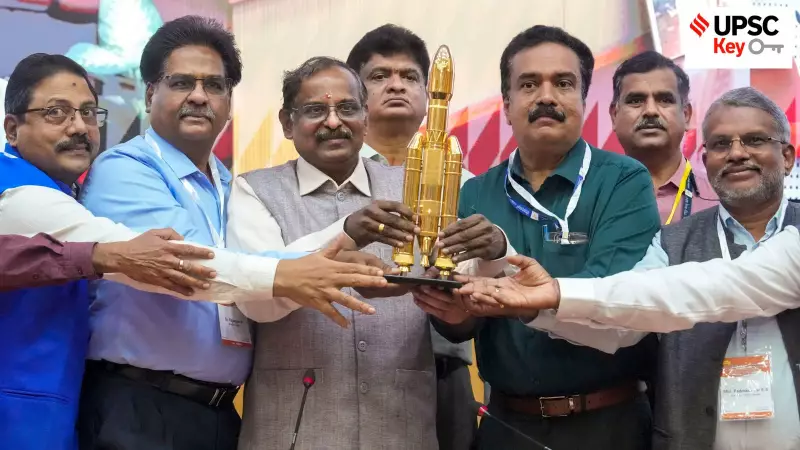
The Indian Space Research Organisation (ISRO) achieved a significant milestone on Wednesday, December 24, 2025, with the successful launch of its heaviest commercial satellite to date. This event, along with critical developments in environmental science, legal frameworks, and defence technology, forms the core of essential current affairs for aspirants of the Union Public Service Commission (UPSC) Civil Services Examination.
ISRO's LVM-3 Creates History with Heaviest Payload
In its third commercial mission, designated LVM3-M6, India's most powerful launch vehicle, the Launch Vehicle Mark-3 (LVM-3), placed the US communication satellite Bluebird Block-2 into a precise orbit. The launch took place in the early hours from the Satish Dhawan Space Centre in Sriharikota, Andhra Pradesh.
The satellite weighed approximately 6,100 kilograms, making it the heaviest payload ever launched by an Indian rocket. This mission marks the ninth consecutive successful flight for the LVM-3, underscoring its reliability. ISRO Chairman V. Narayanan highlighted that the satellite was placed with a deviation of less than 2 kilometres from the planned orbit, a performance ranking among the best globally.

This launch is strategically important for India's space ambitions. A human-rated version of the same LVM-3 vehicle will be used for the ambitious Gaganyaan mission, which aims to send Indian astronauts into space. The successful deployment of such a heavy satellite also reduces India's dependency on foreign launch service providers like SpaceX and Ariane Space for heavier payloads.
The Bluebird Block-2 satellite, developed by ASTSpace Mobile of the United States, is part of a constellation designed to provide direct-to-mobile connectivity from low-earth orbit, potentially bypassing the need for ground stations.
Delhi's Air Pollution: The Dominant Role of Secondary Ammonium Sulfate
A new analysis by the Centre for Research on Energy and Clean Air (CREA) has revealed a concerning detail about the air quality in the national capital. Nearly one-third of Delhi's annual PM2.5 pollution consists of secondary ammonium sulfate. This pollutant is not directly emitted but forms in the atmosphere through chemical reactions.
It results from the oxidation of sulphur dioxide (SO2)—released primarily from coal-based power plants and industries—which then reacts with ammonia emissions from agricultural activities. Its formation is accelerated under humid conditions.
The study found that the contribution of ammonium sulfate to PM2.5 mass spikes dramatically during high-pollution periods, accounting for 49% of PM2.5 during post-monsoon and 41% in winter, compared to just 21% in summer and monsoon. This indicates that the worst pollution episodes in Delhi and the National Capital Region (NCR) are significantly driven by region-wide industrial and agricultural emissions, not just local sources.
At a national level, states with a high concentration of coal-fired power plants, such as Chhattisgarh, Odisha, and Jharkhand, recorded the highest annual contributions of ammonium sulfate to PM2.5.
Supreme Court's New Definition of the Aravallis Sparks Debate
A recent decision by the Supreme Court of India, accepting a new definition of the Aravalli hill range proposed by the central government, has become a major topic for environmental and geographical discussions relevant to the UPSC syllabus.
The new definition classifies the Aravallis as landforms with an elevation of 100 metres or more above the local relief. An internal assessment by the Forest Survey of India suggests this could exclude nearly 90% of the Aravalli range from stringent protections against mining and development.
Environmentalists have expressed deep concern, arguing that this could deal a severe blow to an already degraded ecological shield. The billion-year-old Aravalli range acts as a crucial barrier against the expansion of the Thar Desert into the fertile plains of north-western India, aids in groundwater recharge, and supports unique biodiversity.

Critics fear the new criterion may open up vast stretches of the hills for mining, especially for critical minerals. However, government representatives have countered that all landforms within the contour encircling the 100-metre-high hills are also protected, and that any mining activity would still require statutory environmental clearances.
Personality Rights Gain Traction in Courts Amid AI Boom
With the rise of artificial intelligence (AI) and deepfake technology, Indian courts are witnessing a surge in cases related to the protection of personality rights. Recently, the Delhi High Court restrained the unauthorized commercial use of actor R. Madhavan's image and likeness, ordering the takedown of obscene and AI-generated content.
This trend is part of a larger movement where celebrities like Aishwarya Rai Bachchan and NTR Jr. are seeking judicial orders to prevent the misuse of their persona on digital platforms.
Personality rights in India are not governed by a single law but are derived from a combination of statutes and constitutional principles. These include the Copyright Act (for performer's rights), the Trademarks Act (for protection against 'passing off'), and Article 21 of the Constitution (right to life and privacy).
Courts are now proactively issuing orders to block infringing links and direct online platforms to comply swiftly. This judicial activism highlights the growing challenge of regulating digital likeness and AI-generated impersonation in the absence of specific legislation, a gap that countries like the United States have started to address with new laws.
DRDO's Akash-NG Missile System Clears User Trials
In the realm of indigenous defence technology, the Defence Research and Development Organisation (DRDO) has successfully completed the User Evaluation Trials (UET) of the Akash-New Generation (Akash-NG) missile system.
This paves the way for its induction into the Indian Air Force (IAF). The Akash-NG is an advanced surface-to-air missile system designed to intercept high-manoeuvring, low-radar-signature aerial threats. It boasts an enhanced range of up to 70 kilometres, a sleeker design, and a smaller ground system footprint compared to its predecessors.
The successful trials, which intercepted targets at various ranges and altitudes, demonstrate India's growing self-reliance in critical air defence technology. The Akash system, born from the Integrated Guided Missile Development Programme, already serves both the IAF and the Indian Army, with over 96% indigenous components.