CBSE Class 10 English Exam 2026 Successfully Conducted Nationwide
The Central Board of Secondary Education (CBSE) successfully administered the Class 10 English Language and Literature examination on Friday, February 21, 2026. The crucial board exam was held from 10:30 AM to 1:30 PM across the country, marking a significant milestone for millions of students.
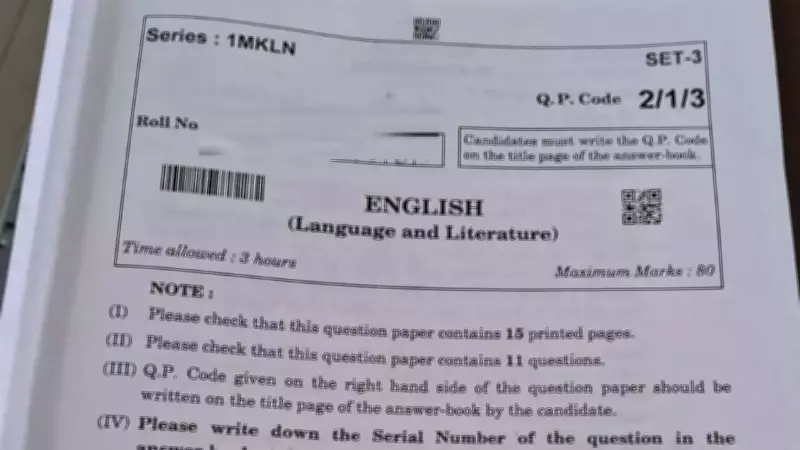
Following the completion of the examination, CBSE has officially released the question paper in PDF format. This document is now accessible for download by students, educators, and parents, providing a valuable resource for comprehensive analysis and review.
Massive Scale of the 2026 Board Examinations
The 2026 CBSE Class 10 board exams witnessed unprecedented participation, with a staggering 25,08,319 candidates appearing for the examinations. These students were accommodated across 8,075 examination centers strategically located throughout India.

The gender distribution among candidates revealed 14,08,546 male students and 10,99,773 female students. The examinations covered an extensive curriculum of 83 different subjects, all conducted in a single shift under the standard CBSE examination protocols and regulations.
Accessing the Question Paper for Strategic Analysis
Students who have completed the examination, as well as those preparing for future board exams, can now download the CBSE Class 10 English question paper 2026 PDF from the official board website or other authorized educational portals.
This resource serves multiple critical purposes:
- Enabling detailed analysis of question patterns and formats
- Facilitating accurate assessment of marks distribution
- Helping students evaluate their examination performance
- Identifying key preparation areas for future improvement
- Understanding the competency-based assessment framework
The examination paper adhered strictly to the prescribed CBSE pattern, comprehensively testing students across four core areas: reading comprehension, writing skills, grammar proficiency, and literature from NCERT textbooks.
Student Reactions: English Paper Deemed Easier Than Mathematics
Initial feedback from students indicates general satisfaction with the English examination's difficulty level. Students from Govt Boys Senior Secondary School, Tukhmirpur, School No. 2 shared their perspectives with TOI Education.
Rizwan commented, "The English paper was straightforward and manageable. We wouldn't categorize it as moderate or challenging. It was certainly more approachable than the Mathematics paper, which presented significant difficulties, particularly in the Basic Mathematics section, though Standard Mathematics was comparatively easier."
Ishrar added, "Questions were directly sourced from NCERT textbooks, and the reading passages were clear and comprehensible. We could understand them easily and respond without confusion."
Ishan noted, "While the overall paper was manageable, some grammar questions, especially those involving reported speech, presented moderate challenges."
Comprehensive Paper Analysis and Educational Insights
A thorough review of the question paper reveals several important characteristics:
- Competency-Based Assessment: Most questions focused on testing practical skills and application rather than rote memorization.
- Predictable Pattern: Students who thoroughly prepared using NCERT materials and sample papers found the paper format familiar.
- Scoring Opportunities: The reading comprehension section was particularly clear and offered good scoring potential.
- Standardized Writing Tasks: Writing sections followed conventional formats that students had practiced extensively.
- Literature Focus: Questions emphasized thematic understanding, character analysis, and textual interpretation rather than simple recall.
The timely release of the question paper PDF represents a significant step toward transparency in the examination process, allowing for immediate feedback and continuous improvement in educational outcomes.