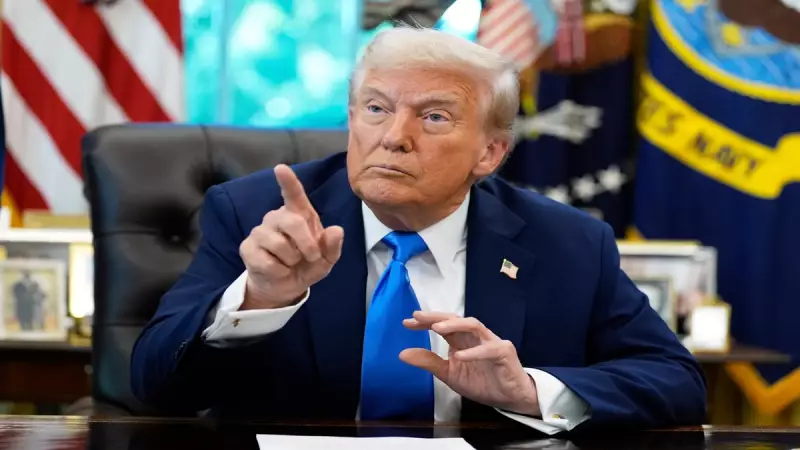
Former United States President Donald Trump, known for his "America First" approach, is reportedly preparing to expand his aggressive trade policy beyond Venezuela. Fresh from imposing steep tariffs on the South American nation, Trump's administration is said to be evaluating similar tough measures against five additional countries, signalling a potential new phase in global economic confrontations.
The Immediate Trigger: A 200% Tariff on Venezuela
The recent escalation began with a decisive move against Venezuela. On January 5, 2026, the Trump administration announced the imposition of a staggering 200% tariff on all goods imported from Venezuela. This drastic measure was framed as a response to the Venezuelan government's failure to adhere to commitments made during the 2024 electoral process. The administration cited a lack of progress on democratic reforms and the continued suppression of opposition as key justifications for this economic punishment.
This action is not an isolated event but appears to be a template. Analysts suggest it marks the opening salvo in a broader strategy where Trump leverages US economic power to compel political and trade concessions from nations perceived as adversaries or unfair competitors.

Five Nations Now on the Radar
Sources indicate that the Trump administration has identified five specific countries for potential similar tough trade actions. While the official list remains confidential, policy circles and trade experts point to nations that have long been points of contention in Trump's worldview.
The primary targets are believed to be China and Mexico, two economic giants with which Trump has a history of fraught trade negotiations. The remaining three are likely nations with significant trade surpluses with the US or those accused of currency manipulation and intellectual property theft. Candidates often discussed in this context include Vietnam, Indonesia, and Thailand, all of which have seen their exports to the US grow substantially.
The criteria for selection seem to revolve around a combination of large trade deficits, allegations of unfair trade practices, and broader geopolitical disagreements. The administration's goal is ostensibly to rebalance trade relationships and bring manufacturing jobs back to American soil.
Behind the Hardline Stance: Strategy and Politics
Several factors are driving this renewed tough stance. Firstly, it aligns perfectly with Trump's long-standing campaign rhetoric and core political brand, which is built on challenging globalist economic policies and protecting American industry. By taking a hard line, he aims to solidify his support among his political base ahead of future electoral contests.
Secondly, the approach is seen as a tool of coercive diplomacy. The threat of crippling tariffs is a powerful lever to force countries back to the negotiating table or to extract concessions on issues ranging from market access to security cooperation. The move against Venezuela demonstrates a willingness to follow through on threats, giving weight to warnings issued to other nations.
Finally, there is an element of economic recalibration. The administration argues that decades of liberal trade policies have eroded the US industrial base. By applying pressure, they hope to force a restructuring of global supply chains, making them less dependent on perceived rivals and more resilient—and domestic.
Potential Global Repercussions and India's Stance
An expanded Trump trade war would send shockwaves through the global economy. It could disrupt supply chains, increase costs for consumers worldwide, and trigger retaliatory measures from targeted nations, leading to a cycle of economic protectionism. For a trade-dependent nation like India, the implications are significant.

While India is not currently among the named five targets, its trade relationship with the US has seen tensions in the past over issues like digital services taxes and market access. New Delhi will be watching developments closely. The Indian government has consistently advocated for rules-based, stable, and predictable international trade. A volatile US trade policy could push India to further diversify its economic partnerships and strengthen regional trade blocs as a buffer against unilateral actions from any single powerful nation.
In conclusion, the 200% tariff on Venezuela is more than a bilateral dispute; it is a potential blueprint. As Donald Trump sets his sights on five more countries, the world braces for a period of heightened economic uncertainty where trade becomes a primary weapon of statecraft, with consequences that will resonate far beyond Washington's immediate targets.