

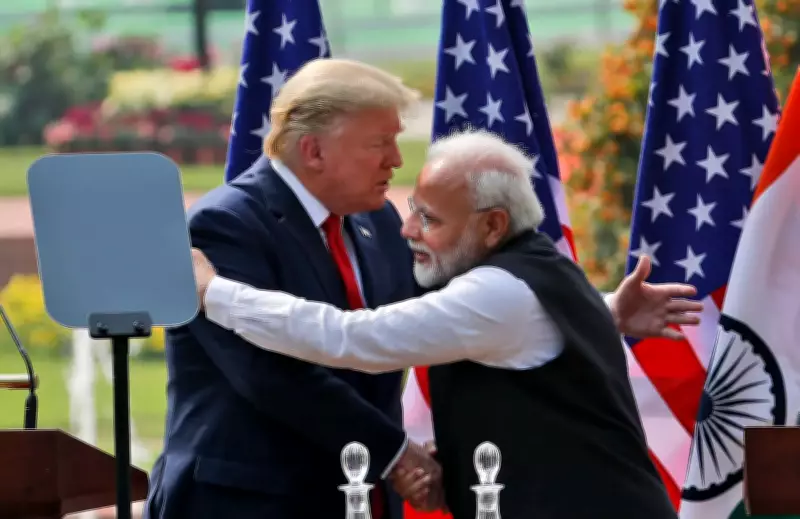
Trump Confirms India Trade Deal Progress, Praises Bilateral Relations
US President Donald Trump stated on Friday that the trade agreement with India remains firmly on course, while enthusiastically describing the current state of bilateral relations between the two nations as "fantastic." He specifically noted that India will continue to adhere to the 18% tariff rate established under the interim framework of the pending deal.
Indian Authorities Monitor US Response to Supreme Court Ruling
Indian officials are vigilantly observing the Trump administration's reaction to a recent US Supreme Court decision concerning tariffs. Some within the Indian government perceive a potential window for negotiation, given that the interim trade pact has not yet been formally signed. As part of this interim arrangement, India has consented to lower tariffs on a majority of goods. In reciprocal action, the United States has agreed to reduce its tariffs to 18%, although sector-specific duties on items like iron, steel, copper, aluminum, automobiles, and auto parts will remain at a higher rate of 50%. The Indian government has refrained from official comment, with sources indicating it is premature to assess the full impact of the court's ruling.
Ongoing Negotiations and Finalization Efforts
"Since India has not yet signed the agreement, there may be some scope for further dialogue. However, we will adopt a wait-and-see approach regarding the US government's official response to the ruling," a senior Indian official explained. To advance the process, a delegation led by India's chief negotiator, Darpan Jain, is en route to Washington. Their objective is to finalize the legal text of the agreement in collaboration with US Trade Representative Jamieson Greer.

Subsequently, the USTR is scheduled to visit New Delhi next month to formally sign the interim trade agreement. Earlier on Friday, India's Commerce and Industry Minister, Piyush Goyal, projected that the agreement would be operationalized starting in April.
Global Context and Congressional Scrutiny
In a related development on Friday, Indonesia became the latest nation to formalize a trade agreement with the United States, locking in reciprocal tariffs at 19%. This move places Indonesia alongside other countries such as Malaysia, Argentina, Cambodia, Guatemala, El Salvador, Bangladesh, and Taiwan, which have also recently signed trade pacts with the US. However, several American trade experts have raised questions about the long-term validity of these agreements, suggesting that the US Congress may intervene or scrutinize the deals more closely in the future.
Strategic Caution and US Trade Policy Tools
The Indian government is proceeding with measured caution in light of these developments. Tariffs have been a central policy instrument for President Trump since his return to office last year. The administration has employed what some analysts call a 'Plan B' strategy by invoking Section 122 of the Trade Act of 1974. This provision allows for the imposition of temporary tariffs of up to 15% for balance-of-payments reasons. Under this authority, Trump has decided to levy an additional 10% tariff on all trading partners.
Furthermore, President Trump indicated he would utilize Section 301 of the Trade Act to order investigations into countries suspected of engaging in unfair trade practices. These probes could take approximately five months to complete and may likely be followed by the imposition of additional tariffs if violations are found. This context is particularly significant for India, as the United States serves as its largest export market, accounting for nearly one-fifth of all Indian shipments abroad.






