

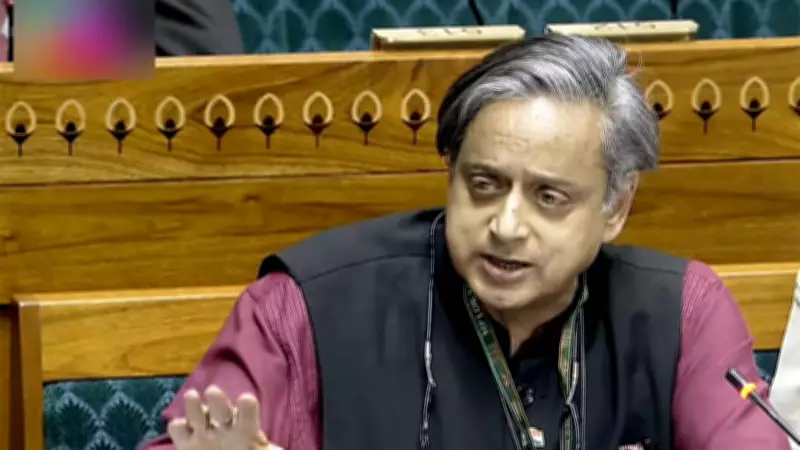
Congress MP Shashi Tharoor Lambasts India-US Trade Deal and Budget in Lok Sabha
Congress Member of Parliament Shashi Tharoor launched a scathing critique of the India-US interim trade agreement on Tuesday, describing it as a "pre-committed purchase agreement" that fundamentally undermines the principle of reciprocity. During a discussion on the Budget in the Lok Sabha, Tharoor asserted that Union ministers S. Jaishankar and Piyush Goyal have consistently evaded providing clear details regarding the scale, timeline, or fiscal impact of this bilateral arrangement with the United States.
Trade Deal Scrutinized as Lacking Fairness
Tharoor challenged the government's claim that India secured a "better deal" with the US compared to other Asian economies, stating that this assertion does not withstand rigorous scrutiny. "It appears less like a Free Trade Agreement (FTA) and more like a pre-committed purchase that overturns the very idea of reciprocity," he remarked. He elaborated that while India might have obtained minor tariff reductions of 1-2 percentage points, no East Asian economy has consented to deliberately erode its trade surplus with the US through guaranteed purchase obligations, highlighting a perceived imbalance in the agreement.
Budget Termed a 'Squandered Opportunity'
Initiating the parliamentary discussion on the Budget, Tharoor characterized it as "underwhelming" and a "squandered opportunity." He employed a vivid analogy, comparing it to "rearranging the airbags on a crashing car, while assuring the passengers that the chassis is sturdy and they will feel better afterwards." This critique underscores his view that the Budget fails to address substantive economic challenges effectively.

Accusations of 'Headline Management' Over Governance
Targeting the government's overall approach, Tharoor accused it of prioritizing "headline management" over genuine governance. He contended that "promises are loud, Budgets are grand, but delivery is conspicuously absent," suggesting a disconnect between announcements and actual implementation. This criticism extends beyond the trade deal to broader policy execution, reflecting ongoing political tensions.
The remarks by Tharoor, a senior Congress leader and former diplomat, have ignited further debate on India's trade strategies and fiscal policies, with implications for bilateral relations and domestic economic management. The government has yet to issue a formal response to these specific allegations in Parliament.






