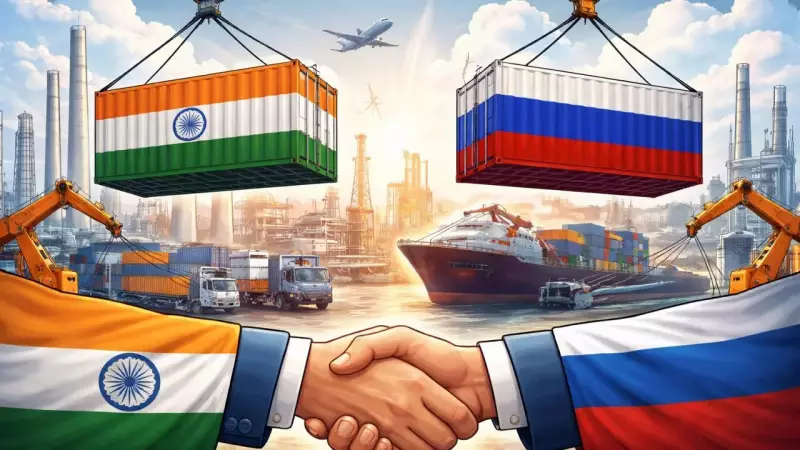
Russia Expands Economic Partnership with India Beyond Traditional Energy Ties
Russia is actively working to deepen its economic relationship with India. The country now aims to move beyond energy and oil collaborations. It seeks to establish joint ventures with Indian firms across several key sectors.
Multiple Sectors Targeted for Local Manufacturing
Several Russian companies are currently engaged in discussions with Indian partners. They want to localize manufacturing in India across diverse segments. These include engineering, shipbuilding, information technology, renewable power, oil processing and metallurgy.
This push follows the annual India Russia summit held in December. That meeting placed a strong emphasis on enhancing economic cooperation between the two nations.

Andrey Sobolev, Russia's trade representative in India, recently gave an interview to the Russian state-owned news agency TASS. He stated clearly that India remains an absolute priority in Moscow's foreign economic agenda.
Broadening Bilateral Commerce Beyond Resources
According to Sobolev, both sides share a keen interest. They want to broaden bilateral commerce by significantly increasing the share of non-resource and non-energy products in their trade. He noted that this mutual interest is clearly evident on both sides.
Russian companies increasingly view India as an attractive destination. They are looking to set up local production facilities there. These facilities would aim not only to serve the vast Indian market but also to supply South Asia and other international markets.
Simultaneously, Indian firms are demonstrating growing interest. They are actively exploring business opportunities within Russia itself.
The Northern Sea Route Emerges as Key Collaboration Area
Sobolev also highlighted the Northern Sea Route. He identified it as a key area with strong potential for collaboration between India and Russia.
He said the two countries have already agreed on benchmarks. These benchmarks will help develop a stable cargo base and define economic parameters for transportation along this strategic route.
Both nations are examining prospects for joint ventures in logistics and shipbuilding related to the corridor. Sobolev told TASS that these efforts point to rising business interest in the Northern Sea Route over the medium to long term.
The Northern Sea Route serves as the primary maritime corridor within Russia's Arctic zone. It runs along the country's northern shoreline through several Arctic seas. These include the Barents, Kara, Laptev, East Siberian, Chukchi and Bering seas.
This important passage links ports in European Russia and the Far East with navigable Siberian rivers. It creates an integrated transport network. The route extends about 5,600 kilometers from the Kara Strait in the west to Providence Bay in the east.
India Sets Ambitious Export Targets for Russian Market
India has set clear goals for its trade with Russia. Ajay Sahai, director general and CEO of the Federation of Indian Export Organisations, spoke at a meeting in December. The meeting was hosted by the Russian Trade Mission in India.
Sahai stated that India aims to double the value of its exports of goods and services to Russia. The target is to reach $10 billion.
He noted there are a number of sectors where India has already gained market access in Russia. The country will likely have to increase its reach into the Russian market further.
Sahai added that progress towards the bilateral trade target of $100 billion by 2030 is encouraging. However, he expressed a specific desire for the composition of that trade.
He would be very happy if at least $30-35 billion came from exports from India. He expects imports from Russia to account for around $60-65 billion of the total $100 billion goal.