Rajasthan Highway Projects Stalled by Petrochemical Shortages Amid Global Tensions
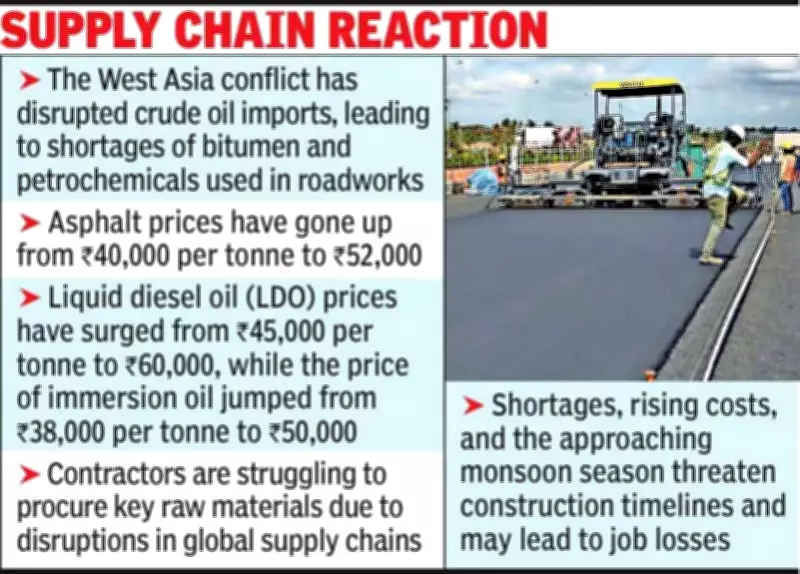
Jaipur: Road construction on several critical national highway projects across Rajasthan has experienced a sharp and significant slowdown. This deceleration is directly attributed to contractors grappling with an acute and severe shortage of petroleum-based construction materials, including bitumen. The root cause of this scarcity is traced back to major disruptions in global petrochemical supply chains, exacerbated by ongoing geopolitical tensions and conflicts in regions like West Asia.
Major Projects Grind to a Halt
Key construction activities on National Highway 27 and National Highway 148D have been particularly hard hit. Asphalt-laying operations have been completely halted at multiple locations along these vital corridors. A contractor, who requested anonymity, revealed the staggering scale of the impact. "Roadwork projects currently underway in the Kota division alone, which are collectively valued at nearly Rs 600 crore, have been seriously and adversely affected," the contractor stated.
On NH-27, the situation is dire. Contractors report an urgent requirement of approximately 20,000 tonnes of asphalt. However, supplies have fallen drastically short, with only around 7,000 tonnes delivered so far. The financial burden has compounded the physical shortage. "Earlier, asphalt was available at roughly Rs 40,000 per tonne. After the escalation of tensions in West Asia, however, prices skyrocketed to above Rs 50,000 per tonne. Now, supplies are extremely difficult and challenging to secure even at that inflated rate," the contractor added.

Widespread Shortages of Essential Materials
The crisis extends beyond asphalt. A critical shortage of Liquid Diesel Oil (LDO), which is essential for operating heavy construction machinery like rollers and pavers, has been reported from numerous project sites. Against an estimated aggregate requirement of 27 lakh litres across multiple ongoing projects, a mere 10 lakh litres have been delivered. Prices for LDO have surged from about Rs 45,000 per tonne to nearly Rs 60,000 per tonne, with supplies remaining erratic and unreliable.
Furthermore, immersion oil, another indispensable petroleum derivative used extensively in roadworks, is also in critically short supply. Project sites require roughly 9,000 tonnes, but have received only about 3,500 tonnes to date. The cost of this material has similarly escalated, rising from around Rs 38,000 per tonne to nearly Rs 50,000 per tonne, excluding applicable GST.
Contractors express frustration, noting that despite having valid supply contracts and making timely payments, suppliers are simply unable to fulfil orders. This is because refined petrochemical products are not reaching domestic Indian markets in adequate and sufficient quantities due to the global supply chain breakdown.
Official Acknowledgment and Project-Specific Impacts
Officials from the National Highways Authority of India (NHAI) have formally acknowledged the severe impact of these material shortages on project timelines. An NHAI official confirmed, "Asphalt-related work has slowed down considerably at several sites. We have advised contractors to continue with other preparatory or ancillary activities wherever possible so that the overall project progress does not come to a complete and total halt."
Among the worst-affected projects is the Rs 199 crore upgradation of the 240-kilometer Gulabpura–Uniara stretch of NH 148D, which passes through Bundi district. Here, asphalt-laying has been temporarily suspended. Similarly, the renovation of a 104-kilometer stretch of NH-27 between Kota, Bhanwargarh, and Kelwara, valued at approximately Rs 171 crore, has stalled after reaching nearly 30% completion.
Broader Consequences and Official Response
The widespread slowdown has triggered a cascade of operational consequences. With work stalling across multiple locations, expensive heavy machinery has been idled and moved to temporary camps. Several workers, including skilled engineers and daily-wage labourers, are currently without active assignments, leading to concerns about livelihood and project workforce retention.

Delays have also been reported on parts of Package 10 of the ambitious Delhi–Mumbai Expressway, particularly affecting culvert construction and road surfacing activities. While NHAI officials noted that projects on the Gurugram–Jaipur and Jaipur–Deoli stretches of this expressway have not been significantly affected yet, precautionary measures are being proactively implemented.
NHAI Project Director Ajay Arya emphasized that authorities are monitoring the volatile situation closely and making concerted efforts to arrange alternative supplies. "Even though there is no immediate crisis on these specific stretches, shortages could compound and worsen if supply disruptions continue indefinitely. We are making all necessary arrangements and procuring materials from wherever possible across the country so that essential work does not suffer prolonged delays," Arya stated, highlighting the proactive steps being taken to mitigate the crisis.