

Mumbai Metro's Phase 1 Launch: A Tale of Two Lines
The inaugural day of Mumbai's Metro Phase 1 extensions brought a stark contrast in commuter engagement. Metro Line 9, stretching from Kashigaon to Dahisar, and Metro Line 2B, covering Mandale to Diamond Garden in Chembur, debuted with markedly different public reactions, highlighting the city's evolving transit dynamics.
Line 9: A Resounding Success with Immediate Benefits
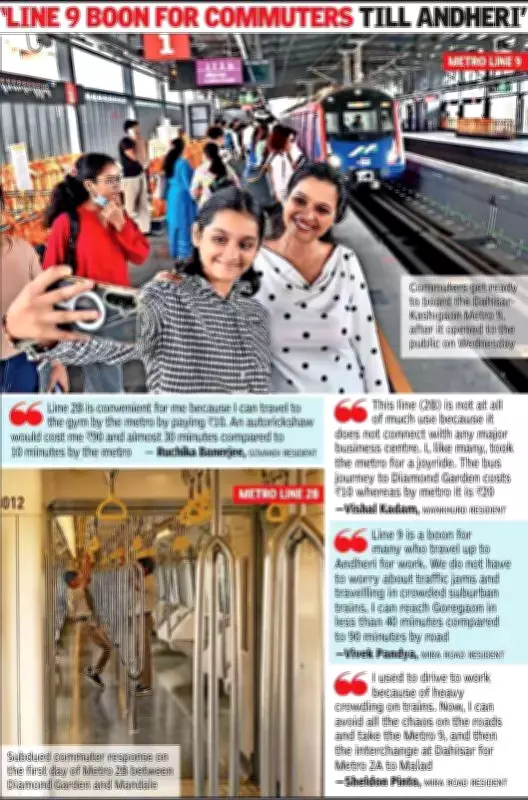
Metro Line 9 witnessed robust footfalls from day one, driven by its seamless integration with existing Line 7 up to Gundavali. Commuters reported significant time savings, with daily journeys reduced by 15 to 20 minutes. This new corridor offers a comfortable alternative to congested roads and overcrowded suburban trains, addressing long-standing mobility challenges.
A Metro One official noted, "On day 1 of the opening of Metro 9, positive ridership trends were observed in all 5 stations between WEH and Saki Naka." With Metro 2A and 7 already averaging 3.4 lakh daily riders, the addition of Line 9 is projected to boost ridership by at least 1 lakh, underscoring its immediate impact.

Residents of Mira Road and Bhayander expressed relief, particularly in bypassing the notorious Dahisar check naka traffic bottleneck. Hari Pal, a logistics professional, shared, "This is a huge relief. Earlier, reaching Dahisar itself used to be a struggle. Now, I can board the metro at Kashigaon and reach Andheri far more comfortably." Vaibhav Singh from Bhayander East added that his commute time dropped from 45 minutes to a more manageable 10-15 minutes via the metro, praising its comfort over buses.
Students highlighted cost savings, noting the metro is more economical than autorickshaws charging Rs 60. Samadhan Patil, traveling with family, called it "faster, more convenient and ideal," while Pradeep Shetty emphasized the benefit of direct connectivity to Andheri. Women commuters appreciated the reduced wait times for buses, and many described the service as "better late than never," offering respite from crowded local trains.
However, some raised safety concerns, suggesting that platform screen doors could enhance passenger security, as currently, guards with whistles are stationed on platforms.
Line 2B: Subdued Turnout Due to Connectivity Gaps
In stark contrast, Metro Line 2B experienced a muted response on its first day. A staffer at one station reported that by 4:30 PM, only about 250 people had traveled on this route since morning. Commuters cited the line's limited present-day connectivity as a key deterrent, noting it neither links with the monorail nor major commercial hubs, making it less practical for daily office travel.
Navi Mumbai's Arindam Mahapatra, an infrastructure enthusiast, commented, "The line's true potential will unfold only after it is extended to crucial interchange and business districts such as Kurla, Bandra and Andheri. Once these nodes are connected, Line 2B is likely to emerge as a key east-west mobility corridor." This sentiment reflects broader expectations for future expansions to unlock its utility.
Unlike previous metro launches, where agencies promptly shared day one ridership figures, the Mumbai Metropolitan Region Development Authority (MMRDA) had not released commuter numbers at the time of reporting, adding to the uncertainty surrounding Line 2B's initial performance.
The divergent responses underscore how immediate travel gains and connectivity play pivotal roles in shaping public adoption of new transit infrastructure in Mumbai's bustling urban landscape.






