

Leather Goods Prices Set to Skyrocket by 50-60% Amid West Asia Conflict
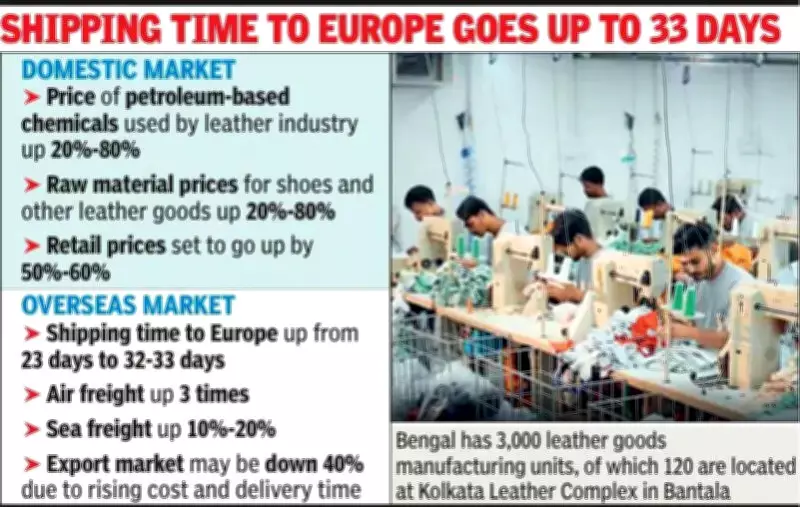
In a significant development for consumers and the leather industry, prices of shoes, belts, and various leather goods are poised to increase dramatically by 50% to 60%. This sharp rise is directly attributed to the escalating costs of petroleum-based chemicals, essential for leather manufacturing, which have surged due to the ongoing conflict in West Asia.
Council for Leather Exports Issues Stark Warning
The Council for Leather Exports (CLE) has issued a grave warning, indicating that exports of leather and leather goods from Kolkata and across India could plummet by as much as 40% as a direct consequence of the war. CLE chairman Ramesh Kumar Juneja elaborated on the situation, revealing that the price of petroleum-based chemicals used in producing shoes and other leather items has escalated by 20% to 80%.
Juneja emphasized, "The cost of manufacturing shoes and leather goods has increased by at least 30%. When it hits the retail market, there will be a price rise of 50%-60%. Many manufacturers will find it difficult to sell at the revised prices."

Production Challenges and Capacity Reductions
The impact extends beyond raw material costs. Sole factories, which rely on LPG to melt thermoplastic rubber granules through boilers, are currently operating at a mere 20% of their capacity due to severe LPG shortages. This bottleneck further exacerbates production delays and cost pressures within the industry.
While the central government has taken steps to alleviate some burdens by issuing a notice to remove a 7.5% import duty on chemicals for the tannery sector, this measure falls short. The specific chemicals utilized by the leather industry are notably absent from the exemption list, leaving manufacturers to bear the brunt of the increased expenses.
Bengal's Leather Industry at a Crossroads
West Bengal, a key hub for leather production, hosts approximately 550 tanneries, with an additional 300 slated to commence operations within the next year and a half. The state boasts around 3,000 leather goods manufacturing units, including 120 located at the Kolkata Leather Complex in Bantala. This extensive network now faces unprecedented challenges that threaten its growth and stability.
Export Market Disruption and Logistics Woes
Juneja further cautioned that leather goods exports could decline by 40%, not only because Indian products have become more expensive—eroding their competitive edge—but also due to significantly longer shipping timelines. Previously, shipments to Europe took about 23 days. However, with vessels now rerouting around Africa to avoid the Strait of Hormuz, the journey has extended by 9 to 10 days, resulting in a total transit time of 32 to 33 days.
Europe and the United States collectively account for 70% of Kolkata's leather goods export market, making these delays particularly detrimental. Although the government is providing a 75% subsidy on the increased shipping costs to Europe, the additional time required is hampering order fulfillment and disrupting supply chains.
Compounding the issue, the disruption of air travel between India and Europe due to the conflict has led to a scarcity of space in aircraft bellies for cargo. Despite an additional air freight subsidy, this logistical hurdle further impedes the timely export of leather goods, adding to the industry's woes.
In summary, the leather industry in Kolkata and across India is grappling with a perfect storm of rising material costs, production constraints, and logistical nightmares, all stemming from the West Asia conflict. Consumers should brace for higher prices, while manufacturers and exporters navigate these turbulent times with cautious optimism.






