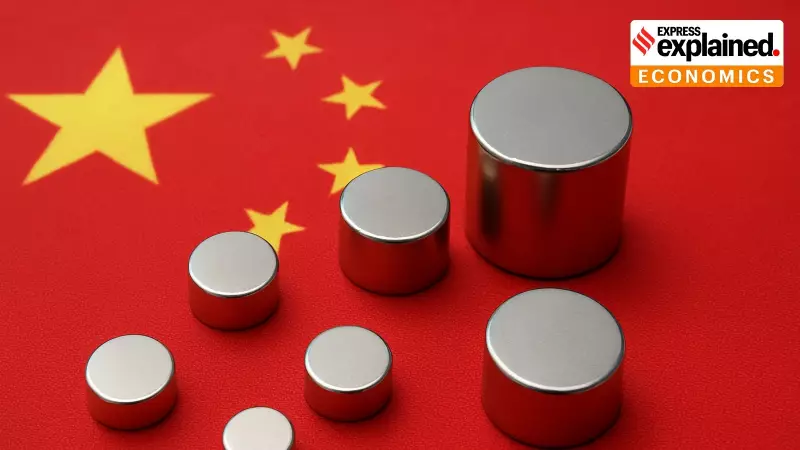
The Indian government has taken a significant step toward reducing its overwhelming dependence on Chinese imports by approving a Rs 7,280 crore scheme to promote domestic manufacturing of rare earth permanent magnets (REPM). This strategic move comes at a crucial time when China's near-total control over the global supply chain has raised serious concerns about economic security.
China's Stranglehold and India's Vulnerability
The urgency behind this initiative becomes clear when examining the numbers. During the 2024-25 fiscal year, India imported more than 53,000 tonnes of rare earth magnets, with over 90% originating from China. This dependency creates significant vulnerability, as demonstrated in April when China imposed export controls on magnets in response to US tariffs, highlighting how geopolitical tensions can disrupt global supply chains.
Rare earth permanent magnets are not ordinary components—they are essential for cutting-edge technologies including electric vehicles, renewable energy systems, electronics, aerospace applications, and defense equipment. Despite their critical importance, manufacturing remains concentrated in very few countries, with China dominating both the processing of raw materials and final magnet production.

Decoding the Government's REPM Scheme
The newly approved scheme targets the establishment of 6,000 metric tonnes per annum of integrated REPM manufacturing capacity. This capacity will be distributed among five beneficiaries selected through competitive bidding, with each eligible for up to 1,200 MTPA.
The financial support package includes sales-linked incentives worth Rs 6,450 crore spread over five years, complemented by capital subsidies of Rs 750 crore for setting up integrated REPM facilities. The scheme specifically focuses on sintered rare-earth permanent magnets, primarily neodymium, iron and boron (NdFeB) magnets, which are considered the strongest and most commercially demanded variety.
These powerful magnets utilize both light rare-earth elements like neodymium and praseodymium, combined with iron and boron, as well as heavy rare-earth elements such as dysprosium and terbium to enhance performance at high temperatures. The manufacturing process involves multiple complex stages from mining to final magnet production, with the new scheme supporting the crucial final three stages: converting rare earth oxide to metal, metal to alloy, and finally alloy to REPM.
Challenges on the Path to Self-Reliance
While the scheme represents a positive step forward, significant challenges remain. India's planned capacity of 6,000 metric tonnes annually appears modest compared to China's estimated production capacity of approximately 2,40,000 tonnes. This stark contrast underscores the substantial gap India needs to bridge.
The raw material supply chain presents another major hurdle. While Indian Rare Earths Limited (IREL) produces some required light rare earth oxides such as neodymium-praseodymium oxides, its current output remains insufficient to support the scale envisioned under the new scheme. More critically, India has no domestic production capability for heavy rare-earth oxides, which are essential for manufacturing high-strength magnets.
Rishabh Jain, fellow at Council on Energy, Environment and Water (CEEW), explains the core challenge: "In India, we primarily produce light rare-earth oxides through IREL. The real challenge is with heavy rare-earth oxides. To make high-strength magnets, you need heavy rare earths. India doesn't produce these, so we will have to import them."
Cost competitiveness remains another significant concern. China's massive production scale, tightly integrated value chain, and substantial subsidies enable it to offer prices that other countries struggle to match. As Jain notes, "Unless mandated, no one wants to buy a magnet that's significantly more expensive."

Global Context and India's Broader Strategy
India's REPM scheme forms part of a broader global trend of countries seeking to reduce dependence on Chinese critical minerals. According to a 2022 US Department of Energy report, approximately 93% of the NdFeB magnet market consists of sintered magnets, with China dominating the entire supply chain from mining to final manufacturing.
Recent international initiatives reflect this shifting landscape. The Quad grouping comprising India, Australia, Japan, and the United States launched an initiative in July to secure critical mineral supply chains. This followed the Critical Minerals Action Plan presented at the G7 Summit in Canada in June, which India also endorsed.
At the national level, India has been building a comprehensive framework for critical mineral security. The government launched the National Critical Mineral Mission (NCMM) in January with a proposed outlay of Rs 16,300 crore for the period from 2024-25 to 2030-31. This mission aims to secure India's critical mineral supply chain through domestic and international sourcing while strengthening the entire value chain.
Complementing these efforts, India identified 30 minerals as "critical" in 2023 and amended the Mines and Minerals Act to empower the central government to exclusively auction critical and strategic mineral blocks. So far, 34 critical mineral blocks have been auctioned across the country.
Internationally, India has established Khanij Bidesh India Limited (KABIL) as a joint venture company to explore critical mineral assets in foreign countries. KABIL has already signed an Exploration and Development Agreement with Argentina's state-owned Camyen for exploring and mining five Lithium Brine Blocks.
As global demand for rare earth magnets continues to grow—with India's consumption expected to double by 2030—the success of this Rs 7,280 crore scheme could determine whether India can transform from a dependent importer to a self-reliant manufacturer in the critical technology sector.