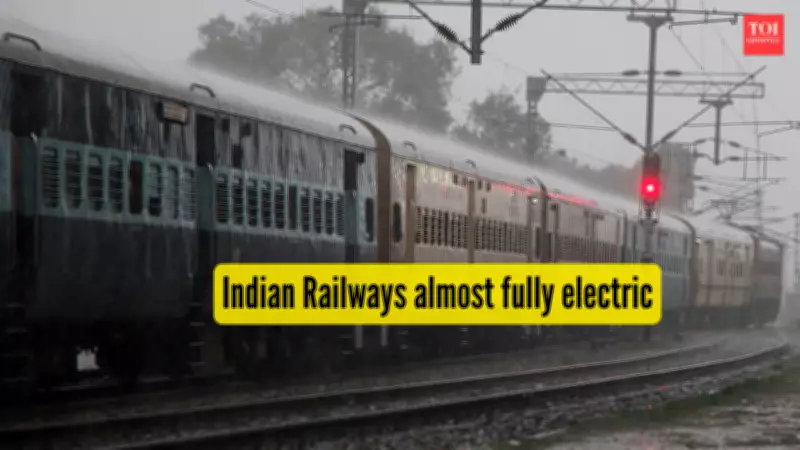
Indian Railways Nears Complete Electrification: A Historic Journey
The journey of Indian Railways towards electrification began over a century ago, marking a transformative shift in the nation's transportation infrastructure. In 1925, the first electric train in India commenced operations, utilizing a 1,500 Volt DC system on the route between Bombay Victoria Terminus and Kurla Harbour. This initial foray, though limited in scope, laid the foundational groundwork for a more efficient and sustainable railway system.
Progress in the subsequent decades was gradual, with electrification covering only 388 route kilometers by the time of India's independence in 1947. During this period, steam and diesel locomotives dominated the railways, but the seeds for change had been sown. The real acceleration began in recent years, as Indian Railways intensified its focus on adopting cleaner operational methods.
Exponential Growth in Electrification
The pace of electrification has seen a remarkable surge, evolving from an average of approximately 1.42 kilometers per day between 2004 and 2014 to around 15 kilometers per day from 2019 to 2025. This represents a paradigm shift in the expansion of the rail network. The share of electrified routes dramatically increased from 24 percent in 2000 to 40 percent in 2017, and further soared to 96 percent by the end of 2024.

As of November 2025, Indian Railways has electrified 69,427 route kilometers, accounting for approximately 99.2 percent of its broad gauge network. Notably, 46,900 route kilometers were electrified between 2014 and 2025, underscoring the rapid advancements made in this decade.
Global Comparison of Railway Electrification
To contextualize India's achievements, it is insightful to examine the electrification status of other leading nations. Here is a detailed comparison:
- Switzerland: This country stands as a global benchmark with a fully electrified rail network at 100 percent. It relies exclusively on electric locomotives, powered largely by renewable hydroelectric sources, enabling high-frequency passenger services and seamless connectivity across challenging European terrains.
- India: With 99.2 percent electrification, India has emerged as one of the world's largest and nearly fully electrified rail networks. Its progress over the past decade is unparalleled in both scale and speed, transitioning from a modest start in 1925 to a dominant position today.
- China: Operating the world's largest high-speed rail network, China has achieved 82 percent electrification. While its main corridors are fully electric, some freight-heavy and remote routes still depend on diesel locomotives.
- Spain: At 67 percent electrified, Spain's efforts are driven by its extensive high-speed rail network, one of the longest in Europe. However, conventional and regional lines remain partially non-electrified.
- Japan: With 64 percent electrification, Japan's major passenger corridors, including the Shinkansen routes, are fully electric. Rural and less-utilized lines account for the remaining non-electrified sections.
- France: France has 60 percent electrification, combining electric high-speed and mainline routes with diesel-powered regional services, particularly in less-densely populated areas.
- Russia: At 52 percent electrified, Russia's vast geography and extreme climate have limited full electrification. Trunk routes like the Trans-Siberian Railway are electric, but large stretches still use diesel locomotives.
- United Kingdom: Despite having one of the oldest railway systems, the UK has only 39 percent electrification. High upgrade costs and legacy infrastructure have hindered expansion, keeping diesel trains in widespread use.
This comparison highlights India's significant strides in railway electrification, positioning it among global leaders in sustainable transport. The ongoing efforts reflect a commitment to reducing carbon emissions and enhancing operational efficiency, setting a precedent for other nations to follow.