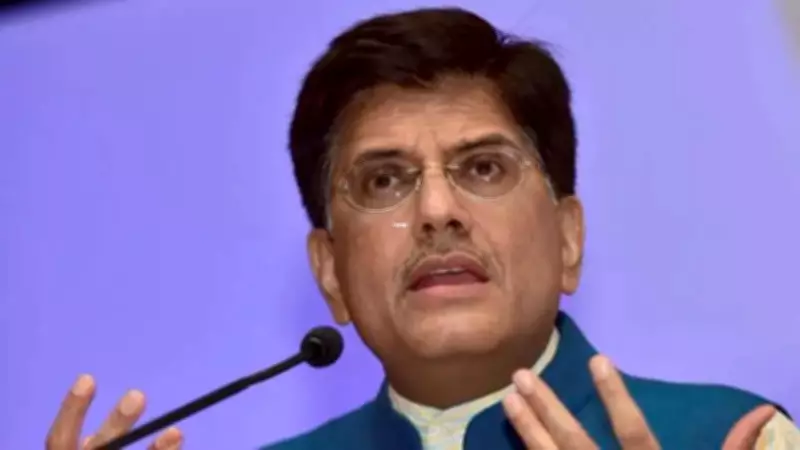
World Looking at India as $30 Trillion Economy, Trusted Partner: Piyush Goyal
In a significant development for India's trade landscape, Union Minister of Commerce and Industry Piyush Goyal has emphasized that countries across the globe are now viewing India as a future $30 trillion economy and a trusted partner. This statement comes shortly after the conclusion of Free Trade Agreement (FTA) negotiations with the European Union, marking a pivotal moment in India's economic diplomacy.
Geopolitical Neutrality and Strategic Timing
Addressing questions about the role of geopolitics in the FTA, Goyal clarified that the deal was not influenced by external pressures. "This has nothing to do with geopolitics," he asserted, noting that negotiations had been ongoing since 2021, with the EU appointing Maros Sefcovic as Trade Commissioner in December 2024 to expedite the process. The timing of the deal, coinciding with EU leaders' invitations to Republic Day celebrations, was described as a "happy coincidence" rather than a strategic maneuver.
Goyal highlighted that the EU's motivation stemmed from recognizing India's immense economic potential. "They are all seeing a $30 trillion economy. Look at the delta of opportunity… from $4 trillion to $30 trillion in 23 years. Who would like to miss out on it?" he remarked, underscoring India's position as a reliable and growing market.

Key Negotiation Outcomes and Practical Solutions
The FTA addresses several contentious issues with pragmatic solutions. On the EU's Carbon Border Adjustment Mechanism (CBAM), Goyal explained that India secured protections through a forward-MFN (Most Favoured Nation) clause, ensuring non-discrimination. "Any carbon taxes paid here will be recognised," he said, adding that the EU has agreed to establish verifiers in India to simplify compliance and reduce costs for Indian businesses.
Additionally, a rapid response mechanism will be implemented to resolve any operational difficulties, reflecting the EU's appreciation for India's efforts in decarbonization. Goyal pointed out that India is among the top three G20 nations in fulfilling climate commitments, with renewable energy targets achieved eight years ahead of schedule.
Resolving Contentious Issues and Protecting Sensitive Sectors
Contrary to past stumbles, Intellectual Property Rights (IPR) did not pose a challenge in this negotiation. "I have not had one meeting on IPR," Goyal stated, attributing this to prior settlements with Switzerland and the UK. Geographical Indication (GI) products will be addressed in a separate agreement, deemed an operational rather than contentious matter.
The minister also detailed how sensitive sectors were safeguarded. "All sensitive items are out. No cereals, no GM products, no dairy, no rice, wheat, no soya, no corn," he affirmed. Government procurement was excluded based on the principle of reciprocity, as the EU could not commit to similar access across its 27 member states.
Economic Opportunities and Export Potential
Goyal highlighted the asymmetric benefits for India, particularly in agriculture and manufacturing. For instance, India secured duty-free access for 85,000 tonnes of table grapes in the EU, valued at over Rs 1,000 crore, while offering limited concessions on wines. "We are bigger exporters than importers," he noted, emphasizing the deal's potential to boost Indian exports.
In the automotive sector, India exports $9 billion worth of vehicles compared to imports of $921 million, indicating a strong competitive position. Goyal expressed optimism about narrowing the trade gap with China, which currently accounts for 10-12% of EU imports versus India's 2%. "Our industry has to create capacities, ramp up production, and ramp up quality," he urged, aligning with Prime Minister Narendra Modi's focus on quality since 2014.

A Vision for Global Manufacturing and Collaboration
Beyond trade, the FTA positions India as a strategic hub for global manufacturing. Goyal revealed that the EU views India as a base for accessing markets in Africa, Asia, and Latin America. "They desperately want us to take their technologies, convert them into scale of manufacturing," he said, highlighting opportunities for technology transfer and industrial growth.
The EU has also committed to supporting India's decarbonization through a joint fund, with an initial announcement of 500 million euros. This collaboration underscores the mutual trust and long-term vision driving the partnership.
In summary, the India-EU FTA represents a milestone in India's economic ascent, grounded in pragmatic negotiations and a shared recognition of India's potential as a $30 trillion economy. As Goyal concluded, the world is not only looking at India's present but betting on its future as a trusted and dynamic partner in global trade.