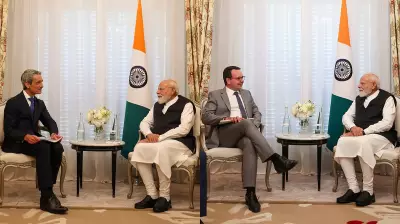
India and New Zealand have successfully concluded negotiations for a comprehensive free trade agreement (FTA), marking a significant step in their economic partnership. The deal was finalised on December 22 following a direct conversation between Prime Minister Narendra Modi and his New Zealand counterpart, Christopher Luxon. This pact represents India's seventh such trade agreement in recent years and is slated for formal signing in the first quarter of 2026.
A Framework Beyond Immediate Trade Gains
An analysis by the Global Trade Research Initiative (GTRI) provides a nuanced view of the agreement's immediate impact. Given the current modest scale of bilateral trade, which stood at $2.1 billion in the financial year 2025, the FTA is seen more as a strategic framework for future cooperation than a dramatic trade breakthrough. Ajay Srivastava, founder of GTRI, emphasised that the real value lies in establishing a structure for deeper economic engagement.
In FY2025, India's merchandise exports to New Zealand were valued at $711.1 million, led by aviation turbine fuel, textiles, pharmaceuticals, and machinery. New Zealand's exports to India amounted to $587.1 million, primarily comprising wood products, scrap metals, coal, and wool. Notably, the politically sensitive dairy sector saw minimal commercial activity, with New Zealand's dairy exports to India totalling just $1.07 million. India successfully shielded its dairy industry, home to millions of small farmers, from significant market access commitments.

Key Provisions: Tariffs, Services, and Investment
The FTA, spanning 20 chapters, covers a wide array of areas including goods, services, rules of origin, and newer themes like investment promotion, MSME cooperation, and intellectual property. The tariff concessions are asymmetrical. New Zealand will eliminate duties on 100% of its tariff lines from the agreement's start, benefiting around 450 Indian export lines. India, adopting a calibrated approach, has offered market access on 70% of its lines, protecting sensitive agricultural products through mechanisms like tariff-rate quotas.
In services, which actually outweigh goods trade in value, New Zealand has committed to opening 118 sectors. It has also introduced favourable mobility provisions, including post-study work rights for Indian students and a pathway for up to 5,000 skilled Indian professionals to work in New Zealand at any given time. India has offered access in 106 services sectors. A major investment pillar involves New Zealand's commitment to facilitate $20 billion in foreign direct investment into India over 15 years.
The Road Ahead: Unlocking Potential
Experts agree that the FTA is a starting point, not an end in itself. Srivastava noted that the agreement alone will not unlock the full potential of the economic relationship. The tangible impact will depend on how both nations leverage the pact to strengthen supply chains, expand services trade—especially in education—and deepen skills partnerships. The report suggests that doubling bilateral trade by 2030 will require enhanced business engagement, better connectivity, simpler visa processes, and mutual recognition of professional qualifications in sectors like IT, healthcare, and aviation.
Ultimately, the India-New Zealand FTA is a forward-looking document that balances immediate economic realities with long-term strategic ambitions, protecting domestic sensitivities while creating avenues for growth in services, investment, and skilled mobility.