EU and India Forge Ahead with Historic Free Trade Agreement
In a significant diplomatic and economic development, the European Union is moving closer to finalizing a long-anticipated free-trade agreement with India. This strategic initiative aims to strengthen ties between two of the world's largest democracies, as they navigate a complex global landscape dominated by the United States and China.
High-Level Diplomacy Sets the Stage
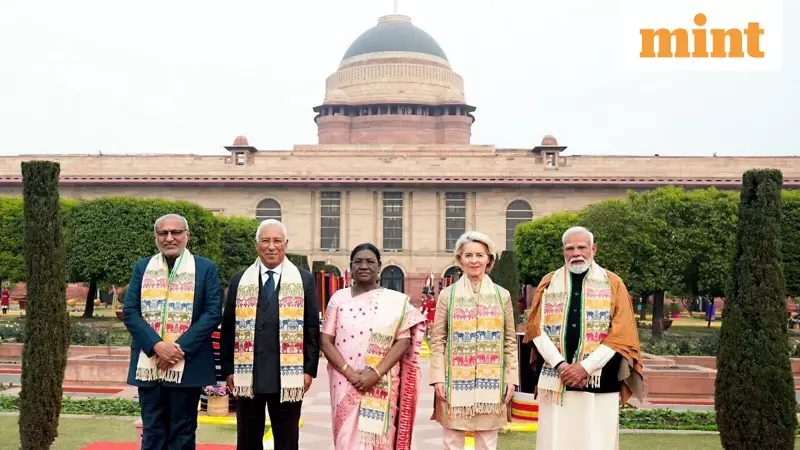
The momentum for this agreement was highlighted during India's 77th Republic Day celebrations in New Delhi, where European Union leaders were honored guests. President Droupadi Murmu, Prime Minister Narendra Modi, and Vice President CP Radhakrishnan hosted President of the European Council António Luís Santos da Costa and President of the European Commission Ursula von der Leyen at Rashtrapati Bhavan. This high-profile visit underscored the mutual commitment to deepening EU-India relations.
The subsequent EU-India summit focused on reaching consensus on multiple accords, with the free-trade pact being a centerpiece. Analysts suggest that former US President Donald Trump's nationalist policies, including tariff impositions and strained alliances, have inadvertently encouraged Europe and India to pursue this deal more vigorously.

Strategic Autonomy Drives the Partnership
Both the European Union and India are seeking to preserve their strategic autonomy as secondary players in their respective spheres. India faces China's dominance in the Indo-Pacific region, while Europe contends with American influence in the Atlantic. According to Chietigj Bajpaee of Chatham House, this shared challenge has fostered a closer partnership.
India's trade strategy has increasingly shifted westward, exemplified by a recent trade deal with Britain in July 2024, while avoiding pacts with Asian competitors. Conversely, the EU is exploring opportunities globally, having recently signed an agreement with Latin America's Mercosur trade zone, despite some parliamentary hurdles.
Economic Impact and Trade Dynamics
In the short term, the EU-India trade deal is expected to have a modest economic impact. Currently, India ranks as the EU's ninth-largest trading partner, accounting for only 2.4% of the bloc's total trade. Europe's goods exports to India amount to approximately €50 billion annually, with services adding another €26 billion, totaling just 0.4% of the EU's GDP.
The average tariff rate on EU exports to India is around 9%, but key reductions, such as lowering India's car tariffs from up to 110% to 40%, could provide significant benefits. Non-tariff barriers, including quality controls and government procurement rules, are more complex to address but are expected to see some progress under the agreement.
For India, the deal offers a buffer against US tariffs, including the 50% rate imposed by the Trump administration and punitive measures on Russian hydrocarbon purchases. India's exports of goods and services to the EU total €105 billion, comparable to its $129 billion exports to the US in 2024. However, with the EU's average tariff on Indian imports at just 4%, the immediate upside may be limited.
A Shallow but Symbolic Agreement
Given India's protectionist reputation, the trade deal will be shallower than recent EU agreements with other partners. Controversial sectors, such as many agricultural goods with high tariffs, will be excluded. Separate agreements will cover geographical indicators, protecting products like Greece's feta cheese, France's champagne, India's Darjeeling tea, and basmati rice.
Beyond tariffs, the agreement promotes longer-term economic cooperation. A parallel security and defence partnership will be signed, reflecting increased trust between the two sides. Garima Mohan of the German Marshall Fund notes that India's production capabilities could complement European arms manufacturers, with growing interest in joint ventures involving AI and space technologies.
Additional Components and Challenges
The summit is also expected to include agreements on India's participation in Horizon, the EU's research funding program, and skilled migration from India to Europe. This migration component distinguishes the EU from the US, which has restricted work visas for Indians.

Despite these advances, disagreements persist. India maintains its relationship with Russia, continuing to purchase Russian oil and export dual-use goods, which has drawn EU criticism and sanctions on some Indian entities. Additionally, India views the EU's carbon border adjustment mechanism as protectionist, while the EU argues it aligns with environmental goals.
Broader Implications and Bilateral Engagements
The EU-India deal signals that secondary global powers are exploring alternatives amid shifting alliances. Some experts believe bilateral deals between India and individual European countries, such as France and Germany, may hold more substantive value. For instance, German Chancellor Friedrich Merz's recent visit to India with business leaders highlights growing interest.
Ultimately, this agreement represents more than just economic terms; it is a strategic statement that nations outside the US-China duopoly have viable options for collaboration and growth.