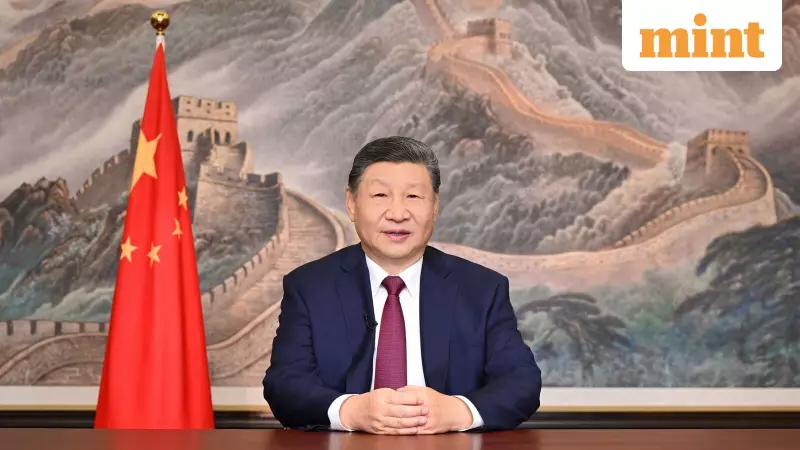
The world's most critical economic relationship is in a state of deep uncertainty. With a potential meeting between US President Donald Trump and Chinese President Xi Jinping in South Korea hanging in the balance, the ongoing trade war has escalated into a tense battle of wills. Contrary to the belief in Washington that America holds the advantage, a closer look reveals a different narrative: China is emerging as the frontrunner in this protracted conflict.
Mastering the Art of Escalation and Retaliation
When President Trump returned to the Oval Office, his strategy on China trade was unambiguous: intensify the pressure campaign initiated in his first term. This translated into higher tariffs, stricter controls on high-tech exports, and aggressive use of sanctions. The objective was clear: to cripple China's manufacturing dominance, secure commercial concessions, and slow its technological ascent.
However, after six months of heightened tensions, China finds itself in a relatively stable position. Analysts point to three key reasons. First, Beijing has demonstrated a remarkable capacity to withstand American coercion and retaliate with precision, achieving what strategists term "escalatory dominance." For instance, the "Liberation Day" tariffs imposed by Trump in April were reversed following a significant slump on Wall Street. Similarly, after China hinted at restricting exports of critical rare earth minerals, Trump's threat of 100% tariffs failed to materialize.

China's retaliatory measures have been calculated and effective. In response to US levies on Chinese container ships, Beijing imposed its own port charges. It has wielded the threat of antitrust investigations against American corporate giants like Google, Nvidia, and Qualcomm. Perhaps most painfully for the US, China's boycott of American soybeans—a $12 billion market crucial for Midwestern farmers—has directly impacted a key voter base for Trump.
Forging a New Global Trade Playbook
Beyond tit-for-tat measures, China's second major success lies in its attempt to rewrite the rules of global commerce. It is actively building a Chinese-centric trading system to rival what it sees as America's "empire of tariffs." This shift is already visible in trade geography: while China's goods exports to the US fell by 27%, its overall exports grew by over 8% in the year to September.
The threat to control rare-earth exports is a potent symbol of this new approach. It not only capitalizes on China's market dominance but also represents an effort to establish a global licensing regime, a move more aggressive than America's playbook in the semiconductor industry. As the primary trading partner for over 70 countries and a sophisticated manufacturing hub, China is positioned to recast trade norms in its favor.
Domestic Consolidation Amid External Pressure
The third, and perhaps most significant, reason for China's perceived advantage is the domestic effect of the trade war. While external observers highlight China's internal challenges—including property sector woes and timid consumer spending—the external pressure has, paradoxically, strengthened the position of Xi Jinping and the Communist Party.
To many Chinese citizens, Trump's aggressive tactics have validated President Xi's long-standing project of preparing China for a hostile world by transforming it into a techno-industrial superpower. This sentiment was reinforced as the Communist Party's leadership convened to discuss a new five-year plan, expected to double down on Xi's techno-nationalist policies. Notably, China's stock market has risen by 34% in dollar terms this year, outperforming the S&P 500's growth.
Of course, risks remain for Beijing. Redirecting exports may provoke more countries to erect tariff barriers, and its new licensing systems could become bureaucratic quagmires. The weaponization of economic power encourages global partners to diversify and innovate to reduce dependence.

If the Trump-Xi meeting in South Korea proceeds, a temporary de-escalation is possible—a pause in US tariffs in exchange for delaying rare-earth controls, coupled with some soybean purchases and a resolution for TikTok. Yet, the broader prospect is not of reconciliation but of two economic giants permanently weaponizing their interdependence. In this high-stakes game, even as China currently navigates the conflict with adeptness, the retreat from open commerce threatens to make losers of all.