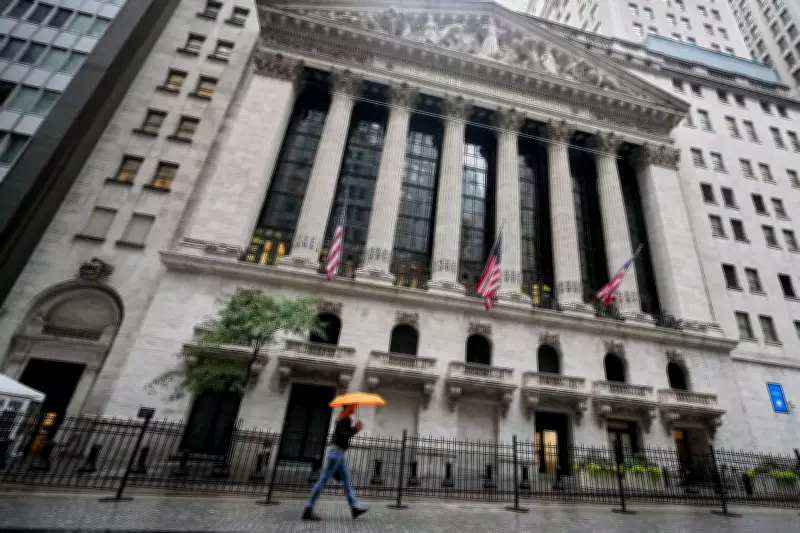
Wall Street Retreats Amid Escalating Middle East Tensions and Oil Supply Fears
US stock markets opened the week in negative territory on Monday, as heightened uncertainty over the Middle East conflict rattled investor confidence. The downturn followed Iran's decision to re-close the strategically vital Strait of Hormuz, shortly after a brief reopening, intensifying geopolitical risks and fueling concerns over global energy supplies.
Market Performance and Key Index Movements
The Dow Jones Industrial Average dipped by 10 points, settling at 49,437, while the Nasdaq Composite initially tumbled 100 points before recovering slightly to close down 54 points, or 0.2%, at 24,413. The S&P 500 also edged lower, slipping 0.1% to 7,119 as of 7:40 pm IST. This bearish sentiment marked a stark contrast to the previous trading session, reflecting growing apprehension among market participants.
"The market mood is very different at the start of the week compared to Friday," noted Kathleen Brooks, Research Director at trading group XTB. Investor sentiment weakened further as the US-Iran ceasefire approached its expiry, with Iran stating it will not participate in a fresh round of negotiations with the United States.

Crude Oil Prices Rebound Sharply on Supply Disruption Concerns
Crude oil prices experienced significant volatility, dropping on Friday after Iran announced it would allow ships to pass through the Strait of Hormuz again. However, prices rebounded sharply on Monday following Iran's renewed closure of the waterway. Iran cited a US blockade and seizure of an Iranian cargo ship as violations of the two-week ceasefire, prompting the action.
US benchmark crude oil surged by $5.18, or 6.3%, to $87.88 a barrel, while Brent crude, the global benchmark, gained 5.3% to $95.20 a barrel. The Strait of Hormuz is a critical global route, facilitating the flow of approximately one-fifth of the world's oil and liquefied natural gas, making its closure a major catalyst for price spikes.
"Renewed attacks on commercial vessels in the Strait of Hormuz increased fears of supply disruptions and raised the risk of a broader escalation in hostilities between the US and Iran," explained Trade Nation analyst David Morrison. "Uncertainty also remains over whether negotiations in Islamabad will proceed after Iran said it would not attend talks while the blockade remains in place."
Global Market Reactions and Broader Implications
European markets mirrored the negative trend, closing in the red during afternoon trading. Frankfurt's DAX index fell by 1.0%, Paris's CAC 40 declined 0.8%, and London's FTSE 100 was lower by 0.5%. This followed earlier gains in Asian markets, including Tokyo, Hong Kong, and Shanghai, highlighting the divergent regional responses to the evolving geopolitical landscape.
The closure of Iranian ports remains a key sticking point in negotiations between the US and Iran, with both sides accusing each other of breaching the ceasefire terms. So far, only one round of talks has occurred in Islamabad on April 11, which concluded without any resolution, though preparations for further discussions have continued. The ongoing impasse underscores the fragile nature of diplomatic efforts and their direct impact on financial markets worldwide.