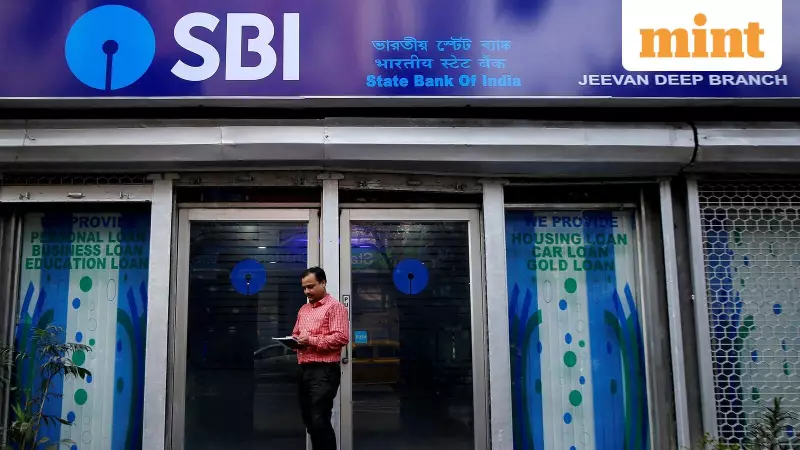
SBI Creates History: Shares Touch Record High of ₹999
The Indian banking sector witnessed a historic moment on Wednesday, November 26, as State Bank of India (SBI), the country's largest public sector lender, saw its shares surge 1.6% to reach an unprecedented high of ₹999 per share. This remarkable achievement brings the PSU banking giant tantalizingly close to breaching the psychological ₹1,000 mark for the very first time in its trading history.
Sustained Bull Run and Market Capitalization Milestones
The state-owned banking behemoth has been experiencing a sustained bull run since late August, with its stock price skyrocketing by an impressive 25% during this period. This phenomenal growth has propelled the company's market capitalization to cross the ₹9 lakh crore threshold, reaching an exact valuation of ₹9.22 lakh crore following today's record performance.
This market cap achievement positions SBI as the sixth most valuable company in the Indian stock market landscape. The current momentum suggests that SBI could potentially overtake ICICI Bank, which currently holds a market capitalization of ₹9.80 lakh crore, in the coming weeks if the bullish trend continues.

Among banking sector stocks, HDFC Bank maintains its dominant position as the most valuable entity with a market capitalization of ₹15.4 lakh crore, according to the latest BSE data.
Fifth Consecutive Year of Positive Returns
The recent upward trajectory in SBI stock has pushed its year-to-date returns to an impressive 25%, placing the bank on track to achieve its fifth consecutive year of positive returns. While the stock began its significant upward movement in late August, the momentum accelerated dramatically following the release of the September quarter results, which surpassed analyst expectations.
The bank's management further fueled investor optimism by revising its credit growth forecast upward, reflecting confidence in the improving economic landscape. The credit demand in the system has shown clear signs of improvement, supported by multiple policy measures implemented by both the Reserve Bank of India and the central government.
Key policy interventions include:
- Repo rate cuts by the RBI
- GST reductions aimed at boosting consumption
- Multiple measures targeting urban India's spending patterns
Technical Analysis Points to Further Gains
Anshul Jain, Head of Research at Lakshmishree, provided valuable technical insights into SBI's current market position. He noted that SBI broke out of a flat base at ₹838 and is now steadily advancing toward its pattern target of ₹1,050, supported by strong momentum at the current market price of ₹993.
Jain observed that the trend structure remains firmly intact, suggesting that any price dip toward the 20-day Exponential Moving Average near ₹955 should be considered a fresh buying opportunity. This recommendation is based on the stock's consistent respect for this moving average throughout its current uptrend.
However, the analyst also cautioned that the recent price appreciation has been sharp and momentum indicators appear stretched at current levels. He advised traders to exercise caution and emphasized the importance of proper position sizing and disciplined entry strategies as the stock approaches its target zone.
Strong Q2 Performance Underpins Growth
The foundation of SBI's stock performance rests on its solid second-quarter financial results. The PSU bank reported a net profit of ₹20,160 crore in Q2, representing a 10% year-on-year improvement compared to ₹18,331 crore in the same quarter last year.
The net interest income (NII) during the period showed healthy growth, increasing to ₹1,19,654 crore from ₹1,13,871 crore in the corresponding quarter a year ago. While the net interest margin (NIM) contracted by 18 basis points year-on-year, it demonstrated quarter-on-quarter improvement by expanding 7 basis points to reach 3.09%.

On the critical asset quality front, SBI showed significant improvement. Gross non-performing assets (NPAs) declined to 1.73% of gross advances as of September 30, 2025, compared to 2.13% a year earlier. Similarly, net NPAs also showed improvement, decreasing to 0.42% of advances from 0.53% in the year-ago period.
The bank's loan book expanded by 12.73% year-on-year to reach ₹44.2 lakh crore in Q2FY26, prompting management to raise its credit growth forecast to 12-14% for the current fiscal year, up from the earlier guidance of 11-12%.
The combination of improving asset quality, stabilizing net interest margins, and robust credit growth has made PSU banks increasingly attractive to Dalal Street investors, with SBI leading the charge in this sectoral resurgence.