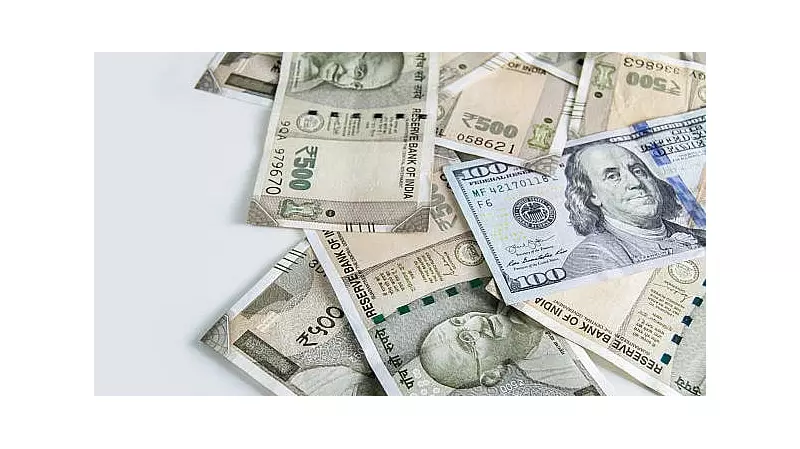
The Indian rupee experienced a decline against the US dollar on Tuesday, closing 8 paise lower as multiple economic factors converged to create downward pressure on the domestic currency.
The rupee settled at 83.90 (provisional) against the US dollar, marking a noticeable drop from its previous close of 83.82. This movement occurred despite some initial stability in early trading sessions.
Market Forces Behind Rupee's Decline
Forex traders identified several key factors contributing to the rupee's weakness. Sustained foreign fund outflows continued to weigh heavily on the domestic currency, while the US dollar maintained its strength in global markets. Additionally, rising crude oil prices in international markets created additional pressure on the Indian rupee.

At the interbank foreign exchange market, the rupee opened relatively flat at 83.83 against the American currency. Throughout the trading day, it witnessed fluctuations between an intraday high of 83.82 and a low of 83.91 before eventually settling at its day's low point.
Global and Domestic Economic Context
The dollar index, which measures the greenback's strength against a basket of six major currencies, traded 0.11% higher at 105.15, indicating sustained global demand for the American currency. This dollar strength typically creates headwinds for emerging market currencies like the Indian rupee.
In parallel developments, Brent crude futures, the global oil benchmark, advanced by 0.63% to $85.18 per barrel. This increase in crude prices is particularly significant for India, which remains one of the world's largest oil importers. Higher crude oil prices typically widen India's trade deficit and put additional pressure on the rupee.
On the domestic equity front, markets showed mixed performance. The BSE Sensex closed marginally higher, gaining 34.09 points to reach 77,341.08. Meanwhile, the broader NSE Nifty experienced a slight decline, falling 18.10 points to settle at 23,516.95.
Foreign Investment Trends and Economic Outlook
Foreign Institutional Investors (FIIs) continued their selling spree in Indian markets, offloading equities worth ₹653.70 crore on Tuesday according to exchange data. This persistent foreign capital outflow represents another factor contributing to the rupee's depreciation pressure.
Market analysts suggest that the rupee's movement reflects the complex interplay of global dollar dynamics, domestic economic indicators, and international commodity prices. The currency's performance remains closely watched by policymakers and market participants alike, given its implications for inflation, import costs, and overall economic stability.
Looking ahead, traders will monitor several key factors that could influence the rupee's trajectory, including upcoming economic data releases, central bank policies in major economies, and developments in global crude oil markets that directly impact India's import bill and currency valuation.