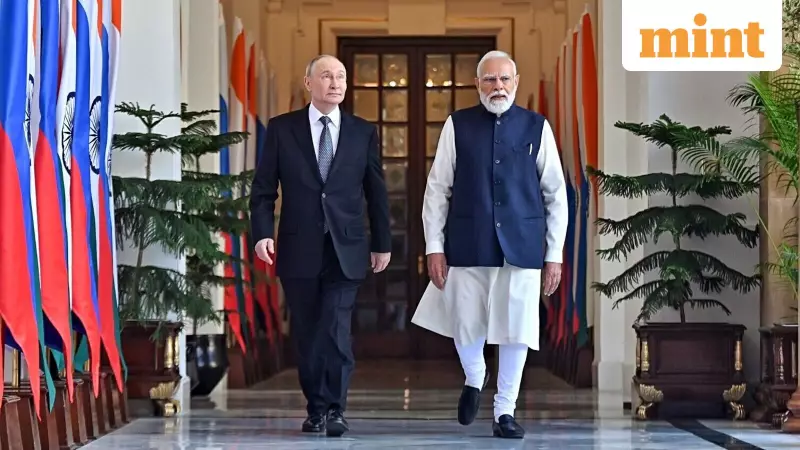
The recent annual summit between Russian President Vladimir Putin and Indian Prime Minister Narendra Modi has set the stage for a significant transformation in economic relations, with a pronounced positive ripple effect expected across Indian stock markets. The high-level meeting, held on Friday, resulted in a major expansion of bilateral cooperation, strategically aimed at diversifying trade far beyond the traditional pillars of oil and defence.
A Strategic Partnership Enters a New Phase
This summit held special significance, commemorating 25 years of the India-Russia Strategic Partnership, a relationship formalized during Putin's first visit to India in the year 2000. Against a backdrop of renewed US pressure for India to reassess its Moscow ties, the two leaders unveiled a concrete roadmap. They confirmed the finalization of a wide-ranging economic cooperation programme stretching through to 2030, with a sharp focus on trade diversification and volume growth.
The ambition is substantial. With India currently representing less than 2% of Russian imports, the two nations have set an aggressive new target: achieving $100 billion in annual bilateral trade by the end of this decade. This marks a significant leap from the approximately $68 billion recorded in the 2024-25 financial year.

Market Analysts Weigh In on Sectoral Opportunities
Financial experts view this deepened partnership as a structural positive for the Indian economy. Sugandha Sachdeva, Founder of SS WealthStreet, noted that while the delayed India-US trade agreement remains a moderating factor, the net effect is constructive for specific themes. "The India–Russia partnership provides structural long-term positives for several sectors and supports a more diversified strategic footprint for India," she said.
Ravi Singh, Chief Research Officer at Master Capital Services, believes the new trade roadmap can meaningfully reshape India's economic landscape. He highlighted that smoother approvals and wider market access could benefit a host of sectors including:
- Defence
- Pharmaceuticals
- Marine products
- Engineering and IT-BPM
- Textiles and jewellery
Singh also pointed out that consistent flows of Russian crude, which accounts for over one-third of India's imports, would cushion refiners against global price volatility. Cheaper Urals crude and fertilisers are seen reducing input costs for petrochemicals, agriculture, and manufacturing industries.
Long-Term Gains: Defence, Energy, and Strategic Autonomy
The cooperation framework through 2030 is poised to reshape India's industrial ecosystem. Analysts point to long-term gains in defence manufacturing, energy transition, nuclear power, and critical-mineral security.
Ross Maxwell, Global Strategy Lead at VT Markets, stated that the partnership enhances India's medium-term growth outlook by ensuring predictable access to Russian resources. "Stable energy supply supports India’s industrial and infrastructure prospects, while diversified supply chains also help protect growth from geopolitical shocks," Maxwell explained. He added that continued investment in defence production and nuclear capabilities will strengthen India's strategic resilience.
Ashwini Shami of OmniScience Capital expects deeper technological collaboration to accelerate India's energy-transition and indigenisation goals through joint production and co-innovation.
Offering a balanced view, Harshal Dasani, Business Head at INVasset PMS, cautioned that geopolitical tensions and sanctions could still influence valuations. However, he emphasized the deal's structural importance: "We view this not as a tactical trade but as a structural variable shaping India’s strategic autonomy narrative."
Stocks and Sectors in the Spotlight
The sectoral impact is expected to be significant and multifaceted. Sachdeva noted that the new framework could help reduce India's $68 billion trade deficit with Russia by boosting exports. Stronger export flows and rupee-based settlements may also ease pressure on the Indian Rupee, supporting external stability.
Specific companies are likely to benefit from the enhanced collaboration:

- Defence & Make in India: Hindustan Aeronautics Limited (HAL) and Cochin Shipyard.
- Infrastructure & Transport Corridors: IRCON International, Larsen & Toubro (L&T), and GMR Group.
- Critical Minerals & EV Supply Chains: National Aluminium Company (NALCO), Vedanta, and Hindalco Industries.
- Nuclear Energy Expansion: L&T, Bharat Heavy Electricals Limited (BHEL), and MTAR Technologies.
However, analysts unanimously agree that while the near-term market impact may be measured, the structural themes emerging from this reinforced partnership are likely to meaningfully shape sectoral opportunities and India's economic trajectory over the next decade.